


























Views
Downloads
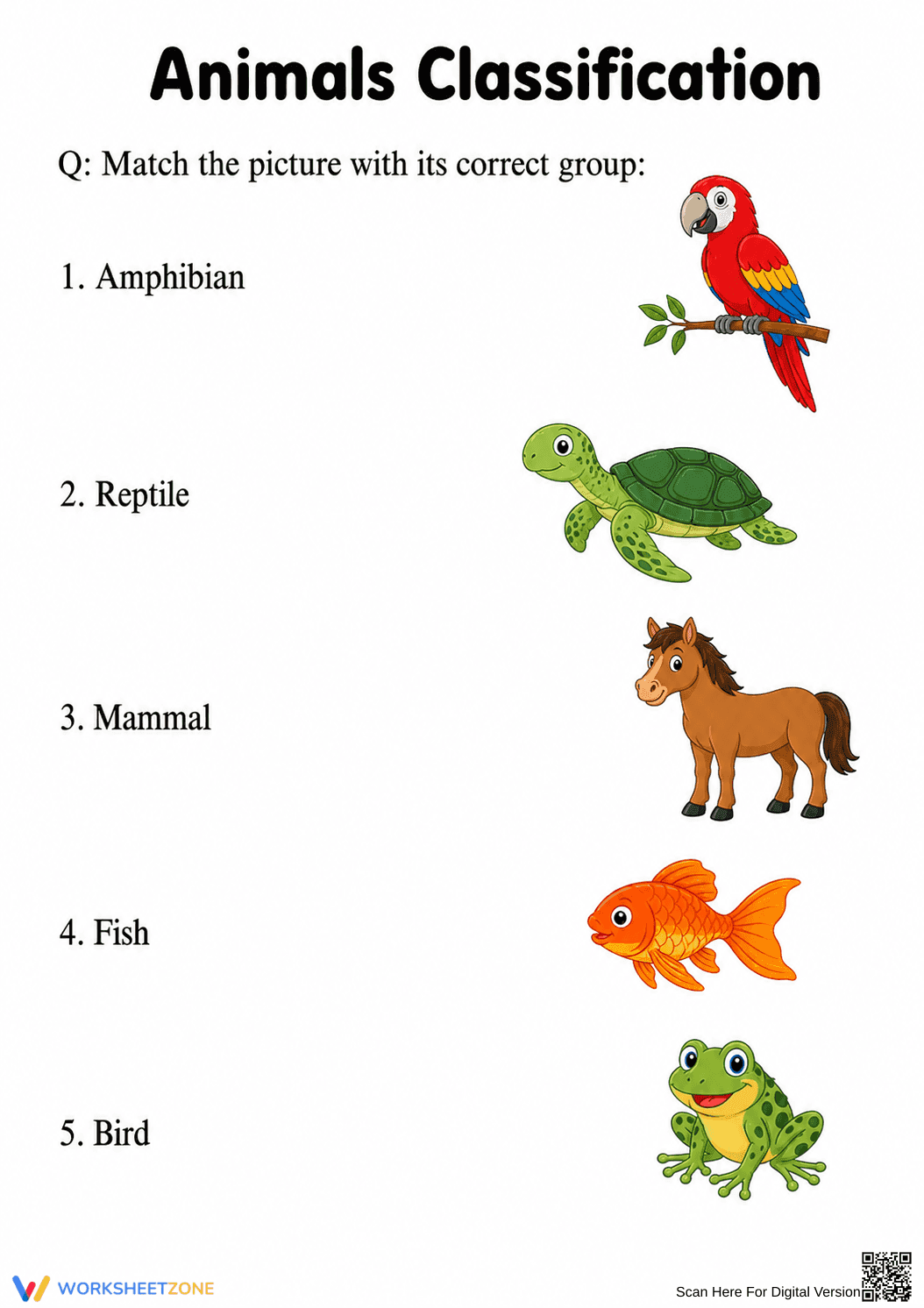

Grade 1 Animal Classification — Printable No-Prep Worksheet
Paste this activity's link or code into your existing LMS (Google Classroom, Canvas, Teams, Schoology, Moodle, etc.).
Students can open and work on the activity right away, with no student login required.
You'll still be able to track student progress and results from your teacher account.
This Grade 1 science worksheet helps students master animal classification by matching physical characteristics to biological groups. By connecting animals to their correct categories, young learners develop observation skills essential for life science. This simple activity reinforces the differences between mammals, birds, reptiles, amphibians, and fish.
At a Glance
- Grade: 1 · Subject: Science
- Standard:
1-LS3-1— Identify patterns in how living things are grouped- Skill Focus: Animal Classification
- Format: 1 page · 5 problems · Answer key included · PDF
- Best For: Quick formative assessment or science centers
- Time: 5–10 minutes
This single-page resource features a clean layout designed for early elementary students. It contains five text labels representing major animal classes paired with five high-quality color illustrations. Students draw lines connecting the vocabulary term to the corresponding animal image, such as linking "Mammal" to the horse. A complete answer key is included.
Zero-Prep Workflow
This resource requires under 2 minutes of teacher prep time.
- Print: Copy the single-page PDF for your class.
- Distribute: Hand out during your life science block.
- Review: Check answers as a group to reinforce animal traits.
This workflow makes it ideal for sub plans or morning work.
Standards Alignment
This resource aligns with 1-LS3-1, focusing on making observations to identify patterns in how living things are grouped. By identifying the unique features of a frog versus a turtle, students recognize patterns used for biological classification. Both standard codes can be copied directly into lesson plans, IEP goals, or district curriculum mapping tools.
How to Use It
Use this worksheet as an exit ticket after a lesson on vertebrates to gauge understanding. Alternatively, place it in a science center alongside plastic animal figurines. As an observation tip, watch whether students check the animal's skin covering before drawing the line. Expect students to complete the task within 5 to 10 minutes.
Who It's For
This activity is ideal for first-grade students and English Language Learners who benefit from visual aids. The clear imagery supports varying reading levels by providing strong visual cues. It pairs naturally with a classroom anchor chart showing animal traits.
Biological classification in early childhood education serves as a critical entry point for scientific inquiry and data organization. According to the RAND AIRS 2024 report, visual-spatial matching tasks in primary science significantly improve long-term retention of domain-specific vocabulary. This worksheet addresses the 1-LS3-1 standard by requiring students to identify patterns in how living things are grouped, observing distinct physical traits—such as feathers, scales, or fur—to categorize organisms accurately. By providing a structured environment for observation, this resource helps bridge the gap between casual observation and formal scientific classification. It ensures that young learners develop the mental frameworks necessary for more advanced biology topics in later grades while maintaining high engagement through recognizable animal imagery and clear, concise labeling. The integration of visual supports allows students to focus on conceptual grouping rather than complex decoding.


