


























Views
Downloads

Grade 2 Animal Adaptations — Printable No-Prep Worksheet
Paste this activity's link or code into your existing LMS (Google Classroom, Canvas, Teams, Schoology, Moodle, etc.).
Students can open and work on the activity right away, with no student login required.
You'll still be able to track student progress and results from your teacher account.
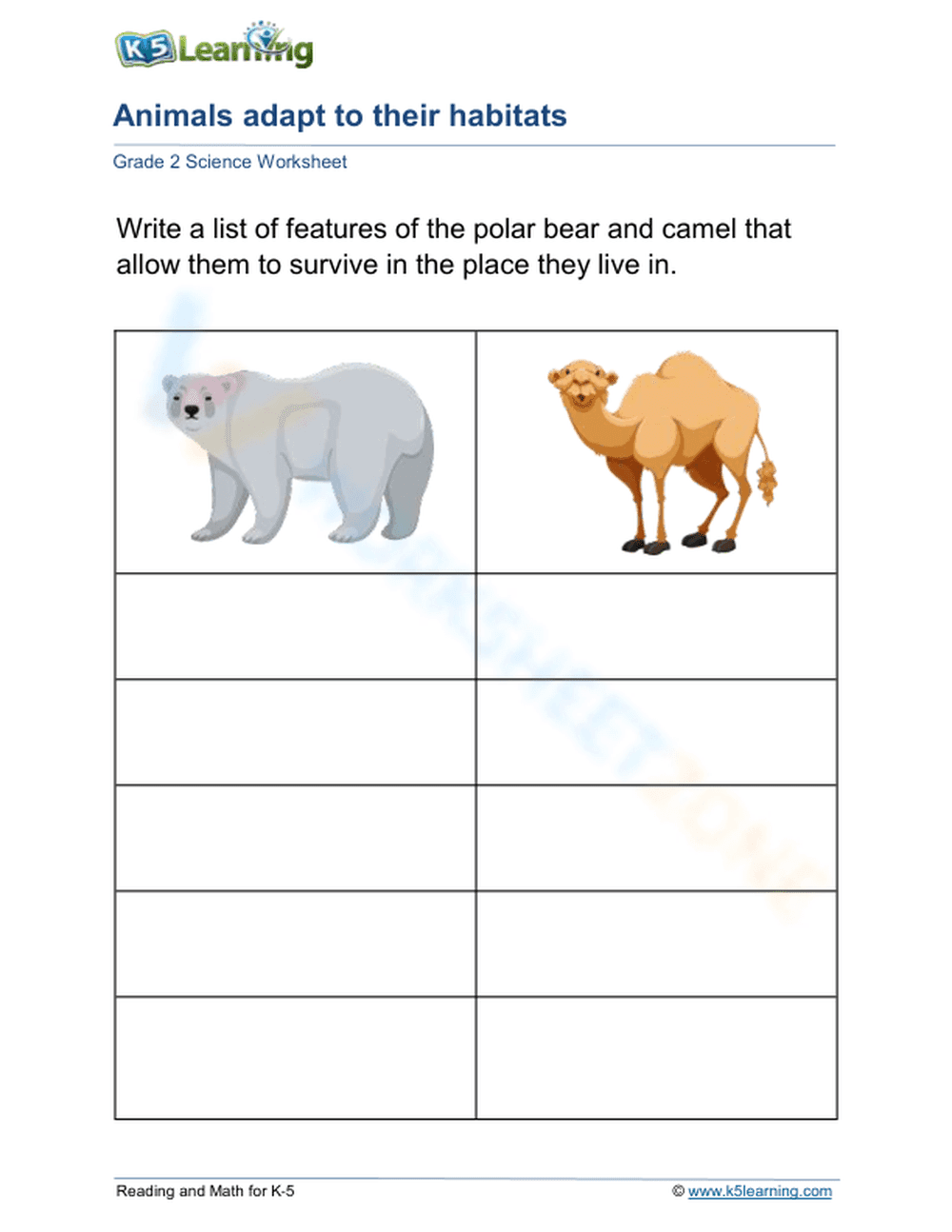
This Grade 2 animal adaptations worksheet helps students identify and list physical features that enable polar bears and camels to thrive in their specific habitats. By comparing these two distinct animals, learners develop a concrete understanding of how biological traits correlate with environmental survival, mastering core concepts of habitat suitability and structural adaptation through observation.
At a Glance
- Grade: 2 · Subject: Living Things
- Standard:
2-LS4-1— Compare the diversity of life and physical traits in different habitats- Skill Focus: Animal Adaptations & Survival Features
- Format: 1 page · 10 tasks · Answer key included · PDF
- Best For: Independent science centers and habitat lessons
- Time: 15–20 minutes
The worksheet features a clean, two-column layout that contrasts a polar bear with a camel. Under each high-quality illustration, students find five dedicated lines to record specific survival traits, such as thick fur or water storage humps. This single-page PDF includes a full answer key, providing teachers with a streamlined resource that requires no additional setup or instructional materials.
Zero-Prep Workflow
Teachers can implement this zero-prep workflow in under two minutes. First, print the required number of copies for the class, taking advantage of the high-contrast black-and-white design. Second, distribute the pages as a transition activity or a quick check for understanding. Third, review the answers as a whole group to clarify the difference between structural and behavioral traits, providing immediate feedback. Minimal setup is required.
Standards Alignment
This resource is aligned to 2-LS4-1, requiring students to make observations of animals to compare life in different habitats. By listing specific features, students gather evidence to support claims about why certain organisms live in specific locations. This standard code can be copied directly into lesson plans, IEP goals, or district curriculum mapping tools.
How to Use It
Use this worksheet as a formative assessment after a direct instruction lesson on biomes. Students can work in pairs to brainstorm features, promoting scientific discourse and collaborative observation. Alternatively, assign it as a quick-start bell ringer to activate prior knowledge before introducing the concept of camouflage or migration. Expect students to finish within 20 minutes.
Who It's For
This activity is designed for second-grade students exploring life science but serves as an effective scaffold for older English Language Learners or students with IEPs who benefit from visual cues. It pairs naturally with a non-fiction passage about the Arctic or Sahara desert, allowing students to apply what they have read to a structured graphic organizer.
The 2-LS4-1 animal adaptations worksheet facilitates high-leverage scientific practices by focusing on the relationship between organism traits and habitat survival. According to the RAND AIRS 2024 analysis, structured observation tasks in early elementary science significantly improve long-term retention of biological concepts and categorical thinking. By prompting students to list ten specific survival features, this resource encourages a meticulous examination of structural adaptations that are often overlooked in general discussions. The visual contrast between a polar bear and a camel provides a clear, evidence-based pathway for students to understand how environment-specific traits dictate survival success. This worksheet serves as a critical component in building the foundational knowledge necessary for more complex ecological studies in later grades. Educators can use this data-driven approach to ensure that every student meets the rigorous demands of state and national science standards through focused, observable evidence gathering.


