


























Views
Downloads
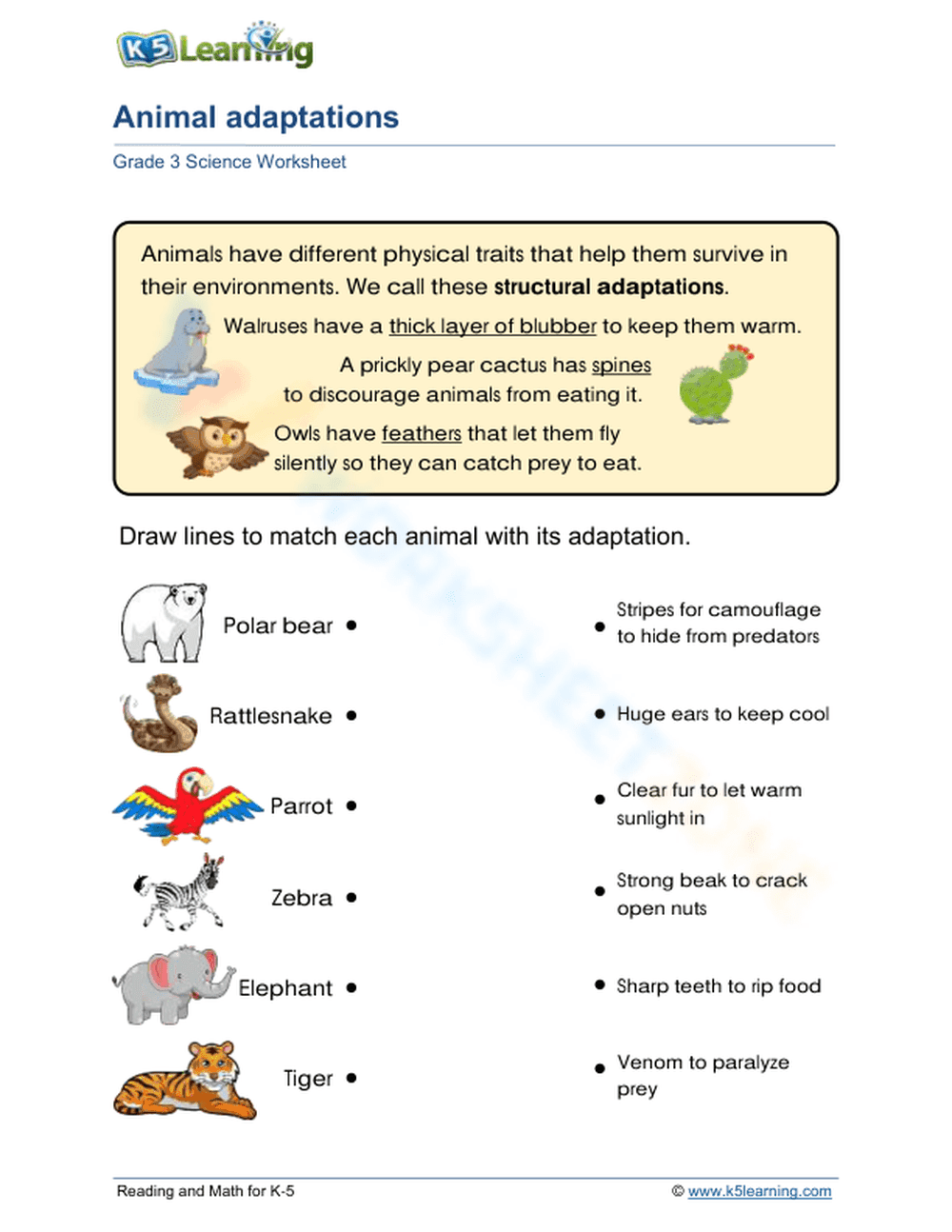

Essential Animal Adaptations Worksheet | Grade 3 Science
Paste this activity's link or code into your existing LMS (Google Classroom, Canvas, Teams, Schoology, Moodle, etc.).
Students can open and work on the activity right away, with no student login required.
You'll still be able to track student progress and results from your teacher account.
Students master survival science with this animal adaptations worksheet. By connecting physical traits to environmental functions, learners develop a concrete understanding of how structural adaptations ensure an organism's existence. This resource provides focused practice for third-grade students to identify and explain biological traits, leading to mastery of essential life science concepts.
At a Glance
- Grade: 3 · Subject: Living Things
- Standard:
3-LS4-3— Construct an argument with evidence that some organisms survive well in habitats- Skill Focus: Animal structural adaptations
- Format: 1 page · 6 problems · Answer key included · PDF
- Best For: Independent practice and formative assessment
- Time: 15–20 minutes
What's Inside
This single-page PDF features a concise instructional header defining structural adaptations with three clear examples: walruses, cacti, and owls. Below the lesson, students find a matching activity containing six unique animals including polar bears, zebras, and elephants. The worksheet includes an answer key for rapid grading and clear, high-quality illustrations that support visual learners in identifying specific physical traits.
Skill Progression
- Guided Practice: The illustrated definition box models the relationship between traits and survival using real-world biology.
- Supported Practice: Students review familiar animals like parrots and tigers to build confidence in their observational skills.
- Independent Practice: Learners match less obvious adaptations, such as a polar bear's fur or an elephant's ears, to specific habitat functions.
This layout utilizes the gradual-release model to move students from teacher-supported concepts to independent mastery of structural traits.
Standards Alignment
Aligned to standard 3-LS4-3, this resource focuses on constructing arguments based on evidence. Students must analyze the physical characteristics of animals to determine how those traits allow them to survive in their respective environments. This standard code can be copied directly into lesson plans, IEP goals, or district curriculum mapping tools to ensure vertical alignment with science frameworks.
How to Use It
Assign this worksheet as an exit ticket following a lesson on habitats to observe how well students can connect biology to environment. Alternatively, use it as a center activity during science rotations for self-directed learning. A key formative assessment tip is to look for students who struggle with the polar bear's fur adaptation, which reveals a need for deeper discussion on solar heat absorption. Expected completion is 15 minutes.
Who It's For
This resource is ideal for third-grade classrooms, ELL students who benefit from visual matching, and special education settings. It pairs naturally with a reading passage on extreme environments or a classroom anchor chart. The clear layout ensures students remain focused on the primary learning objective without being overwhelmed by excessive text.
The 3-LS4-3 standard requires students to construct arguments with evidence regarding habitat survival, making the identification of structural adaptations a critical foundational step. This worksheet bridges the gap between simple observation and scientific argumentation by explicitly defining structural traits—like blubber for warmth or spines for defense—before asking students to apply that logic to new examples. According to Fisher & Frey (2014), the gradual release of responsibility model is most effective when students move from teacher-modeled examples to independent matching tasks, as seen in this layout. By connecting specific physical traits to their environmental functions, learners develop the schema necessary for complex biological reasoning. This resource supports the development of academic vocabulary while reinforcing the concept that survival is contingent upon the alignment of an organism's traits with its specific habitat demands. Use this 3-LS4-3 aligned tool to ensure students can articulate exactly how a polar bear or elephant utilizes its unique biology for continued existence.


