




























Views
Downloads
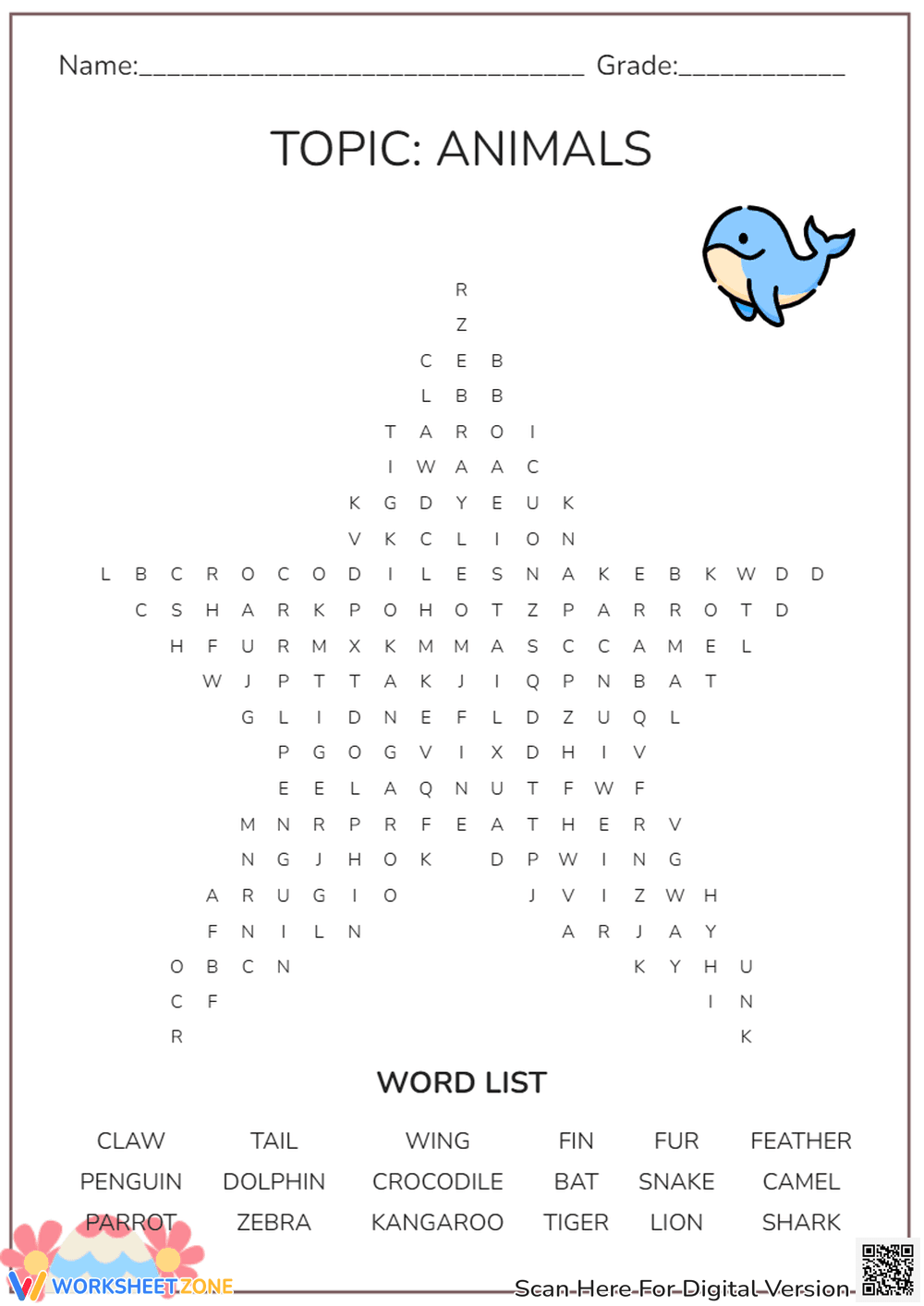

Printable Animal Vocabulary Word Search | Grade 4 ELA

Paste this activity's link or code into your existing LMS (Google Classroom, Canvas, Teams, Schoology, Moodle, etc.).
Students can open and work on the activity right away, with no student login required.
You'll still be able to track student progress and results from your teacher account.
This printable worksheet helps fourth-grade students master animal-related vocabulary through an engaging star-shaped word search puzzle. Students identify and locate key terms, reinforcing spelling and word recognition. By connecting visual search with vocabulary recall, learners build essential language skills and improve reading comprehension.
At a Glance
- Grade: Grade 4 · Subject: ELA Vocabulary
- Standard:
CCSS.ELA-LITERACY.L.4.6— Acquire and use grade-appropriate domain-specific words- Skill Focus: Animal vocabulary and spelling
- Format: 1 page · 18 problems · Answer key included · PDF
- Best For: Morning work or fast finishers
- Time: 15–20 minutes
This resource features a single-page activity containing a star-shaped word search grid and a clear word list at the bottom. The list includes 18 animal-related terms, covering both animal names like penguin, kangaroo, and crocodile, and anatomical features like claw, wing, and feather. The clean layout ensures students can focus entirely on word recognition without visual distractions.
Zero-Prep Classroom Workflow
This activity requires minimal teacher preparation and integrates into your daily routine. First, print the single-page PDF, which takes less than 1 minute. Next, distribute the sheets to your students, taking about 30 seconds. Finally, review the completed puzzles individually or display the solution on your screen for a quick 2-minute self-check. This efficient workflow makes the worksheet an excellent option for emergency sub plans, transition periods, or independent desk work.
Standards Alignment
This worksheet aligns directly with the Common Core State Standard CCSS.ELA-LITERACY.L.4.6, which requires students to acquire and use accurately grade-appropriate general academic and domain-specific words and phrases. By identifying terms like dolphin, zebra, and fin, students expand their science-adjacent vocabulary. Both standard codes can be copied directly into lesson plans, IEP goals, or district curriculum mapping tools.
How to Use It
Use this worksheet during the independent practice portion of your vocabulary lesson or as a warm-up activity at the start of the day. It takes approximately 15 to 20 minutes for students to complete. For a quick formative assessment, observe which students locate the anatomical terms versus the animal names first, noting their scanning strategies and familiarity with the spelling patterns.
Who It's For
This activity is designed for fourth-grade students learning English language arts, but it also serves as an excellent spelling review for third graders or a supportive resource for English language learners. Pair this worksheet with a non-fiction reading passage about animal adaptations or an anchor chart detailing animal body parts to deepen conceptual understanding.
This vocabulary worksheet supports language acquisition by targeting word recognition and spelling retention. According to research from Fisher & Frey (2014) on vocabulary instruction, purposeful word play and search activities reinforce orthographic mapping, helping students transition words from temporary working memory into long-term storage. By focusing on 18 specific animal-related terms, the activity aligns with standard CCSS.ELA-LITERACY.L.4.6, ensuring students build the domain-specific vocabulary necessary for reading complex informational texts. The structured layout provides a low-stakes environment for students to practice scanning text, a critical sub-skill for reading comprehension and standardized testing. Teachers can confidently integrate this resource into their spelling or science-integrated ELA blocks, knowing it meets rigorous developmental benchmarks for fourth-grade language acquisition while maintaining high student engagement.


