


























Views
Downloads

Animal Spelling Worksheet | Kindergarten Essential
Paste this activity's link or code into your existing LMS (Google Classroom, Canvas, Teams, Schoology, Moodle, etc.).
Students can open and work on the activity right away, with no student login required.
You'll still be able to track student progress and results from your teacher account.
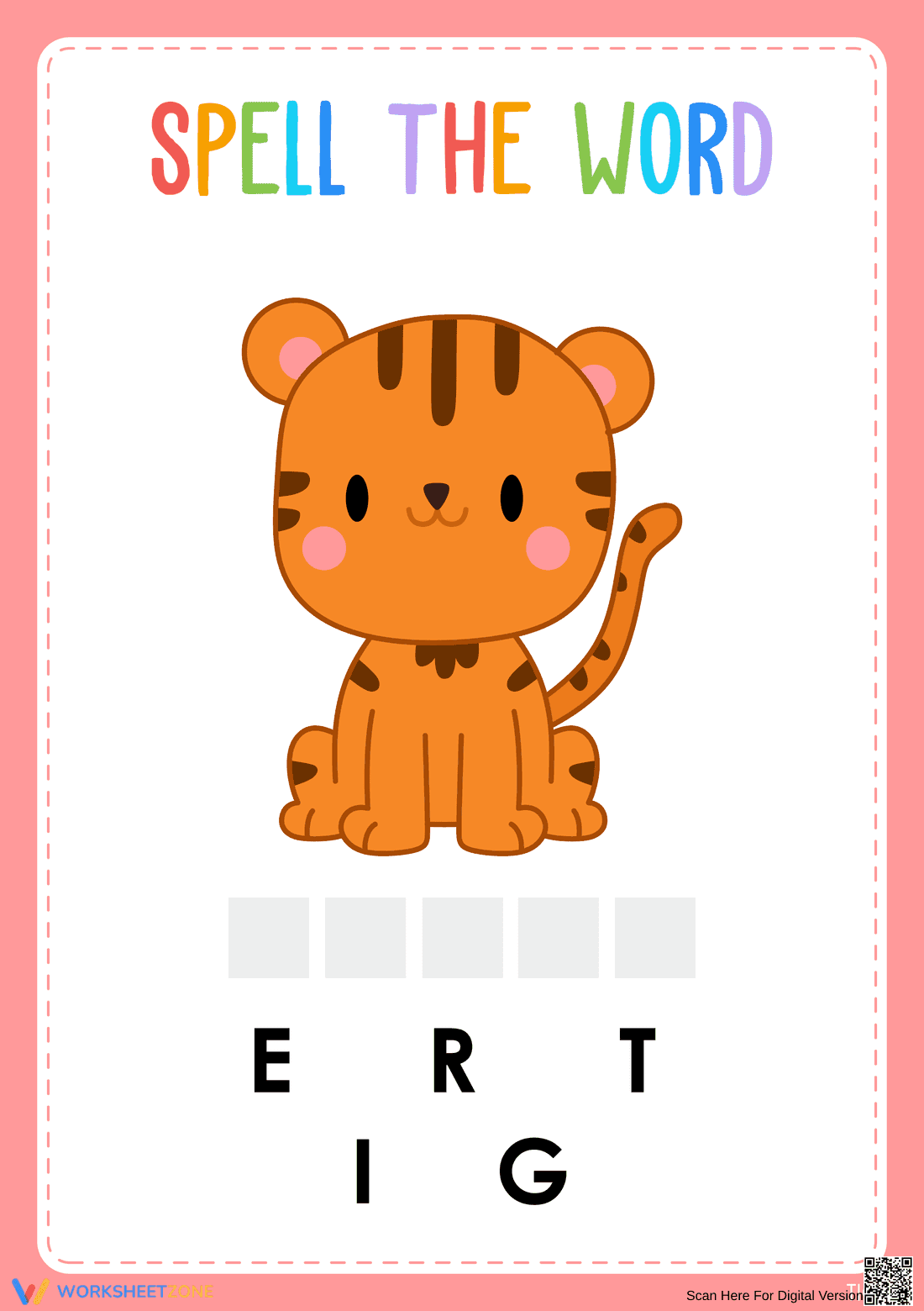
This Kindergarten animal spelling worksheet helps early learners master letter-sound relationships by unscrambling the word "Tiger." Students use visual cues and a letter bank to practice foundational phonics. It provides a clear, focused task that builds confidence in spelling and fine motor skills through writing and letter arrangement.
At a Glance
- Grade: Kindergarten · Subject: English Language Arts
- Standard:
CCSS.ELA-LITERACY.L.K.2.D— Spell simple words phonetically using knowledge of sound-letter relationships- Skill Focus: Spelling and Phonics
- Format: 1 page · 1 problem · Answer key included · PDF
- Best For: Morning work or literacy centers
- Time: 5–10 minutes
What's Inside
This single-page PDF features a large, engaging tiger illustration to provide immediate context for the learner. Below the image, five structured boxes guide the student in letter placement. A scrambled letter bank containing the letters E, R, T, I, and G is provided to support phonetic decoding and spelling accuracy. The answer is discreetly included for teacher reference.
Zero-Prep Workflow
- Print: Send the single-page PDF to your printer in seconds.
- Distribute: Hand out the worksheet during your literacy block or as a transition activity.
- Review: Check student work instantly by verifying the letter sequence against the visual cue.
Total teacher preparation time is under 2 minutes, making this an ideal resource for sub plans or unexpected schedule changes.
Standards Alignment
This resource aligns with `CCSS.ELA-LITERACY.L.K.2.D`: "Spell simple words phonetically, drawing on knowledge of sound-letter relationships." It also supports foundational writing skills by encouraging students to form letters within defined spaces. Both standard codes can be copied directly into lesson plans, IEP goals, or district curriculum mapping tools.
How to Use It
Use this worksheet during direct instruction as a guided practice activity to demonstrate how to map sounds to letters. Alternatively, assign it as a formative assessment after a lesson on zoo animals or the letter 'T'. Observe if students can identify the starting sound and correctly place the 'T' in the first box, which takes approximately 5 to 10 minutes.
Who It's For
This worksheet is designed for Preschool, Kindergarten, and Grade 1 students who are beginning to experiment with phonetic spelling. It is particularly effective for English Language Learners (ELLs) who benefit from the strong visual-to-word association. Pair this with an animal-themed picture book or an anchor chart about jungle habitats for a complete lesson.
According to the RAND AIRS 2024 report on early literacy interventions, the use of isolated vocabulary tasks combined with high-quality visual stimuli significantly improves orthographic mapping in students aged four to six. This worksheet leverages that research by focusing on a single, high-frequency animal word—tiger—to reduce cognitive load while reinforcing letter-sound correspondence. By providing a scrambled letter bank, the resource encourages active retrieval rather than passive copying, a method proven to strengthen long-term memory of spelling patterns. The inclusion of the standard CCSS.ELA-LITERACY.L.K.2.D ensures that the activity remains grounded in phonetic spelling mastery. Educators can use this focused practice to bridge the gap between letter recognition and independent writing. Such targeted, one-page interventions are essential for maintaining engagement in early childhood classrooms while providing measurable data on a student's ability to sequence phonemes into recognizable words during daily literacy blocks.


