


























Views
Downloads

Animal Spelling Worksheet | Kindergarten Essential
Paste this activity's link or code into your existing LMS (Google Classroom, Canvas, Teams, Schoology, Moodle, etc.).
Students can open and work on the activity right away, with no student login required.
You'll still be able to track student progress and results from your teacher account.
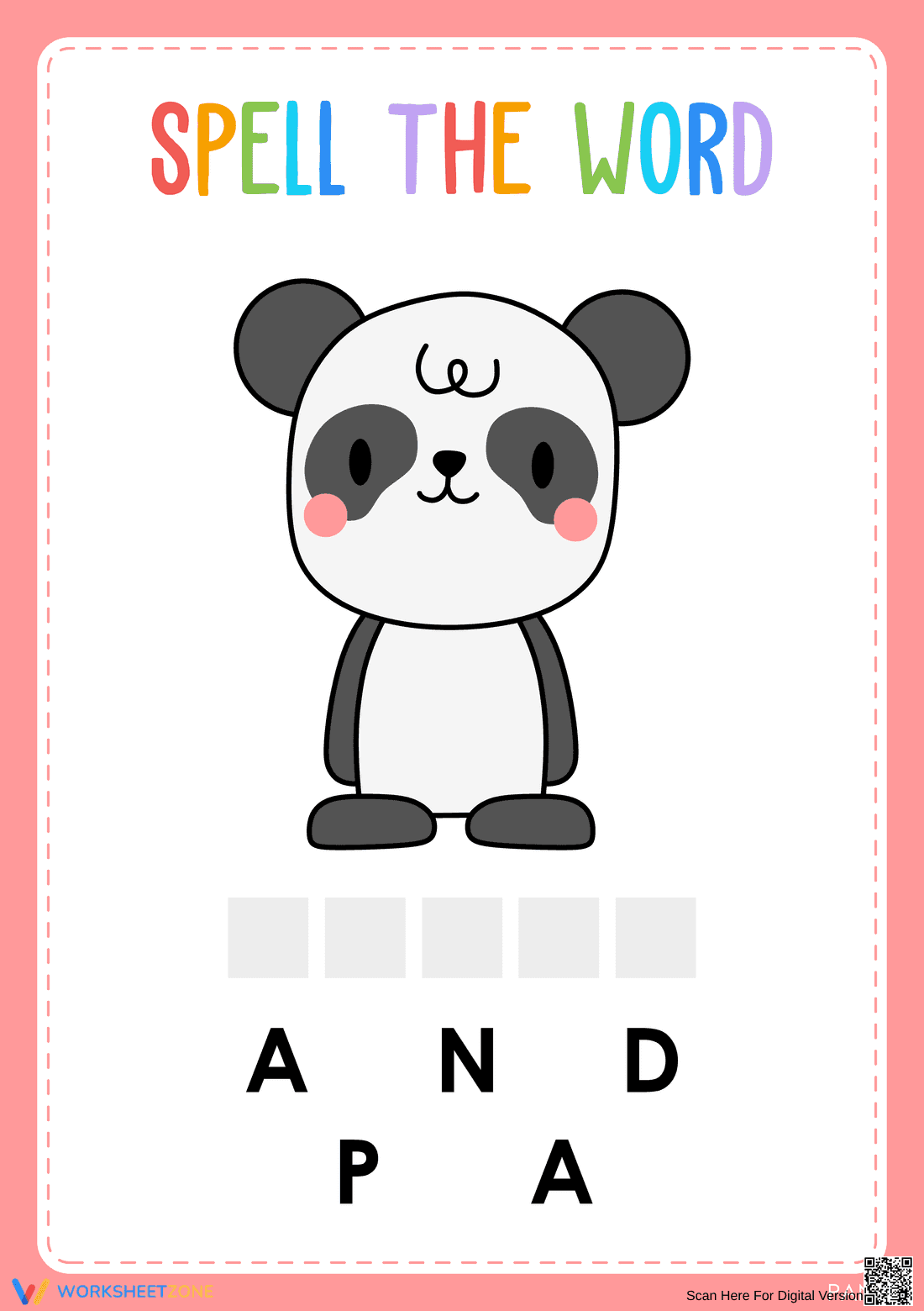
This Kindergarten animal spelling worksheet helps early learners master letter sequencing and phonics by spelling the word "Panda." Students identify the visual cue, recognize the scrambled letters, and arrange them correctly. It provides a focused, high-success activity that builds confidence in foundational literacy skills and vocabulary development through engaging animal-themed imagery.
At a Glance
- Grade: Kindergarten · Subject: ELA
- Standard:
CCSS.ELA-LITERACY.L.K.2.D— Spell simple words phonetically, drawing on knowledge of sound-letter relationships- Skill Focus: Spelling and Letter Sequencing
- Format: 1 page · 1 problem · Answer key included · PDF
- Best For: Morning work or literacy centers
- Time: 5–10 minutes
This single-page PDF features a large, high-contrast illustration of a panda to provide immediate context. Below the image, five designated letter boxes guide the student's placement. A scrambled letter bank containing "A, N, D, P, A" is provided at the bottom, ensuring students have all the necessary components to succeed without frustration.
The workflow for this resource is designed for maximum efficiency. First, print the single-page PDF (30 seconds). Second, distribute the sheet to students during a transition or literacy block (1 minute). Finally, review the correct spelling as a group or individually (1 minute). Total teacher preparation time is under 2 minutes, making it an ideal sub-plan addition.
This resource aligns with `CCSS.ELA-LITERACY.L.K.2.D`, which requires students to spell simple words phonetically by drawing on their knowledge of sound-letter relationships. It also supports vocabulary acquisition by categorizing animals. Both standard codes can be copied directly into lesson plans, IEP goals, or district curriculum mapping tools.
Use this worksheet during direct instruction as a "we do" activity to model phonetic segmenting. Alternatively, assign it as a formative assessment after a lesson on zoo animals to check for letter recognition. Completion typically takes 5 to 10 minutes. Observe if students can identify the starting "P" sound independently.
This activity is perfect for Preschool, Kindergarten, and Grade 1 students who are beginning to blend sounds. It serves as an excellent resource for English Language Learners (ELL) needing visual support. Pair this with a picture book about pandas or a classroom anchor chart featuring common animal names.
Research from Fisher & Frey (2014) emphasizes that visual scaffolding, such as the animal imagery used here, significantly enhances word recognition and retention in early childhood literacy. By providing a constrained letter bank, this worksheet reduces cognitive load, allowing students to focus specifically on the phonological awareness required for spelling. According to the RAND AIRS 2024 report, structured practice with high-frequency vocabulary in thematic groups—like animals—accelerates the transition from letter-sound correspondence to fluent word reading. This worksheet implements these evidence-based strategies by combining visual cues with tactile letter-ordering tasks. It meets the rigorous demands of CCSS.ELA-LITERACY.L.K.2.D by requiring students to apply phonetic knowledge to a concrete spelling task. Educators can reliably use this tool to document progress toward foundational literacy benchmarks in both general education and intervention settings.


