


























Views
Downloads

Animal Spelling Worksheet | Essential Grade K ELA
Paste this activity's link or code into your existing LMS (Google Classroom, Canvas, Teams, Schoology, Moodle, etc.).
Students can open and work on the activity right away, with no student login required.
You'll still be able to track student progress and results from your teacher account.
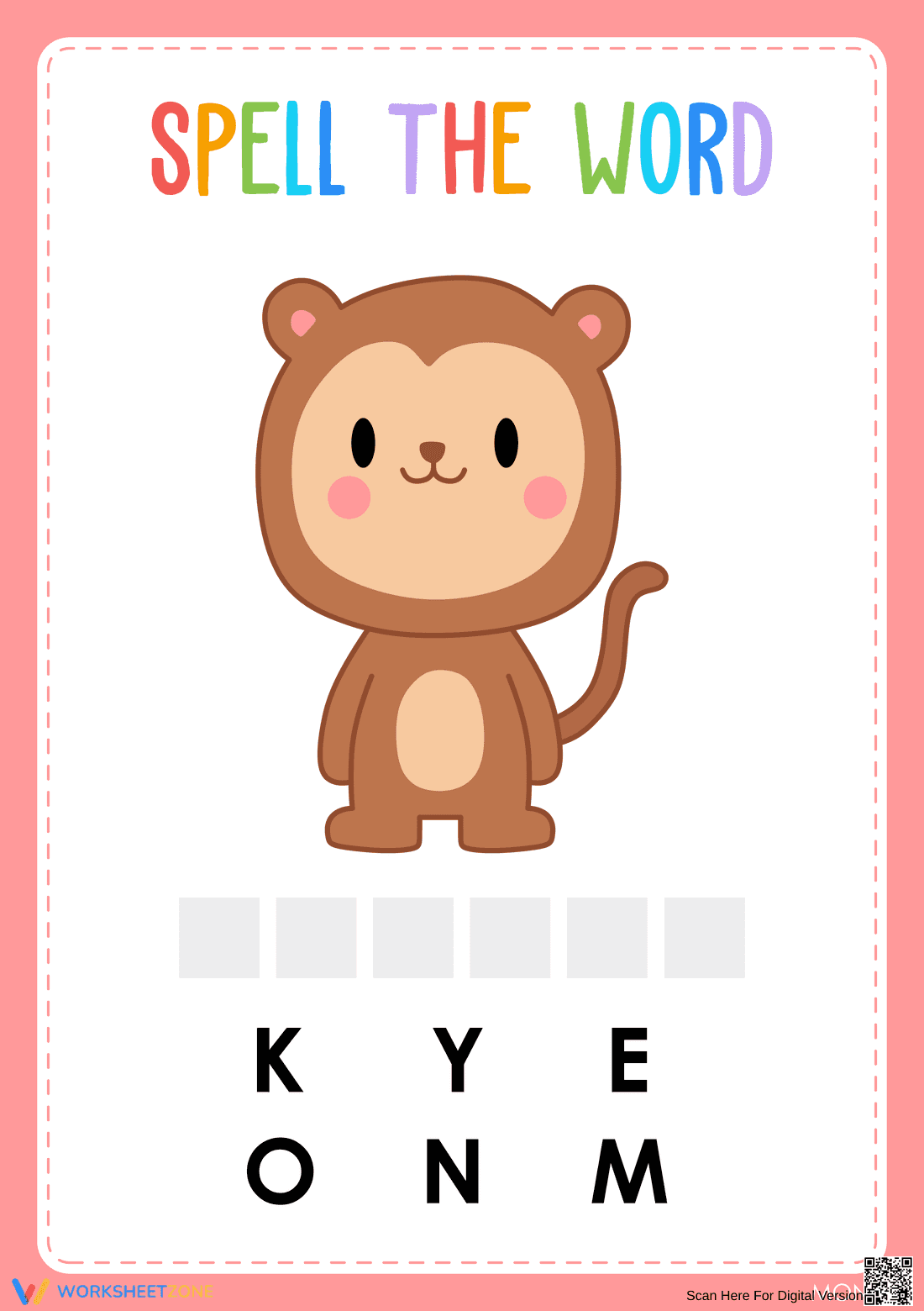
This Kindergarten animal spelling worksheet helps early learners master the word "monkey" through letter sequencing and visual recognition. By connecting a friendly illustration with scrambled letters, students build the phonemic awareness necessary for independent writing and reading fluency in early elementary grades. This activity simplifies complex spelling into a manageable, engaging task.
At a Glance
- Grade: Kindergarten · Subject: ELA
- Standard:
CCSS.ELA-LITERACY.L.K.2.D— Spell simple words phonetically, drawing on knowledge of sound-letter relationships- Skill Focus: Animal Vocabulary & Spelling
- Format: 1 page · 1 task · Answer key included · PDF
- Best For: Morning work or literacy centers
- Time: 5–10 minutes
Inside this single-page PDF, you will find a vibrant "Spell the Word" activity featuring a monkey illustration. The worksheet provides six empty letter boxes and a scrambled letter bank (K, Y, E, O, N, M) to guide the student. This structured layout supports fine motor skills as children write each letter in the designated space, ensuring a clear path to completion.
Skill Progression
- Guided Identification: Students begin by naming the animal in the picture, establishing the target word through visual cues.
- Supported Practice: Learners identify the six letters provided in the scrambled bank, reinforcing letter recognition and phonemic sounds.
- Independent Construction: Students demonstrate mastery by correctly sequencing the letters to spell the word "monkey" in the provided boxes.
This activity follows the gradual-release model, moving from visual identification to independent orthographic construction.
Standards Alignment
This resource aligns with `CCSS.ELA-LITERACY.L.K.2.D`, which requires students to spell simple words phonetically. By focusing on a common animal name, the worksheet also supports vocabulary development and categorization skills. Both standard codes can be copied directly into lesson plans, IEP goals, or district curriculum mapping tools to ensure instructional compliance.
How to Use It
Use this worksheet during a "Zoo" or "Animals" thematic unit to reinforce spelling. It works exceptionally well as a formative assessment after a read-aloud session. Teachers should observe if students can identify the starting "M" sound before writing. Expected completion time ranges from 5 to 10 minutes depending on the student's writing speed and phonics proficiency.
Who It's For
This printable is designed for Preschool, Kindergarten, and Grade 1 students who are beginning to transition from letter recognition to word construction. It is an ideal pairing for an animal-themed anchor chart or a phonics lesson on the letter "M." It provides excellent support for English Language Learners (ELL) through its heavy reliance on visual aids.
According to the RAND AIRS 2024 report, early exposure to structured spelling tasks significantly improves long-term orthographic mapping in young readers. This worksheet targets CCSS.ELA-LITERACY.L.K.2.D by requiring students to spell simple words phonetically, specifically focusing on the high-interest category of animals. By providing a visual cue alongside a scrambled letter bank, the activity reduces cognitive load while still demanding active recall of letter-sound relationships. Research from Fisher & Frey (2014) emphasizes that such scaffolded tasks are vital for the gradual release of responsibility in literacy instruction. This resource provides a focused, 1-page intervention that can be used to track progress in phonemic awareness and letter formation. Educators can utilize this tool to bridge the gap between recognizing individual letters and synthesizing them into meaningful vocabulary words within a classroom or home-school setting.


