


























Views
Downloads

Animal Spelling Worksheet | Kindergarten Essential
Paste this activity's link or code into your existing LMS (Google Classroom, Canvas, Teams, Schoology, Moodle, etc.).
Students can open and work on the activity right away, with no student login required.
You'll still be able to track student progress and results from your teacher account.
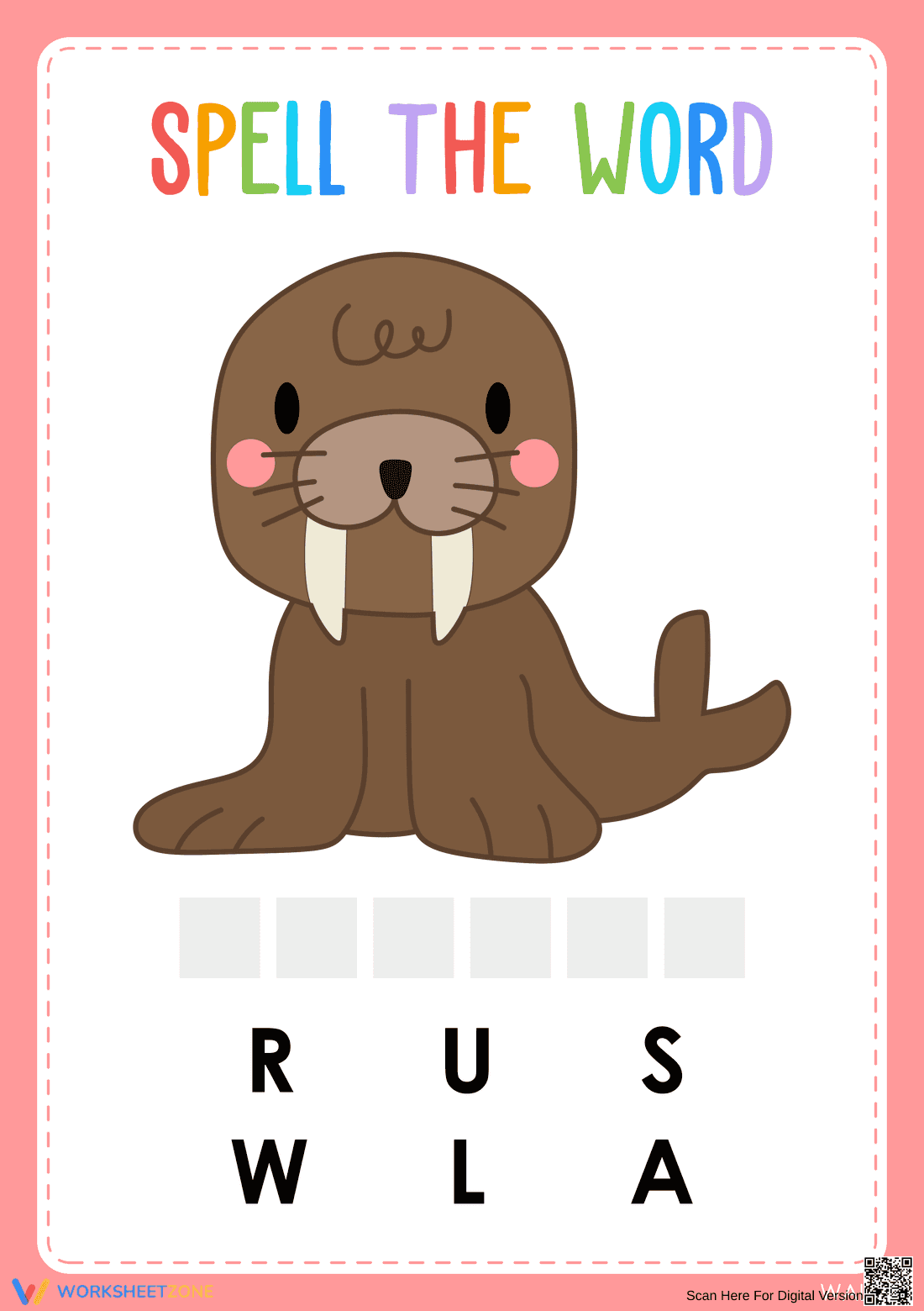
This Kindergarten animal spelling worksheet helps early learners master phonics and letter recognition by unscrambling letters to identify a specific animal. By focusing on a single, high-interest vocabulary word, students build confidence in their ability to map sounds to letters. This activity provides a clear, visual path toward foundational literacy and spelling mastery.
At a Glance
- Grade: Kindergarten · Subject: ELA
- Standard:
CCSS.ELA-LITERACY.L.K.2.D— Spell simple words phonetically, drawing on knowledge of sound-letter relationships- Skill Focus: Animal Vocabulary & Spelling
- Format: 1 page · 1 problem · Answer key included · PDF
- Best For: Morning work or literacy centers
- Time: 5–10 minutes
What's Inside
This single-page PDF features a large, colorful illustration of a walrus to provide immediate visual context. Below the image, students find six empty letter boxes and a scrambled bank of six letters (R, U, S, W, L, A). The clear layout ensures that young readers can focus entirely on the phonetic task without being overwhelmed by complex instructions or distracting page elements.
Zero-Prep Workflow
- Print: Select the page and print in color or grayscale in under 30 seconds.
- Distribute: Hand out to students during independent work time or as a quick transition activity.
- Review: Check the spelling of "WALRUS" as a whole group or individually in less than 1 minute.
This worksheet is an ideal sub-plan addition or a fast-finisher task that requires zero teacher setup beyond the initial print.
Standards Alignment
This resource aligns with `CCSS.ELA-LITERACY.L.K.2.D`, which requires students to spell simple words phonetically by drawing on their knowledge of sound-letter relationships. It also supports vocabulary acquisition within the "Animals" category. Both standard codes can be copied directly into lesson plans, IEP goals, or district curriculum mapping tools.
How to Use It
Use this worksheet during a "Letter of the Week" unit or as a formative assessment after a lesson on aquatic animals. Teachers can observe if students correctly identify the starting "W" sound and the ending "S" sound. It works best as a 5-minute warm-up to settle the class before direct phonics instruction. Expected completion time is between 5 and 10 minutes depending on the student's phonetic level.
Who It's For
This activity is designed for Preschool, Kindergarten, and early Grade 1 students who are beginning to blend sounds. It is particularly helpful for English Language Learners (ELLs) who benefit from the direct image-to-word association. Pair this with a picture book about arctic animals or a classroom anchor chart featuring animal names to provide additional support.
According to the RAND AIRS 2024 report, early literacy success is heavily dependent on the frequency of micro-tasks that reinforce phonemic awareness and letter-sound correspondence. This worksheet provides exactly that type of targeted practice, allowing students to engage with a single vocabulary word in a low-stakes environment. Research from Fisher & Frey (2014) emphasizes that visual scaffolds, such as the walrus illustration provided here, are critical for helping young readers bridge the gap between abstract letter symbols and concrete meanings. By isolating the spelling task to one word, the cognitive load is managed effectively for Grade K learners. This resource ensures that students meet the CCSS.ELA-LITERACY.L.K.2.D standard through a structured, phonetic approach. Educators can use this tool to gather quick data on student progress in letter sequencing and phonetic spelling, which are essential precursors to fluent reading and writing in later primary grades.


