


























Views
Downloads
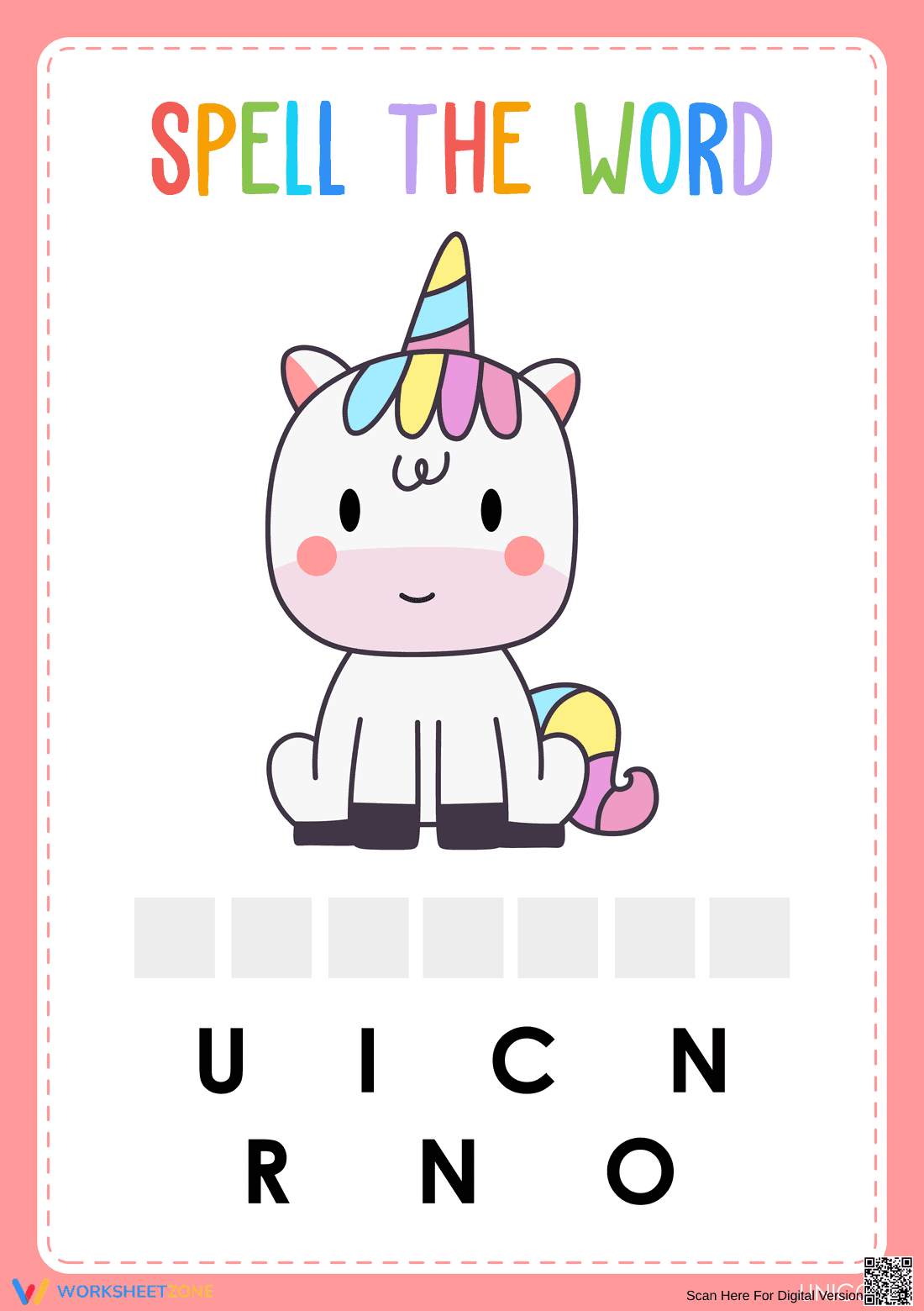

Printable Animal Spelling Worksheet | Kindergarten ELA
Paste this activity's link or code into your existing LMS (Google Classroom, Canvas, Teams, Schoology, Moodle, etc.).
Students can open and work on the activity right away, with no student login required.
You'll still be able to track student progress and results from your teacher account.
This Kindergarten animal spelling worksheet helps early learners master letter-to-sound correspondence by unscrambling the word "Unicorn." By engaging with high-interest imagery, students build confidence in their phonics skills and orthographic mapping. This activity provides a clear, focused task that reinforces foundational literacy through a single, achievable spelling goal.
At a Glance
- Grade: Kindergarten · Subject: ELA
- Standard:
CCSS.ELA-LITERACY.L.K.2.D— Spell simple words phonetically, drawing on knowledge of sound-letter relationships- Skill Focus: Spelling & Letter Recognition
- Format: 1 page · 1 task · Answer key included · PDF
- Best For: Morning work or literacy centers
- Time: 5–10 minutes
This resource features a large, colorful illustration of a unicorn to provide a clear visual cue. Below the image, students find 7 empty boxes corresponding to the 7 letters in the word. A scrambled letter bank (U, I, C, N, R, N, O) is provided at the bottom to support letter identification and sequencing, ensuring students have all the components needed for success.
Zero-Prep Workflow
This zero-prep worksheet is designed for immediate classroom implementation. Teachers can print the single-page PDF in less than 30 seconds. Distribution takes roughly 1 minute, and because the task is self-explanatory, students can begin working immediately. Reviewing the correct spelling as a whole group takes just 2 minutes, making this an ideal sub-plan addition or a quick transition activity between lessons.
Standards Alignment
This worksheet aligns with `CCSS.ELA-LITERACY.L.K.2.D`, focusing on phonetic spelling and letter-sound relationships. It also supports `CCSS.ELA-LITERACY.RF.K.1.B`, recognizing that spoken words are represented in written language by specific sequences of letters. Both standard codes can be copied directly into lesson plans, IEP goals, or district curriculum mapping tools.
How to Use It
Use this as a "hook" activity during a unit on animals or the letter 'U'. It works exceptionally well as a formative assessment; observe if students can identify the initial 'U' sound and the final 'N' sound as they place the letters. Expected completion time is 5 to 10 minutes depending on the student's phonetic mastery and fine motor skills.
Who It's For
This is designed for Preschool, Kindergarten, and Grade 1 students who are beginning to transition from letter recognition to word construction. It is a natural pairing for an alphabet anchor chart or a read-aloud book featuring mythical creatures. The simple layout is also beneficial for English Language Learners (ELLs) building basic vocabulary.
According to Fisher & Frey (2014), the use of visual scaffolds and scrambled letter banks supports the gradual release of responsibility in early literacy. This worksheet targets CCSS.ELA-LITERACY.L.K.2.D by requiring students to apply their knowledge of sound-letter relationships to spell a multi-syllabic word phonetically. By isolating a single high-interest word like "Unicorn," the resource reduces cognitive load while maximizing engagement. Research from the NAEP indicates that early success with phonetic spelling is a strong predictor of later reading fluency. This 1-page PDF provides the structured practice necessary for students to move from recognizing individual letters to understanding how they combine to form meaningful vocabulary. It serves as a reliable tool for teachers looking to provide quick, standards-aligned practice that fits into any literacy block or intervention session.


