


























Views
Downloads

Animal Spelling Worksheet | Essential Kindergarten ELA
Paste this activity's link or code into your existing LMS (Google Classroom, Canvas, Teams, Schoology, Moodle, etc.).
Students can open and work on the activity right away, with no student login required.
You'll still be able to track student progress and results from your teacher account.
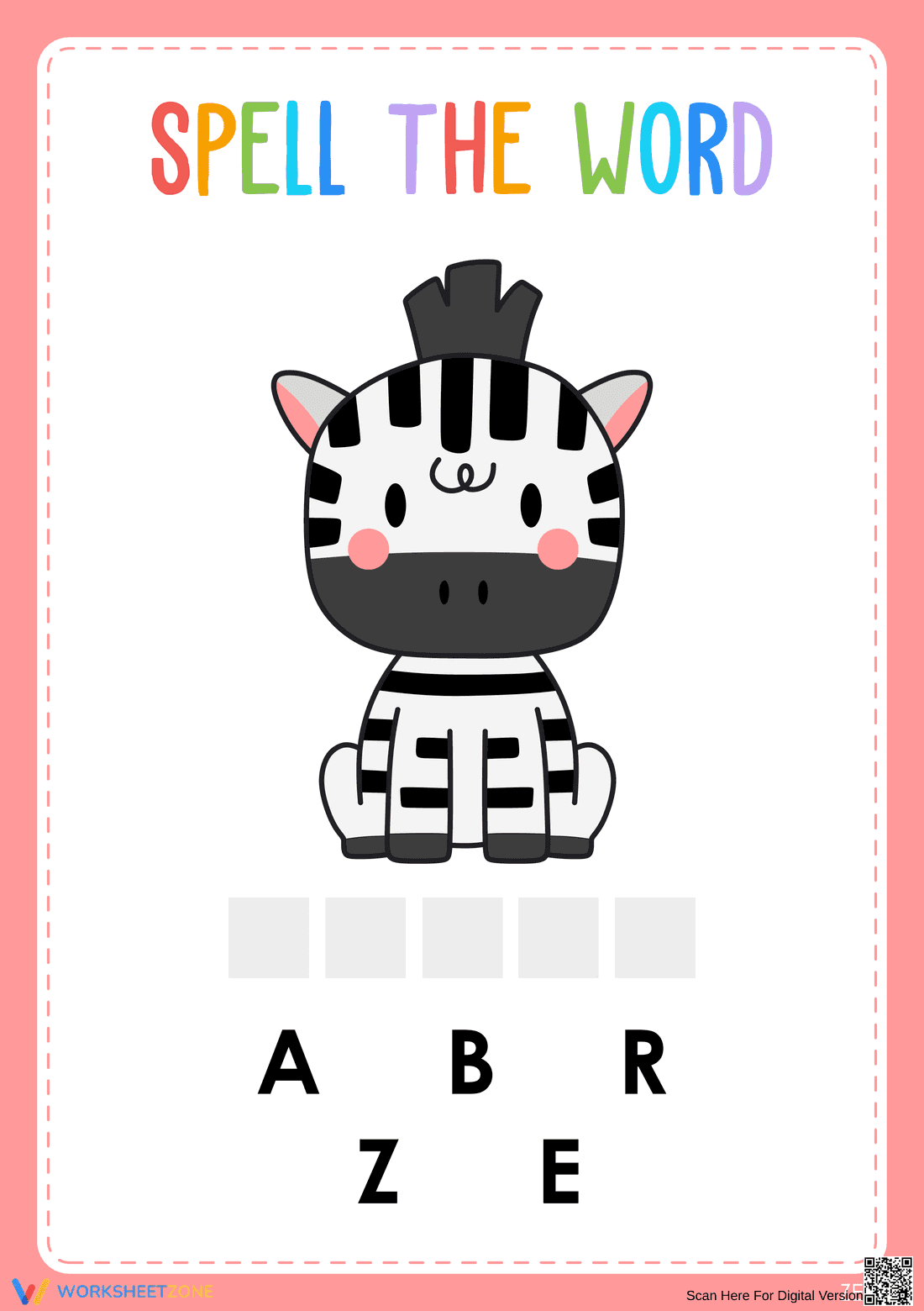
This Kindergarten animal spelling worksheet helps early learners master phonics and letter sequencing by spelling the word "Zebra." Students use provided letter cues to identify, arrange, and write the correct spelling, reinforcing the connection between visual imagery and written language. It is designed to build confidence in foundational literacy skills.
At a Glance
- Grade: Kindergarten · Subject: ELA
- Standard:
CCSS.ELA-LITERACY.L.K.2.D— Spell simple words phonetically, drawing on knowledge of sound-letter relationships- Skill Focus: Spelling and Letter Recognition
- Format: 1 page · 1 task · Answer key included · PDF
- Best For: Morning work or literacy centers
- Time: 5–10 minutes
What's Inside
This single-page PDF features a high-quality illustration of a zebra to provide a clear visual prompt. Below the image, students find five empty letter boxes and a scrambled set of letters (A, B, R, Z, E). The layout is clean and distraction-free, making it ideal for young children who are just beginning to navigate independent worksheets without feeling overwhelmed by complex instructions.
Zero-Prep Workflow
- Print: Select the single-page PDF and print enough copies for your group (30 seconds).
- Distribute: Hand out the sheets during a phonics block or as a quiet transition activity (1 minute).
- Review: Check the correct spelling as a class to provide immediate feedback and reinforce the /z/ sound (1 minute).
This streamlined process makes the resource an excellent choice for emergency sub plans or quick formative assessments during a busy school day.
Standards Alignment
The primary standard addressed is CCSS.ELA-LITERACY.L.K.2.D, which requires students to spell simple words phonetically by drawing on their knowledge of sound-letter relationships. This activity also supports vocabulary acquisition by categorizing animals and identifying specific traits. Both standard codes can be copied directly into lesson plans, IEP goals, or district curriculum mapping tools.
How to Use It
Use this worksheet as a "ticket out the door" after a lesson on zoo animals or the letter 'Z'. It serves as a quick check for understanding regarding letter-sound correspondence. Alternatively, place it in a literacy center inside a dry-erase pocket for repeated practice. Teachers should observe if students can identify the starting sound /z/ before placing the first letter in the sequence.
Who It's For
This resource is tailored for Preschool, Kindergarten, and Grade 1 students who are developing fine motor skills and phonemic awareness. It is particularly helpful for English Language Learners (ELLs) who benefit from the direct pairing of a visual image with its written name. Pair this with an animal-themed anchor chart for additional instructional support.
According to the RAND AIRS 2024 report on early childhood literacy, the integration of visual scaffolds with phonics tasks significantly improves word retention in emergent readers. This worksheet aligns with those findings by providing a clear "Zebra" illustration to anchor the spelling task. By focusing on a single, high-frequency animal word, the activity reduces cognitive load, allowing students to focus entirely on the phonetic sequence required by CCSS.ELA-LITERACY.L.K.2.D. Research from Fisher & Frey (2014) emphasizes that such targeted, short-duration tasks are essential for building the stamina required for more complex writing later in the primary grades. This resource provides the necessary repetition for students to internalize letter-sound relationships while engaging with familiar vocabulary. It is a practical tool for any classroom prioritizing evidence-based literacy instruction and structured phonics practice.


