


























Views
Downloads

Printable Animal Spelling Worksheet | Grade K ELA
Paste this activity's link or code into your existing LMS (Google Classroom, Canvas, Teams, Schoology, Moodle, etc.).
Students can open and work on the activity right away, with no student login required.
You'll still be able to track student progress and results from your teacher account.
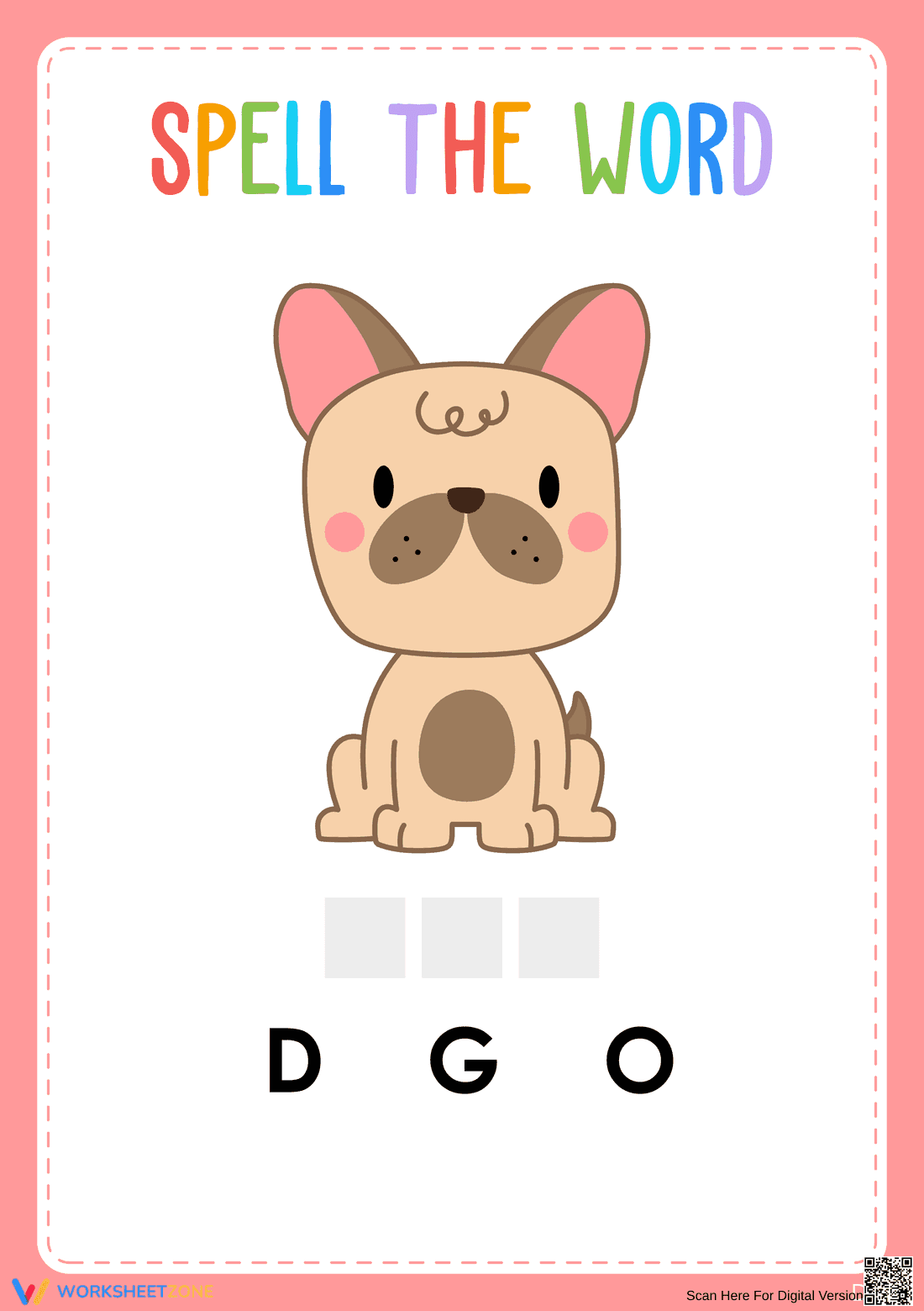
This foundational spelling worksheet helps early learners practice letter recognition and word formation by unscrambling letters to spell a familiar animal name. Students will look at the visual cue, identify the scrambled letters, and write the correct word in the provided boxes, building essential early literacy skills.
At a Glance
- Grade: K · Subject: ELA
- Standard:
CCSS.ELA-LITERACY.L.K.2.D— Spell simple words phonetically using sound-letter relationships- Skill Focus: Spelling and Letter Unscrambling
- Format: 1 page · 1 problem · Answer key included · PDF
- Best For: Independent practice or literacy centers
- Time: 5–10 minutes
This single-page resource features an engaging illustration of a dog alongside a targeted spelling task. Students are presented with three scrambled letters (D, G, O) and three blank boxes to write the correct sequence. The worksheet includes a built-in visual hint at the bottom, serving as an immediate self-correction tool. The clear font and simple layout minimize distractions.
Designed for a zero-prep workflow, this resource is ideal for busy mornings.
- Print (1 min): Download the PDF and print.
- Distribute (1 min): Hand out with pencils. Visual instructions are intuitive.
- Review (2 min): Check work or allow self-checking using the provided word.
Total teacher prep time is under two minutes, making it an excellent sub plan addition.
This activity is aligned to CCSS.ELA-LITERACY.L.K.2.D: Spell simple words phonetically, drawing on knowledge of sound-letter relationships. It also supports early phonemic awareness by requiring students to segment the sounds in a familiar CVC word and match them to the provided letters. Both standard codes can be copied directly into lesson plans, IEP goals, or district curriculum mapping tools.
This worksheet is highly versatile for early childhood classrooms. Use it as a quick morning work activity to settle students in before direct instruction begins, or place it in a literacy center for independent practice. As a formative assessment observation tip, watch how students approach the scrambled letters: do they sound out the word "dog" first, or do they try to guess the order visually? This observation can inform future phonics instruction. Expected completion time is a brief 5 to 10 minutes.
This resource is primarily designed for Preschool, Kindergarten, and early Grade 1 students who are just beginning to encode simple words. For differentiation, teachers can provide letter tiles for students who struggle with fine motor writing skills, allowing them to physically manipulate the letters into the boxes. This worksheet pairs perfectly with a direct instruction lesson on CVC words or a read-aloud book featuring common household pets.
Developing early spelling skills through targeted, visually supported activities is a critical component of foundational literacy instruction in early childhood classrooms. According to Fisher & Frey (2014), providing students with clear, scaffolded tasks that connect visual representations to phonetic spelling significantly improves their ability to encode simple words accurately. This worksheet directly addresses CCSS.ELA-LITERACY.L.K.2.D by requiring students to spell simple words phonetically using sound-letter relationships. By unscrambling the provided letters to form a recognizable animal name, young learners practice essential phonemic segmentation and letter-sound correspondence in a low-stakes, engaging environment. The inclusion of a visual model and a straightforward task structure ensures that students can focus their cognitive resources entirely on the spelling process rather than deciphering complex instructions. Consistent practice with these types of focused activities builds the automaticity necessary for fluent reading.


