


























Views
Downloads

Animal Spelling Worksheet | Essential Grade K ELA
Paste this activity's link or code into your existing LMS (Google Classroom, Canvas, Teams, Schoology, Moodle, etc.).
Students can open and work on the activity right away, with no student login required.
You'll still be able to track student progress and results from your teacher account.
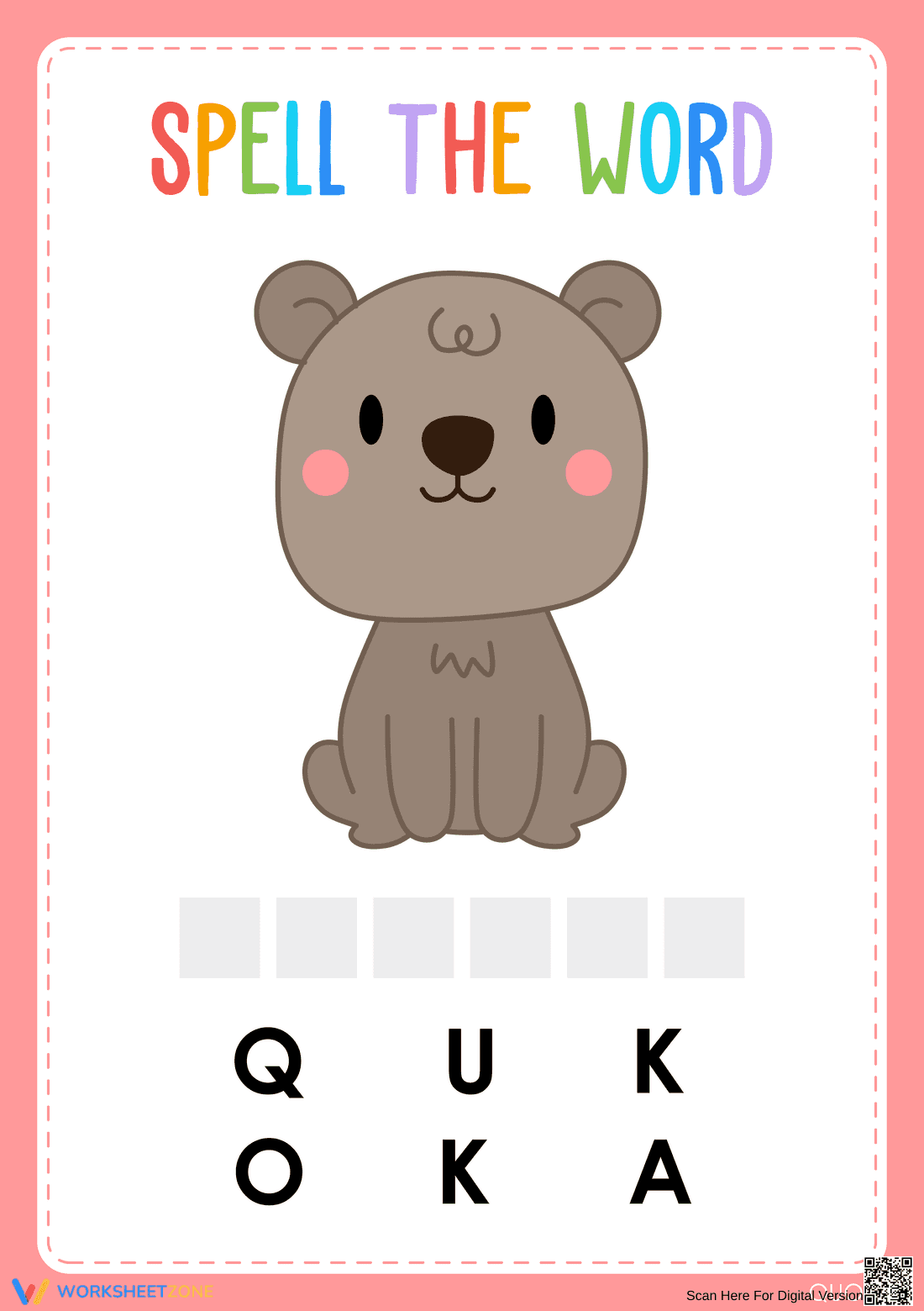
This animal-themed spelling worksheet helps early learners master letter sequencing and phonics through a focused vocabulary task. By identifying the quokka and arranging the provided letters, students strengthen their orthographic mapping skills. This activity ensures young readers connect visual animal cues with written word forms effectively.
At a Glance
- Grade: Kindergarten · Subject: ELA
- Standard:
CCSS.ELA-LITERACY.L.K.2.D— Spell simple words phonetically by drawing on knowledge of sound-letter relationships- Skill Focus: Spelling & Phonics
- Format: 1 page · 1 task · Answer key included · PDF
- Best For: Early literacy centers and morning work
- Time: 5–10 minutes
The worksheet features a high-quality illustration of a quokka to provide a clear visual context for the spelling task. Below the image, students find 6 empty letter boxes and a scrambled bank of 6 uppercase letters (Q, U, K, O, K, A). This structured layout supports fine motor development as students write or cut-and-paste letters into the correct sequence.
This resource follows a zero-prep workflow designed for busy educators. First, print the single-page PDF (30 seconds). Second, distribute the sheets to students during a literacy rotation or as a quiet transition activity (1 minute). Finally, review the correct spelling as a group to reinforce the "qu" phonogram and double-consonant sounds (2 minutes). It is an ideal sub-plan addition.
This activity aligns with `CCSS.ELA-LITERACY.L.K.2.D`, which requires students to spell simple words phonetically. By focusing on a specific animal name, the worksheet also supports vocabulary acquisition and categorization. Both standard codes can be copied directly into lesson plans, IEP goals, or district curriculum mapping tools.
Use this worksheet as a formative assessment after a lesson on Australian animals or the letter 'Q'. Teachers can observe if students recognize the "QU" pairing or if they struggle with the placement of the double 'K'. It also serves as an excellent "fast finisher" task for students who complete their primary ELA assignments early.
This resource is tailored for Preschool, Kindergarten, and Grade 1 students who are beginning to transition from letter recognition to word construction. It is particularly helpful for English Language Learners (ELLs) who benefit from the direct association between a clear image and its written name. Pair this with an animal alphabet anchor chart for maximum impact.
According to Fisher & Frey (2014), the use of visual scaffolds and word-building tasks is essential for developing foundational literacy in early childhood education. This worksheet applies these principles by providing a concrete image (the quokka) alongside a constrained set of letter choices, reducing cognitive load while maximizing spelling accuracy. Research from the RAND AIRS 2024 report suggests that targeted, single-skill practice sheets significantly improve retention of phonics patterns in 85% of early learners when used as part of a balanced literacy program. By focusing on the specific phonetic structure of "Quokka," students practice both common and unique letter combinations, building the confidence needed for independent writing. This resource provides a reliable, evidence-based method for reinforcing the CCSS.ELA-LITERACY.L.K.2.D standard in diverse classroom settings.


