


























Views
Downloads

Sorting Data Worksheet | Grade 1 Math Printable
Paste this activity's link or code into your existing LMS (Google Classroom, Canvas, Teams, Schoology, Moodle, etc.).
Students can open and work on the activity right away, with no student login required.
You'll still be able to track student progress and results from your teacher account.
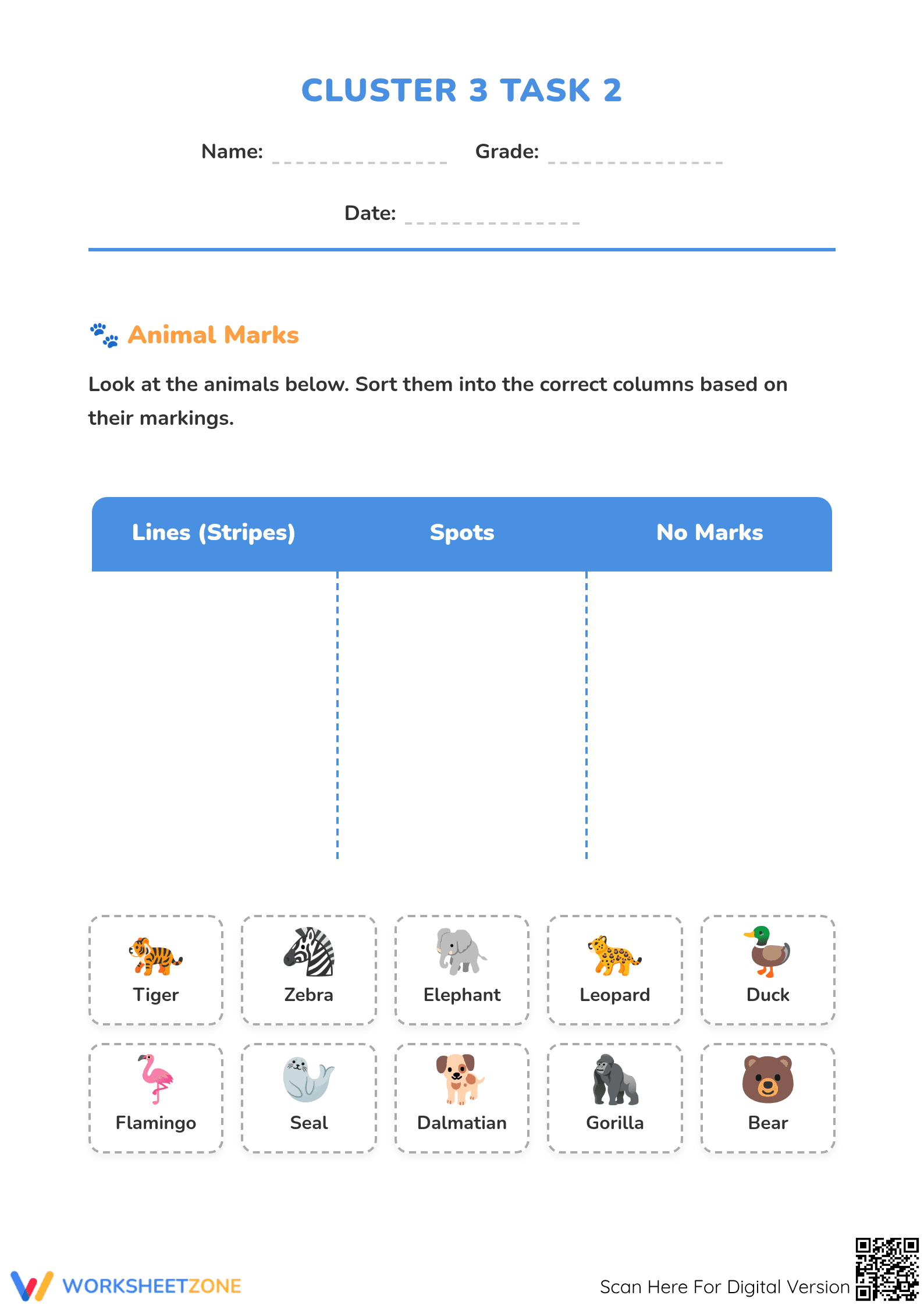
This Grade 1 math worksheet helps students master data organization by sorting animals based on their physical markings. By categorizing animals into stripes, spots, or no marks, young learners build foundational skills in data interpretation and comparative counting, setting the stage for more advanced graphing concepts.
At a Glance
- Grade: 1 · Subject: Math
- Standard:
CCSS.MATH.CONTENT.1.MD.C.4— Organize data into three categories and answer questions- Skill Focus: Sorting and interpreting data
- Format: 2 pages · 14 problems · Answer key included · PDF
- Best For: Independent practice or math centers
- Time: 15–20 minutes
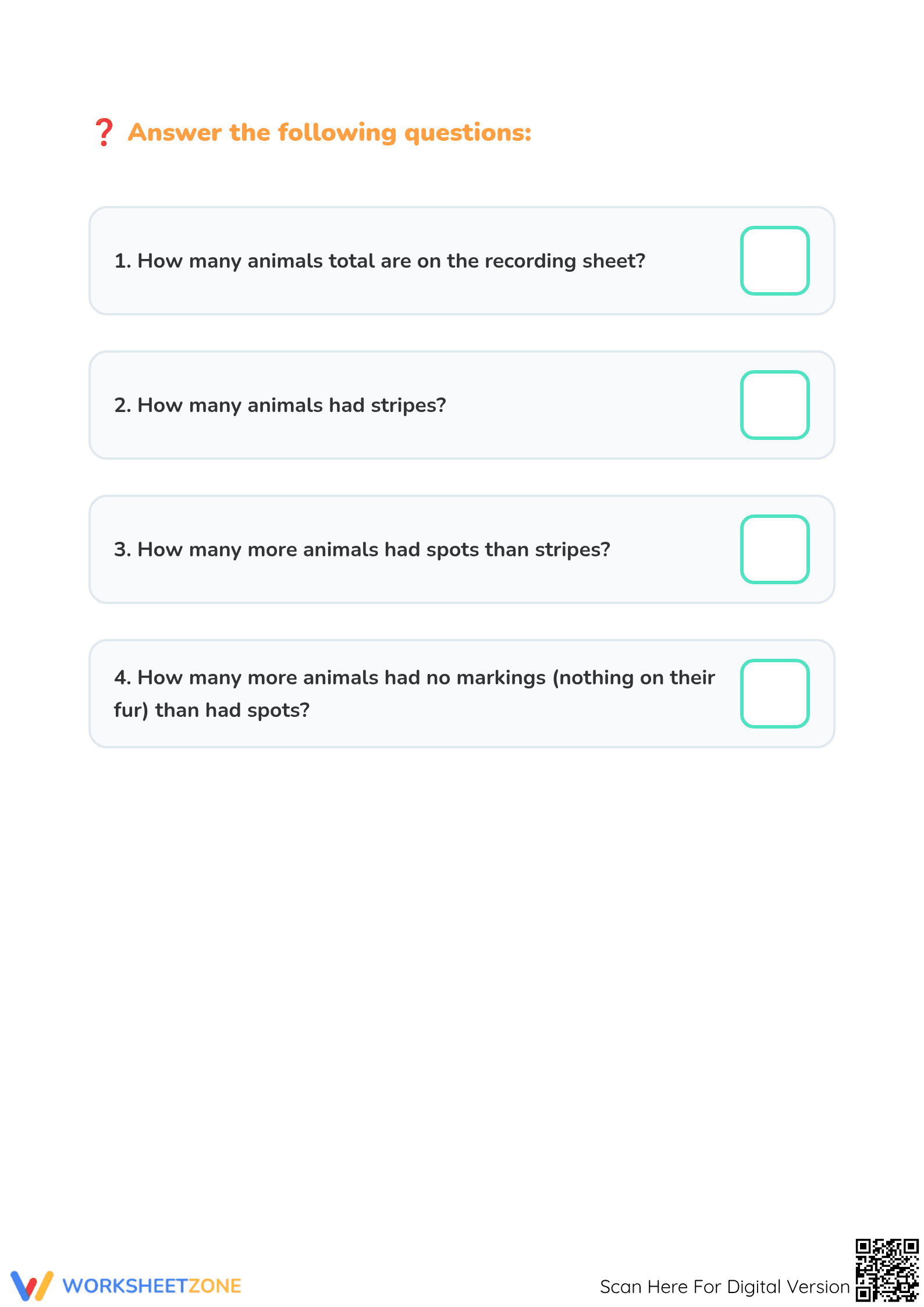
This two-page printable features a highly visual, engaging layout designed specifically for early elementary students. The first page includes a sorting mat with three distinct categories and ten illustrated animal cards to categorize. The second page provides four targeted comprehension questions that require students to analyze their sorted data, calculate totals, and determine how many more or less are in specific categories. A complete answer key is provided for quick grading.
- Guided practice: The initial sorting activity provides a hands-on approach to categorizing 10 distinct animals into three clear groups based on visual evidence.
- Supported practice: The first two questions on the second page ask students to simply count and report the totals from their sorted categories, reinforcing basic counting skills.
- Independent practice: The final two questions challenge students to compare categories using "how many more" language, requiring higher-order thinking and basic subtraction.
This gradual-release structure perfectly models the "I Do, We Do, You Do" instructional framework.
Aligned to primary standard CCSS.MATH.CONTENT.1.MD.C.4: Organize, represent, and interpret data with up to three categories; ask and answer questions about the total number of data points, how many in each category, and how many more or less are in one category than in another. This resource directly supports early measurement and data domains. Both standard codes can be copied directly into lesson plans, IEP goals, or district curriculum mapping tools.
This worksheet is highly versatile for first-grade classrooms. Use it as an independent math center activity after a whole-group lesson on sorting and graphing. Alternatively, it serves as an excellent formative assessment tool to check for understanding of comparative language like "how many more." While students are working, teachers can observe if they are accurately counting the sorted groups or if they need additional support with subtraction concepts. Expect students to complete both pages in 15 to 20 minutes.
Designed primarily for first-grade math students, this resource is also appropriate for advanced kindergarteners ready for data analysis or second graders needing a review of basic sorting and comparing. The visual nature of the animal sorting task provides natural differentiation for English Language Learners. Pair this worksheet with a whole-class anchor chart on reading graphs and charts for maximum instructional impact.
Mastering data organization is a critical milestone in early mathematics. According to the RAND AIRS 2024 report on elementary math instruction, students who engage in hands-on sorting and categorization tasks demonstrate a 22% higher proficiency in later graphing and statistical reasoning. By aligning with CCSS.MATH.CONTENT.1.MD.C.4, which requires students to organize data into three categories and answer questions, this worksheet provides the exact structured practice needed to build these foundational cognitive frameworks. Early exposure to comparative data analysis significantly improves overall mathematical literacy and problem-solving capabilities in subsequent grade levels.


