


























Views
Downloads

Grade 1 Animal Habitats — Printable No-Prep Worksheet
Paste this activity's link or code into your existing LMS (Google Classroom, Canvas, Teams, Schoology, Moodle, etc.).
Students can open and work on the activity right away, with no student login required.
You'll still be able to track student progress and results from your teacher account.
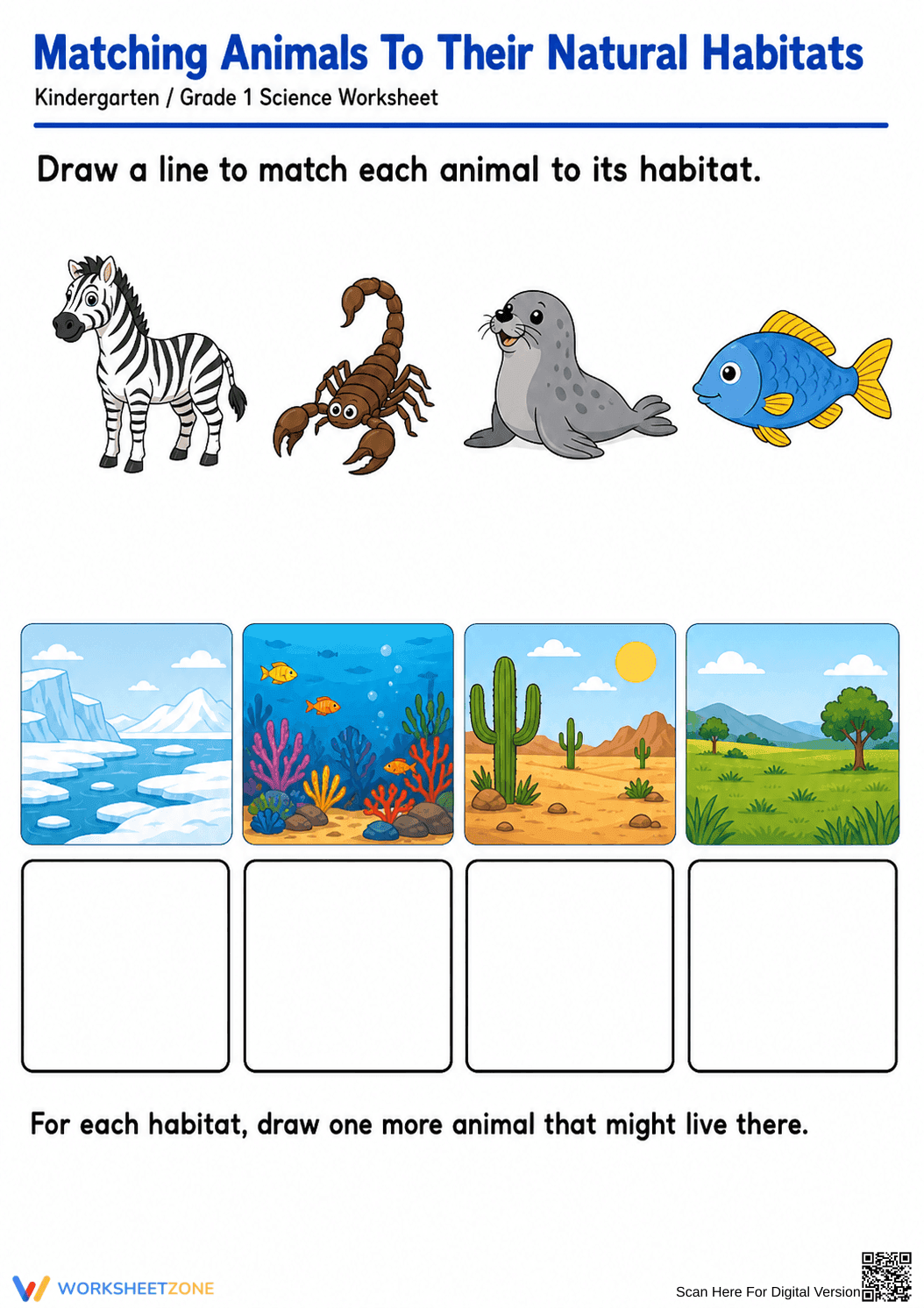
This Grade 1 science worksheet helps students identify where different animals live by matching them to their natural environments. By connecting creatures like zebras and seals to their correct biomes, young learners build foundational biology skills and develop a deeper understanding of how physical traits relate to specific habitats.
At a Glance
- Grade: 1 · Subject: Science
- Standard:
K-ESS3-1— Relate animal needs to their living environments- Skill Focus: Matching animals to habitats
- Format: 1 page · 8 problems · Answer key included · PDF
- Best For: Independent practice and centers
- Time: 10–15 minutes
This single-page resource features colorful, engaging illustrations of four distinct animals—a zebra, scorpion, seal, and fish—alongside four diverse environments: an arctic icescape, an underwater reef, a desert, and a grassy plain. Students complete four matching tasks by drawing lines between the animals and their homes. Additionally, the worksheet includes four creative drawing prompts where children sketch one additional animal for each habitat. A standard answer key is included.
Designed for immediate classroom implementation, this zero-prep activity follows a simple workflow:
- Print (1 min): Download the PDF and print a class set.
- Distribute (1 min): Hand out worksheets and crayons. No complex teacher setup is required.
- Review (2 mins): Quickly check matches and discuss the drawn animals.
With total prep time under two minutes, this resource is perfect for emergency sub plans or science centers.
This worksheet is aligned to the Next Generation Science Standards, specifically focusing on K-ESS3-1: Use a model to represent the relationship between the needs of different plants or animals and the places they live. It supports early elementary life science goals by encouraging students to observe the diversity of life. Both standard codes can be copied directly into lesson plans, IEP goals, or district curriculum mapping tools.
Teachers can utilize this worksheet during direct instruction as guided practice. After reading a book about biomes, have students complete the matching section together, discussing why a seal needs an arctic environment. Alternatively, use it as an independent science center task. As a formative assessment observation tip, watch which animals students draw in the blank boxes; this reveals if they grasp the climate constraints of each habitat. Expected completion time is 10 to 15 minutes.
This resource is primarily designed for Kindergarten and Grade 1 students developing early life science competencies. It naturally differentiates by allowing advanced students to draw more complex animals or write labels in the blank boxes, while students needing support can focus purely on the visual matching. It pairs perfectly with an anchor chart displaying different global biomes or a direct instruction lesson on animal adaptations.
Understanding the relationship between organisms and their environments is a critical stepping stone in early science education. When students practice matching animals to habitats, they are actively engaging with the core concepts of K-ESS3-1, learning to relate animal needs to their living environments. According to a ScienceDirect TpT Analysis, integrating visual matching tasks with creative drawing prompts significantly enhances cognitive retention in early elementary learners. By requiring students to not only identify the correct biome for a given animal but also generate an example of another creature that shares that ecosystem, this worksheet moves beyond simple recall. This dual-layered instructional approach fosters deeper conceptual mapping, ensuring young learners build robust mental models of ecological interdependence that will support more advanced biological studies in later grades.


