


























Views
Downloads
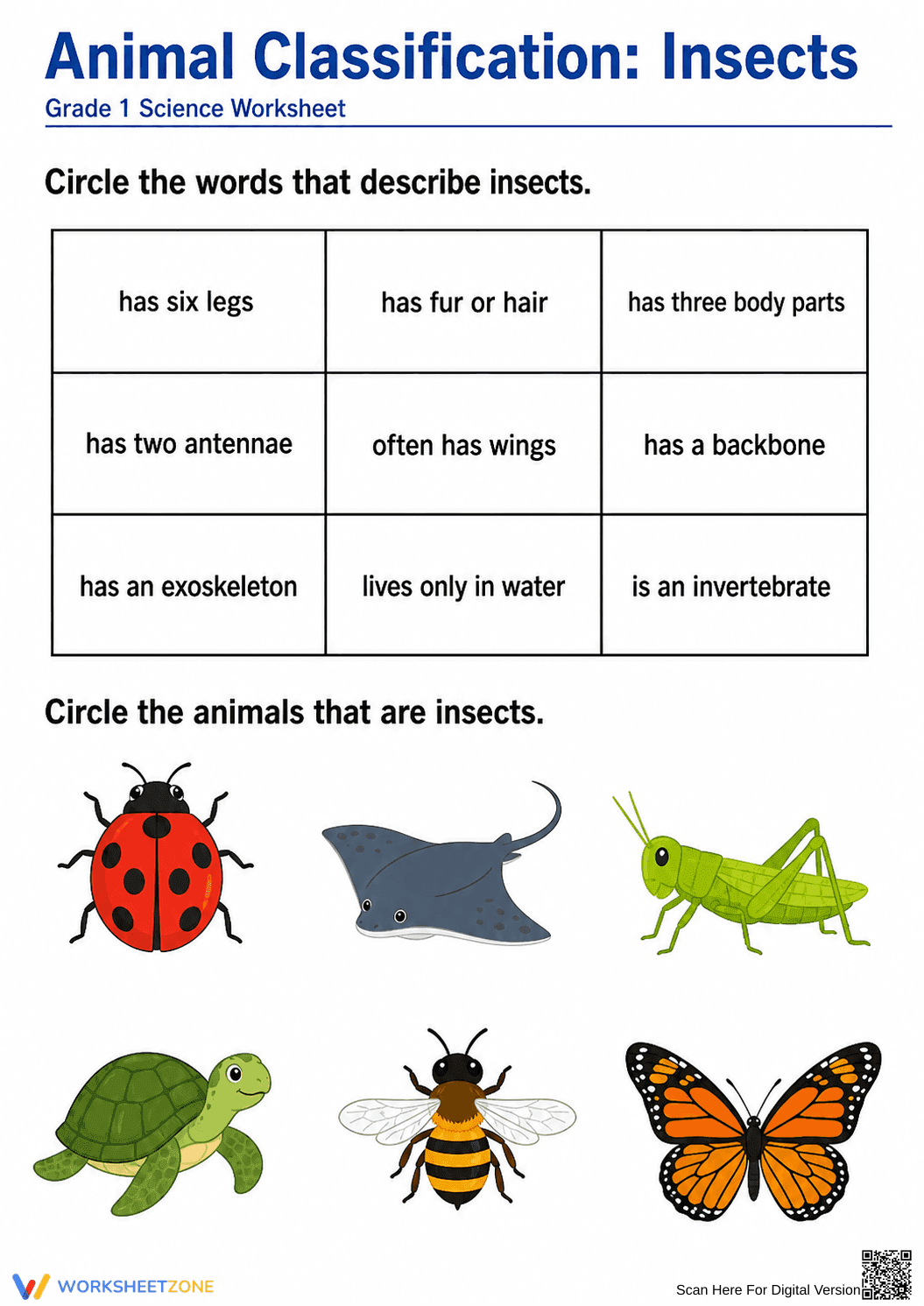


Grade 1 Insect Classification — Printable No-Prep Worksheet
Paste this activity's link or code into your existing LMS (Google Classroom, Canvas, Teams, Schoology, Moodle, etc.).
Students can open and work on the activity right away, with no student login required.
You'll still be able to track student progress and results from your teacher account.
This Grade 1 science worksheet helps students identify and classify insect traits through focused visual practice. By distinguishing specific animal characteristics, learners isolate the biological markers that define an insect. Students observe structures like antennae and exoskeletons to build a strong foundation for early life science literacy.
At a Glance
- Grade: 1 · Subject: Science
- Standard:
1-LS1-1— Identify external animal parts used for survival- Skill Focus: Insect trait classification
- Format: 2 pages · 30 problems · Answer key included · PDF
- Best For: Independent practice or sub plans
- Time: 15–20 minutes
What's Inside
This PDF includes a two-page student worksheet and a corresponding teacher answer key. Each page features two distinct identification activities. The first task presents a nine-cell grid where students circle insect-specific attributes, such as having three body segments or two antennae. The second section provides six animal illustrations, challenging students to visually classify insects like ladybugs and grasshoppers while excluding non-insects like frogs and turtles.
Zero-Prep Workflow
This resource allows for immediate classroom integration with minimal teacher oversight.
- Print (30 seconds): Generate copies or upload the PDF directly to your digital learning management system.
- Distribute (30 seconds): Hand out the worksheet as a quick science transition or morning work activity.
- Review (1 minute): Use the provided answer key to quickly verify student accuracy and spot misconceptions.
Total prep time is under two minutes, making this an ideal option for emergency sub plans or last-minute science lessons.
Standards Alignment
This activity aligns directly to 1-LS1-1, focusing on helping students identify and describe the external parts of animals that help them survive. By isolating specific traits like jointed legs and antennae, students begin to understand how organisms are uniquely structured. Both standard codes can be copied directly into lesson plans, IEP goals, or district curriculum mapping tools.
How to Use It
Deploy this worksheet during the independent practice phase of a science lesson to reinforce direct instruction on animal groups. It also serves as an excellent formative assessment to gauge student understanding of basic animal anatomy. Teachers should observe students as they work to catch any misconceptions regarding body segments versus other animal features. Expected completion time ranges from 15 to 20 minutes for first-grade learners.
Who It's For
Optimized for Grade 1 students, this resource also supports Grade 2 review sessions or intervention groups. It aids English Language Learners through clear visual cues and concise, repetitive vocabulary. The worksheet pairs naturally with an anchor chart about animal groups or a shared reading passage detailing the lives of common garden insects.
Classification activities in early childhood science serve as a critical entry point for developing hierarchical thinking and observational rigor. According to research from RAND AIRS 2024, providing students with structured sorting and identification tasks significantly improves retention of biological vocabulary compared to passive lecture formats. This worksheet specifically addresses the 1-LS1-1 standard by requiring students to isolate external structures like jointed legs and body segments to identify external animal parts used for survival. By contrasting insect traits against other animal features, learners engage in the evidence-based reasoning process central to modern science standards. Scaffolded identification tasks are essential for the gradual release of responsibility in the elementary science classroom. This 30-problem resource provides the exact level of cognitive demand needed for first graders to master the plain-English skill of animal trait identification while ensuring the results are easily measurable for teacher gradebooks.


