


























Views
Downloads

Grade 3 Vertebrate Groups — Printable No-Prep Worksheet
Paste this activity's link or code into your existing LMS (Google Classroom, Canvas, Teams, Schoology, Moodle, etc.).
Students can open and work on the activity right away, with no student login required.
You'll still be able to track student progress and results from your teacher account.
This Grade 3 science worksheet helps students master vertebrate classification by sorting animals into five distinct groups. By categorizing mammals, birds, fish, amphibians, and reptiles, learners develop a foundational understanding of biological taxonomy and physical traits. This resource ensures students can accurately distinguish between different animal classes.
At a Glance
- Grade: 3 · Subject: Science
- Standard:
3-LS4-3— Construct an argument with evidence about habitat survival- Skill Focus: Vertebrate classification
- Format: 1 page · 15 tasks · Answer key included · PDF
- Best For: Independent practice or science centers
- Time: 15–20 minutes
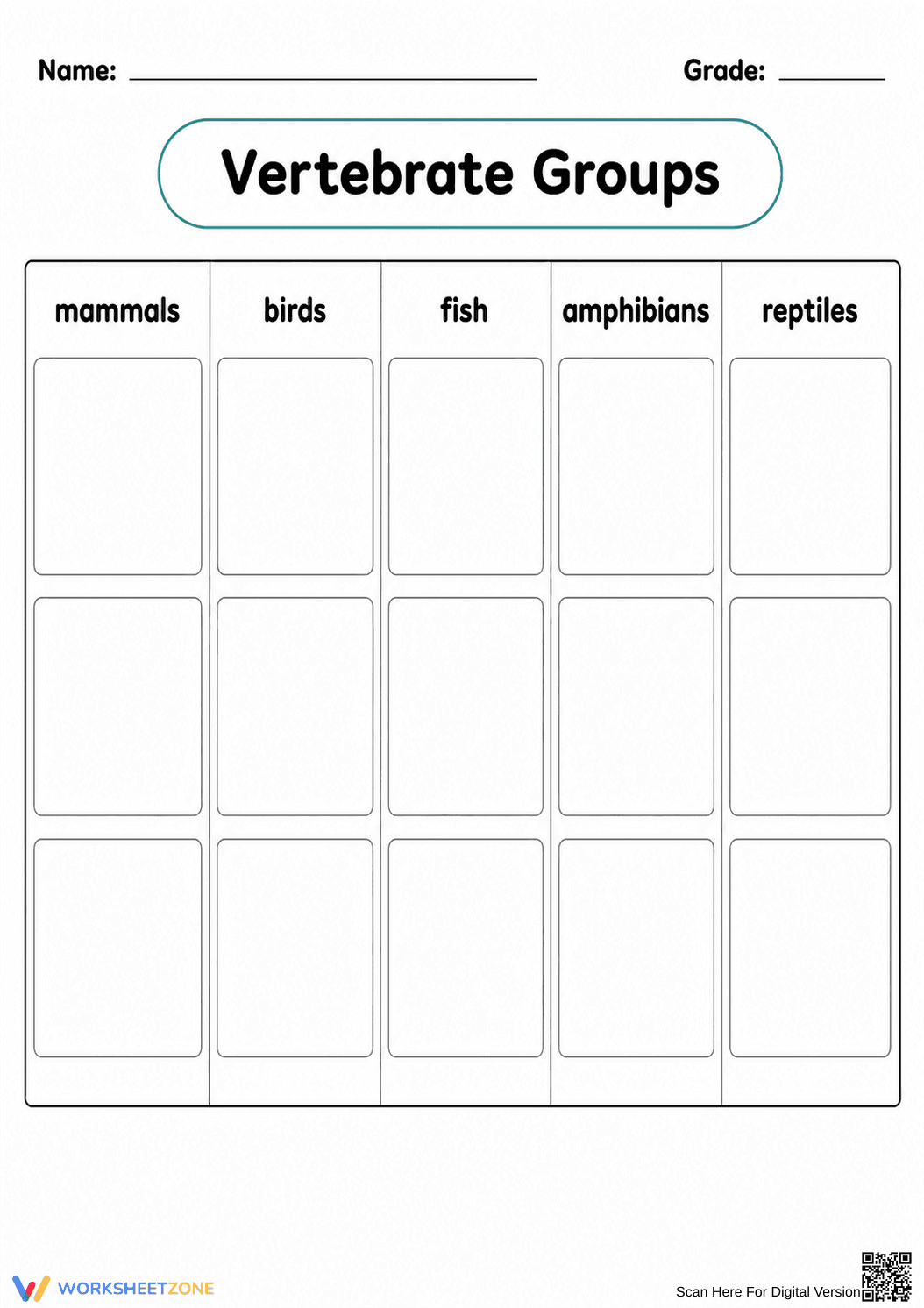
This single-page PDF features a clean, structured grid layout designed for maximum clarity. It includes five labeled columns for the primary vertebrate groups: mammals, birds, fish, amphibians, and reptiles. Each column provides three dedicated spaces for students to list, draw, or paste examples, totaling 15 individual classification tasks. The worksheet includes a clear header for student names and a comprehensive answer key for rapid grading.
Teachers can integrate this resource into their science block in under two minutes. First, print the required number of copies for your class (1 minute). Next, distribute the sheets as a transition activity or independent practice following a lesson on animal traits (30 seconds). Finally, use the included answer key to review student work or allow for self-correction during a whole-group wrap-up (30 seconds). It is an ideal sub-plan component requiring zero teacher setup.
This resource aligns with 3-LS4-3, which requires students to construct an argument with evidence that in a particular habitat some organisms can survive well, some survive less well, and some cannot survive at all. By classifying vertebrates, students identify the physical traits that define these groups and dictate their survival. Both standard codes can be copied directly into lesson plans, IEP goals, or district curriculum mapping tools.
Use this worksheet as a formative assessment after an introductory lesson on vertebrates. Observe if students can correctly place animals like whales or penguins, which often challenge initial classification logic. It also functions well as a ticket out the door to gauge mastery before moving to invertebrate studies. Expect students to complete the sorting task within 15 to 20 minutes depending on their prior knowledge.
This worksheet is designed for third-grade students beginning their study of biology and animal taxonomy. It is particularly effective for visual learners who benefit from categorized graphic organizers. Pair this resource with a vertebrate anchor chart or a short informational text about animal life cycles to provide students with the necessary evidence to complete their classification grid.
According to the RAND AIRS 2024 report on elementary science instruction, structured classification tasks are vital for developing categorical reasoning in young learners. This worksheet targets the 3-LS4-3 standard by requiring students to organize biological data and practice vertebrate classification across five major groups: mammals, birds, fish, amphibians, and reptiles. Graphic organizers, like the grid provided here, reduce cognitive load and allow students to focus on the specific traits that differentiate species. By completing 15 distinct classification tasks, students build the schema necessary for more complex evolutionary biology concepts in later grades. This resource provides a high-utility, evidence-based approach to science literacy, ensuring that students can accurately identify and group organisms based on observable physical characteristics. It serves as a reliable tool for both general education classrooms and specialized science interventions.


