


























Views
Downloads

Essential Animal Actions Worksheet | Grade K ELA
Paste this activity's link or code into your existing LMS (Google Classroom, Canvas, Teams, Schoology, Moodle, etc.).
Students can open and work on the activity right away, with no student login required.
You'll still be able to track student progress and results from your teacher account.
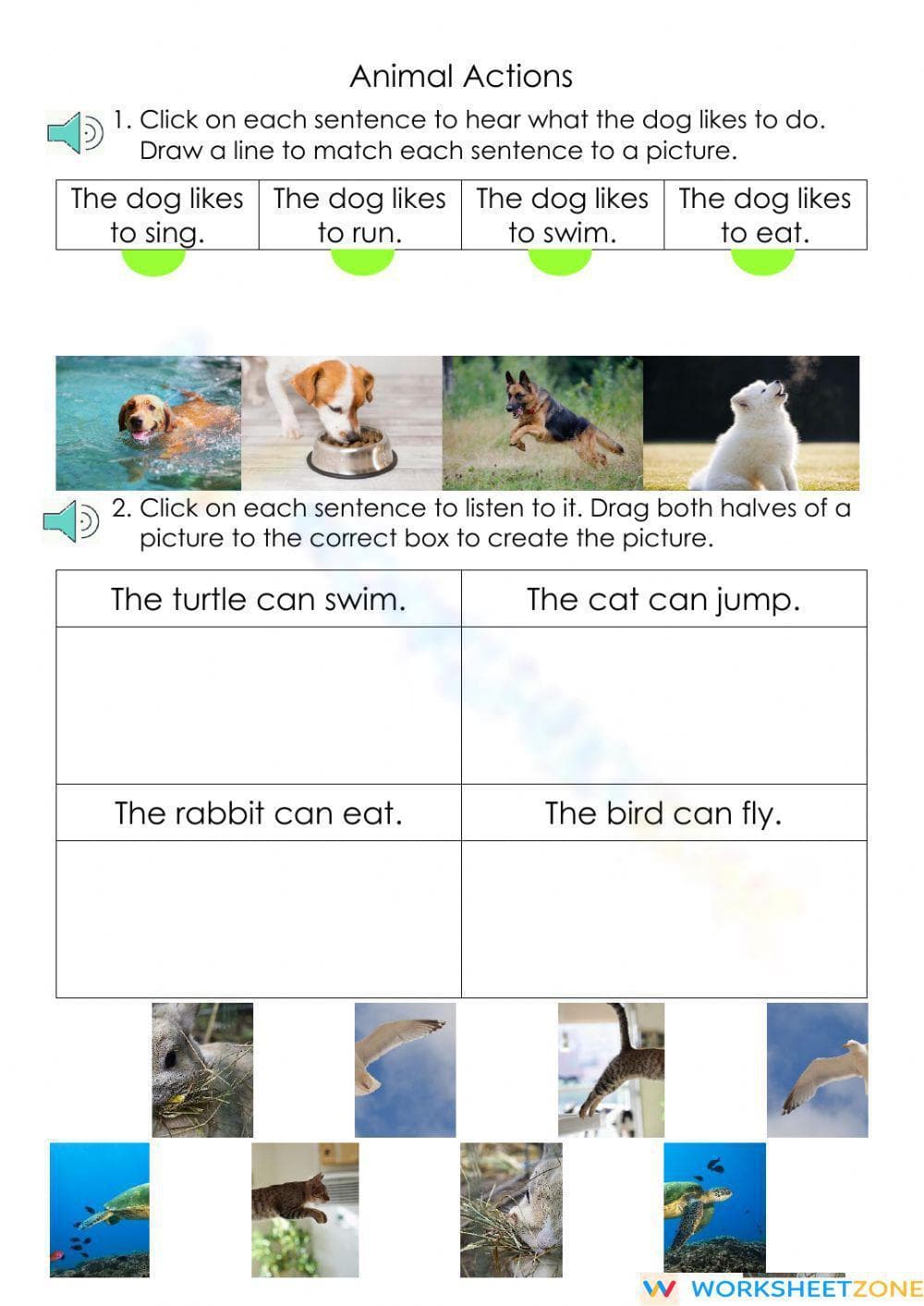
This Animal Actions worksheet helps Preschool and Kindergarten students master early vocabulary and sentence structure through engaging visual associations. By matching simple descriptive sentences to clear photographs, learners build the foundational skills needed to connect text with meaning. This resource provides a focused approach to identifying common animal behaviors while reinforcing basic reading comprehension in a structured environment.
At a Glance
- Grade: K · Subject: English Language Arts
- Standard:
CCSS.ELA-LITERACY.RI.K.7— Describe the relationship between illustrations and the text in which they appear- Skill Focus: Animal actions vocabulary
- Format: 1 page · 8 tasks · Answer key included · PDF
- Best For: Early literacy centers and vocabulary building
- Time: 10–15 minutes
This one-page PDF features two distinct sections designed to sustain engagement. The first half includes four sentences describing dog behaviors (singing, running, swimming, eating) paired with matching photographs. The second half challenges students to assemble four split-images of a turtle, cat, rabbit, and bird while reading sentences that describe their unique abilities. The layout is clean and formatted for young learners.
- Guided Practice: Students begin by listening to or reading simple "The dog likes to..." sentences with teacher support to identify the correct action.
- Supported Practice: Learners draw lines to connect four distinct actions to their corresponding visual representations, reinforcing word-to-picture correspondence.
- Independent Practice: In the final stage, students match image halves to descriptive sentences for four different animals, demonstrating mastery of the targeted vocabulary.
This worksheet follows a gradual-release model, moving from teacher-led sentence exploration to independent visual problem-solving and vocabulary application.
Primary standard: CCSS.ELA-LITERACY.RI.K.7: "With prompting and support, describe the relationship between illustrations and the text in which they appear." This resource directly addresses this goal by requiring students to verify that their visual choices accurately reflect the written sentence. This standard code can be copied directly into lesson plans or district curriculum mapping tools.
Use this worksheet during a whole-group lesson on verbs to introduce how animals move in the real world. Alternatively, place it in a literacy center as a self-directed activity. As students work, observe whether they are looking at the specific verb (e.g., "jump" vs "fly") or relying solely on animal recognition. Most Kindergarten learners will complete the 8 tasks in 15 minutes.
This resource is ideal for Preschoolers and Kindergarteners, as well as English Language Learners (ELL) who benefit from clear photographic cues. It provides support for students with IEPs focusing on basic word recognition. This worksheet pairs naturally with a classroom anchor chart showing common animal verbs or a direct instruction lesson about household pets and their habits.
Effective early literacy instruction relies on the integration of visual and textual information to build cognitive schemas. Research from Fisher & Frey (2014) emphasizes that the gradual release of responsibility, combined with strong visual scaffolding, significantly improves vocabulary acquisition in early childhood settings. This worksheet applies these principles by focusing on CCSS.ELA-LITERACY.RI.K.7, which requires students to interpret the relationship between illustrations and text. By using high-quality photographs instead of abstract drawings, the resource minimizes cognitive load, allowing learners to focus on the specific linguistic task of identifying animal actions. This method ensures that vocabulary is not just memorized but deeply connected to recognizable real-world concepts. According to current pedagogical standards, such multimodal approaches are essential for developing the phonemic and semantic awareness necessary for long-term reading success in primary education and beyond.


