


























Views
Downloads

Angle Bisector Expressions Worksheet | Grade 7 Essential
Paste this activity's link or code into your existing LMS (Google Classroom, Canvas, Teams, Schoology, Moodle, etc.).
Students can open and work on the activity right away, with no student login required.
You'll still be able to track student progress and results from your teacher account.
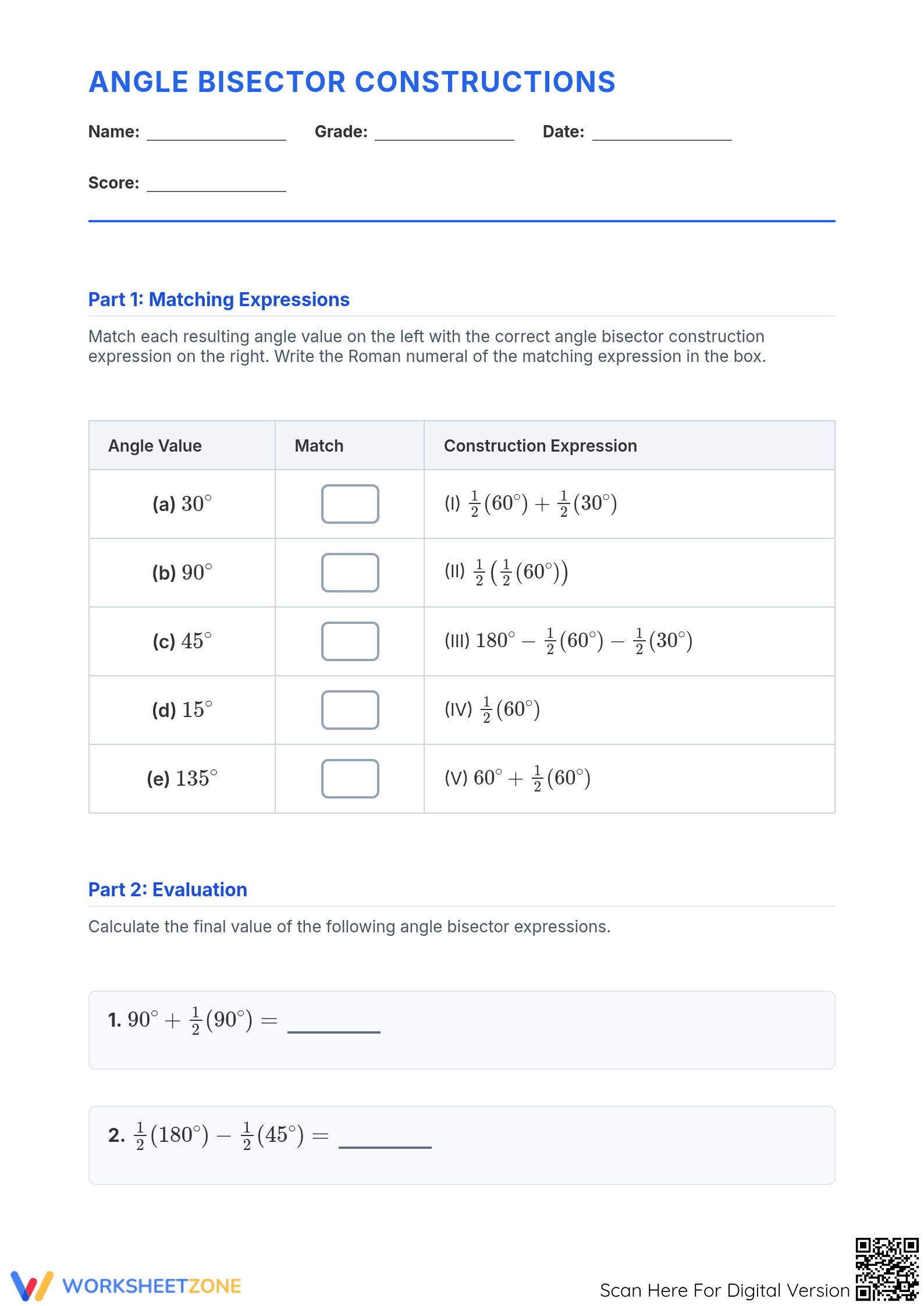
This Grade 7 math worksheet helps students master the concept of angle bisectors through algebraic evaluation. Instead of just drawing, students calculate resulting values using fractional expressions. By connecting geometric bisection to numerical operations, learners develop a deeper understanding of how angles are partitioned and combined in complex geometric constructions.
At a Glance
- Grade: 7 · Subject: Math
- Standard:
CCSS.MATH.CONTENT.7.G.B.5— Use facts about angles to write and solve simple equations for unknown angles- Skill Focus: Angle Bisector Expressions
- Format: 2 pages · 9 problems · Answer key included · PDF
- Best For: Independent practice or quick formative assessment
- Time: 15–20 minutes
What's Inside
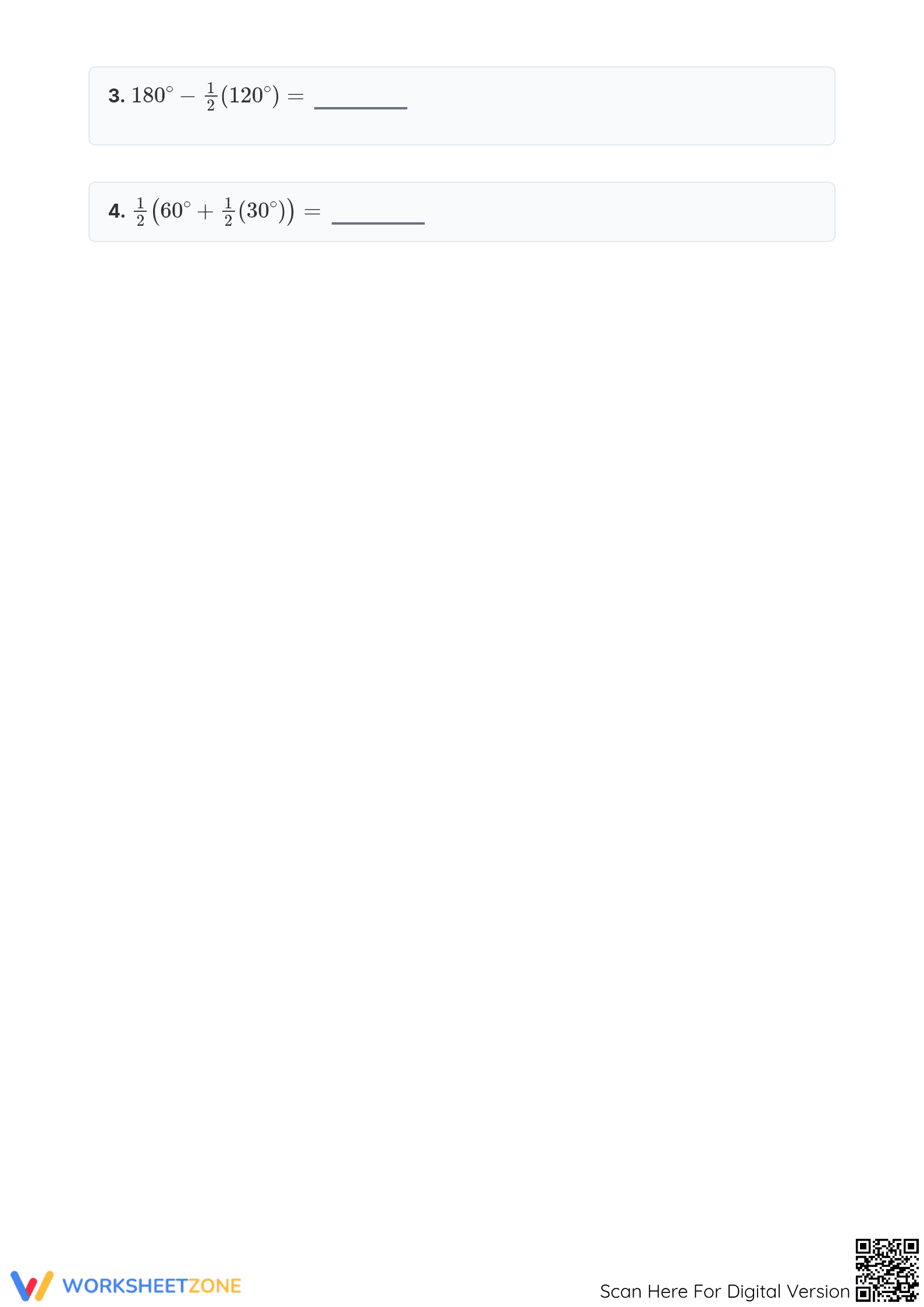
This 2-page PDF features 9 targeted problems designed to bridge the gap between geometry and algebra. Part 1 includes a matching table where students link 5 specific angle values to their corresponding bisector construction expressions. Part 2 provides 4 evaluation tasks requiring students to solve multi-step equations involving halves and sums of angles. A full answer key is provided for immediate feedback and grading efficiency.
Zero-Prep Workflow
- Print: Select the 2-page PDF and print enough copies for your class (approx. 30 seconds).
- Distribute: Hand out the sheets as a bell-ringer, warm-up, or exit ticket during your geometry unit (approx. 30 seconds).
- Review: Use the included answer key to review results as a whole group or allow students to self-correct their work (approx. 1 minute).
Standards Alignment
The primary focus is CCSS.MATH.CONTENT.7.G.B.5: "Use facts about supplementary, complementary, vertical, and adjacent angles in a multi-step problem to write and solve simple equations for an unknown angle in a figure." This worksheet specifically targets the "equations for an unknown angle" aspect by using bisector logic. Both standard codes can be copied directly into lesson plans, IEP goals, or district curriculum mapping tools.
How to Use It
Assign this worksheet during the "You Do" phase of a lesson on geometric constructions. It serves as an excellent bridge between physical compass work and abstract mathematical reasoning. For a formative assessment, observe if students correctly interpret the fraction 1/2 as the bisecting action. Expected completion time is 15 to 20 minutes, making it perfect for a focused mid-lesson check.
Who It's For
This resource is built for general education students in grades 7-9, but it also supports high school geometry students needing a refresher on construction logic. It pairs naturally with a protractor demonstration or an anchor chart showing common angle partitions. It is particularly effective for visual learners who benefit from seeing the numerical representation of geometric splits alongside the terminology.
According to the RAND AIRS 2024 report on secondary mathematics, the integration of algebraic expressions within geometric contexts significantly improves student retention of spatial concepts. This worksheet applies that research by requiring students to translate the physical act of bisecting an angle into a mathematical expression. By mastering CCSS.MATH.CONTENT.7.G.B.5 through these 9 structured tasks, students move beyond rote memorization toward conceptual mastery of angle relationships. The plain-English skill focus here is the ability to calculate unknown angle values resulting from bisection and addition. Research from Fisher & Frey (2014) suggests that this type of scaffolded evaluation helps bridge the gap between concrete manipulation and abstract geometric proof. Educators can use this resource to provide the rigorous practice necessary for high-stakes testing while maintaining a low-barrier entry point for diverse learners in middle and high school settings.


