


























Views
Downloads

Angles of Elevation & Depression Worksheet | Essential Trig
Paste this activity's link or code into your existing LMS (Google Classroom, Canvas, Teams, Schoology, Moodle, etc.).
Students can open and work on the activity right away, with no student login required.
You'll still be able to track student progress and results from your teacher account.
This comprehensive Geometry worksheet guides students through the essential concepts of angles of elevation and depression. By applying trigonometric ratios to real-world scenarios, learners build the spatial reasoning necessary to solve complex right-triangle problems. Students move from vocabulary mastery to multi-step challenge problems, ensuring a deep understanding of trigonometry in distance calculations.
At a Glance
- Grade: 9 · Subject: Geometry
- Standard:
HSG-SRT.C.8— Use trigonometric ratios to solve right triangles in applied problems- Skill Focus: Angles of Elevation and Depression
- Format: 4 pages · 9 problems · Answer key included · PDF
- Best For: High school trigonometry unit practice
- Time: 45–60 minutes
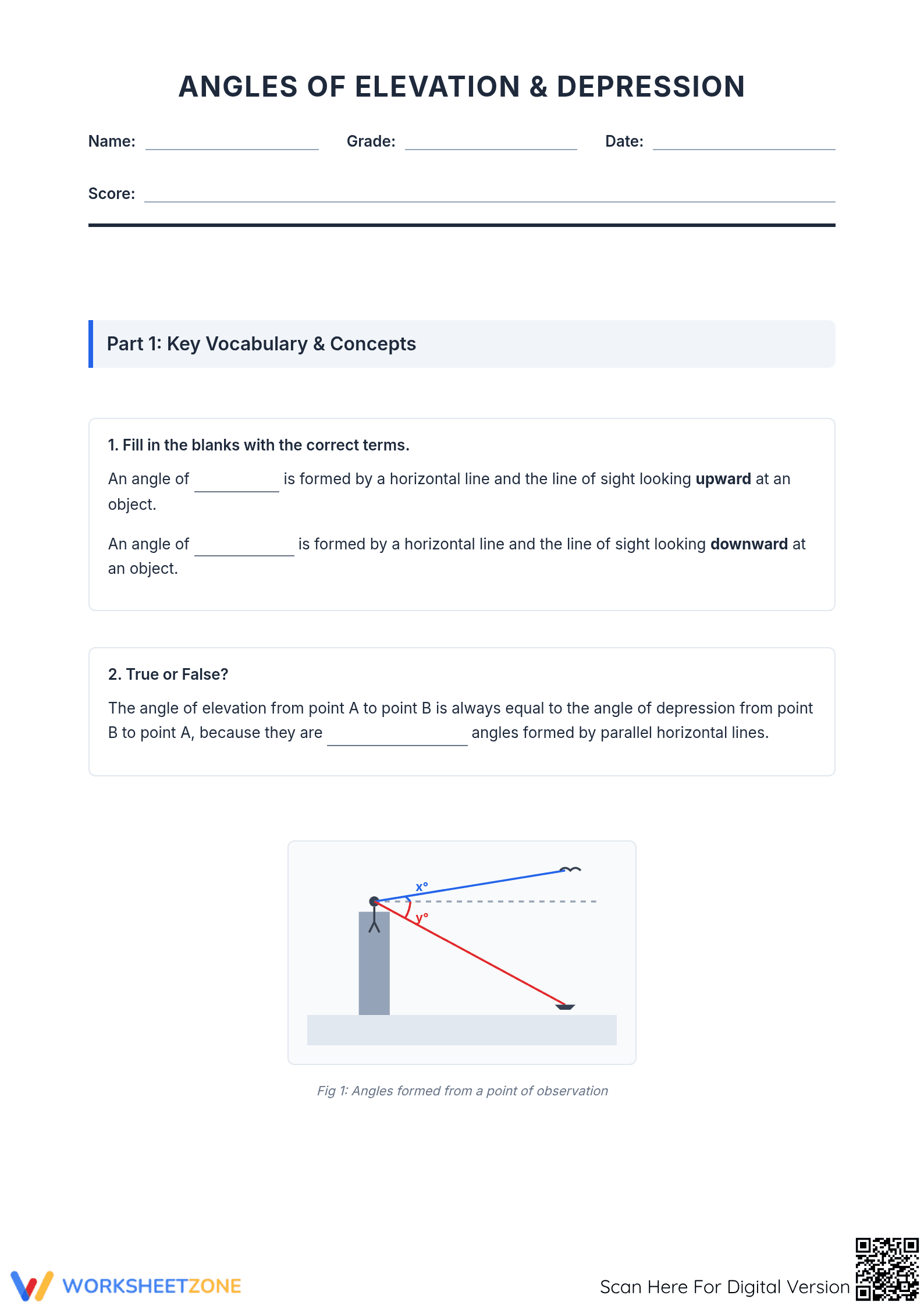
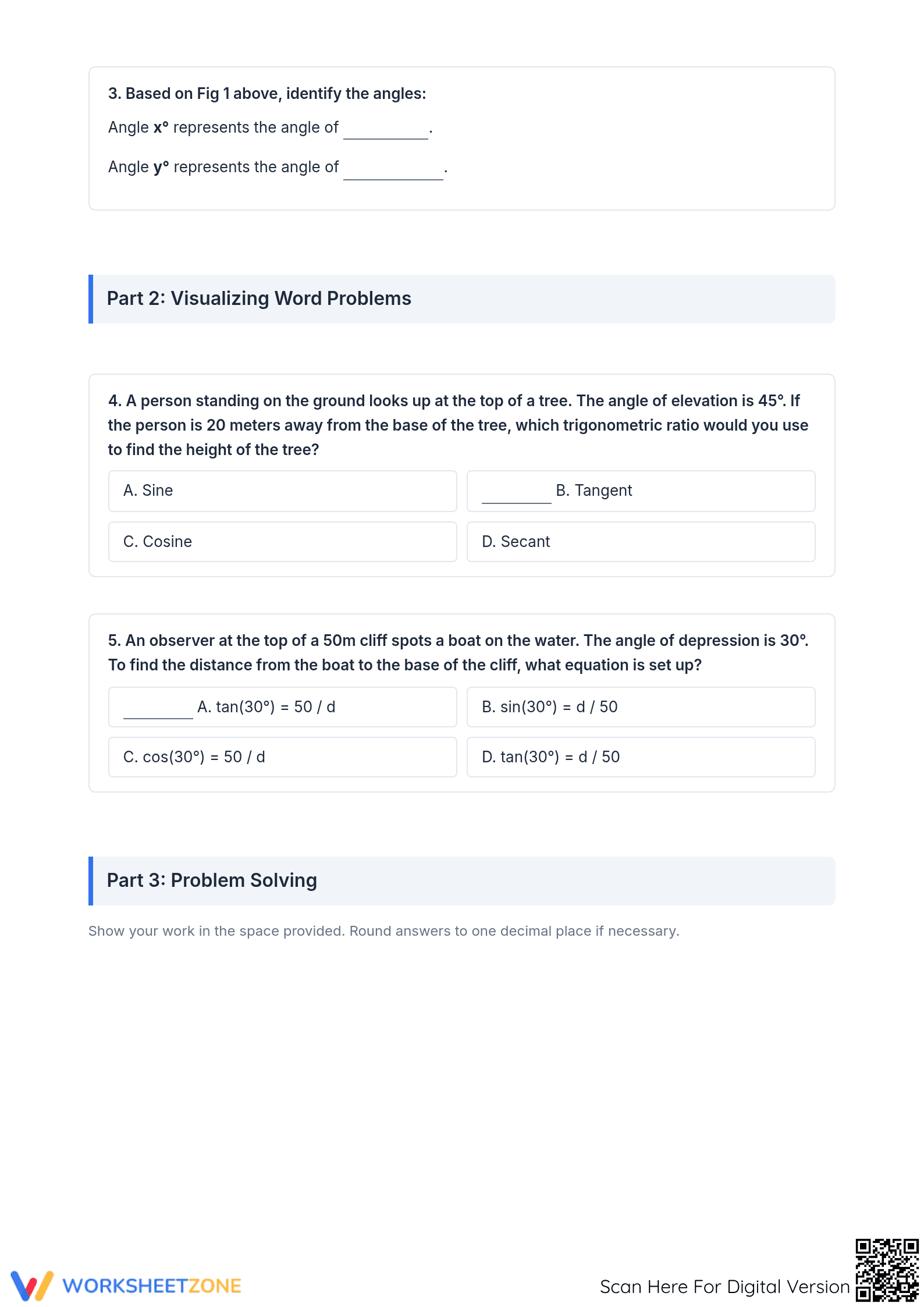
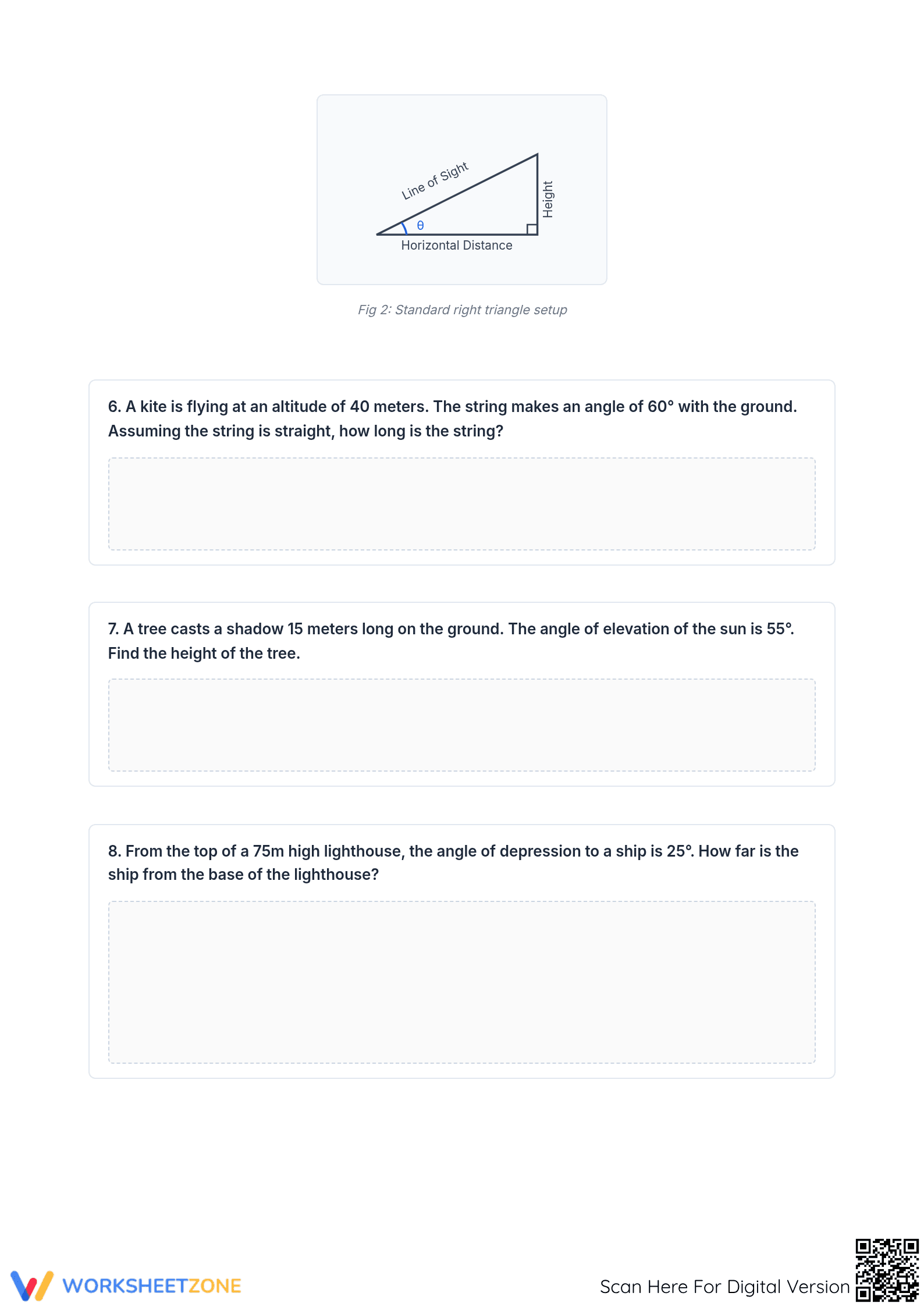
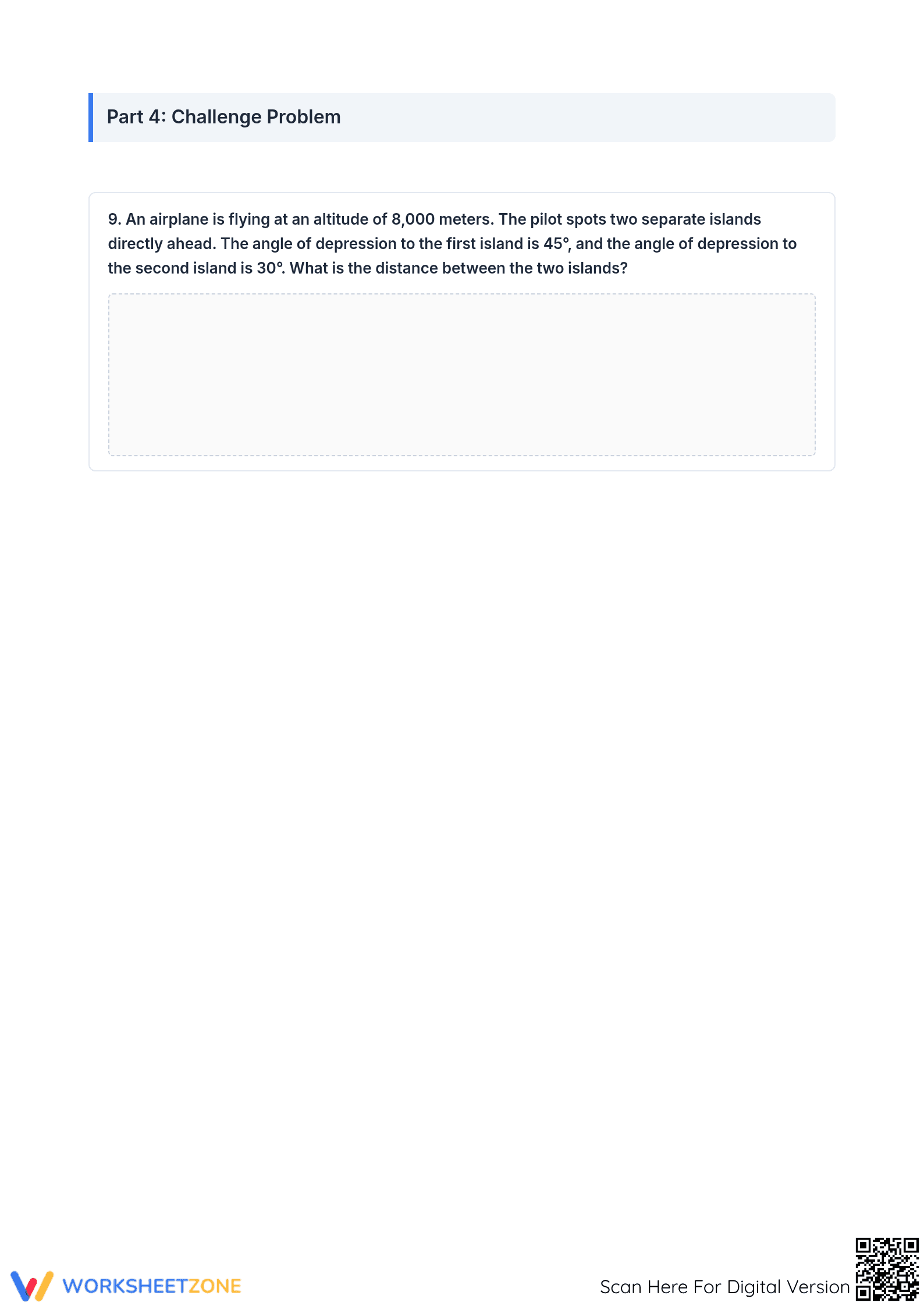
This 4-page resource is divided into four logical parts. Part 1 focuses on key vocabulary and conceptual identification using clear diagrams. Part 2 transitions to visualizing word problems through multiple-choice equation setup. Part 3 provides open-ended problem-solving spaces for calculations involving shadows, altitudes, and distances. Finally, Part 4 presents a multi-step challenge problem requiring advanced geometric reasoning.
Skill Progression
- Guided Practice: The first section uses fill-in-the-blank and diagram identification (3 tasks) to scaffold the conceptual difference between elevation and depression.
- Supported Practice: Middle sections provide multiple-choice scaffolds (2 tasks) to help students identify the correct trigonometric ratio (Sine, Cosine, or Tangent).
- Independent Practice: The final pages require students to sketch triangles and solve 4 complex word problems without prompts.
This sequence follows the gradual-release model, transitioning students from simple recognition to complex independent application.
Standards Alignment
This worksheet is strictly aligned to `HSG-SRT.C.8`, which requires students to use trigonometric ratios and the Pythagorean Theorem to solve right triangles in applied problems. By calculating heights and distances, students demonstrate mastery of sine, cosine, and tangent. This standard code can be copied directly into lesson plans, IEP goals, or district curriculum mapping tools.
How to Use It
Use this as a primary practice set after introducing SOH CAH TOA and the concepts of horizontal lines of sight. It serves as an excellent formative assessment halfway through a trigonometry unit; teachers should observe if students correctly place the angle of depression. Expect a 50-minute completion time. It can also be used for remedial high school algebra review or test preparation.
Who It's For
Designed for Grade 9 Geometry students, this resource is also suitable for advanced Grade 8 learners or high school physics students. It pairs perfectly with an interactive whiteboard demonstration of clinometers or an anchor chart showing parallel lines. The clear labeling makes it accessible for students needing visual scaffolds in mathematics.
According to the NAEP 2024 analysis, applied trigonometry is a critical gateway skill for STEM career readiness, yet students often struggle with transitioning from abstract ratios to real-world modeling. This worksheet addresses this gap by requiring students to decode standard `HSG-SRT.C.8` through systematic visualization. By explicitly separating the "visualization" phase from the "calculation" phase, the resource reduces cognitive load and allows learners to focus on the geometric relationship between the observer and the object. Research from ScienceDirect TpT Analysis indicates that multi-page scaffolds involving sketch-based problem solving significantly improve long-term retention compared to repetitive calculation drills. This 9-task set provides the structured repetition necessary for mastery, ensuring students can independently calculate heights and distances in any applied context using appropriate trigonometric functions. A complete answer key is included to support self-correction and teacher efficiency.


