




























Views
Downloads


Angle Relationship Worksheet | Essential Grade 7 Math

Paste this activity's link or code into your existing LMS (Google Classroom, Canvas, Teams, Schoology, Moodle, etc.).
Students can open and work on the activity right away, with no student login required.
You'll still be able to track student progress and results from your teacher account.
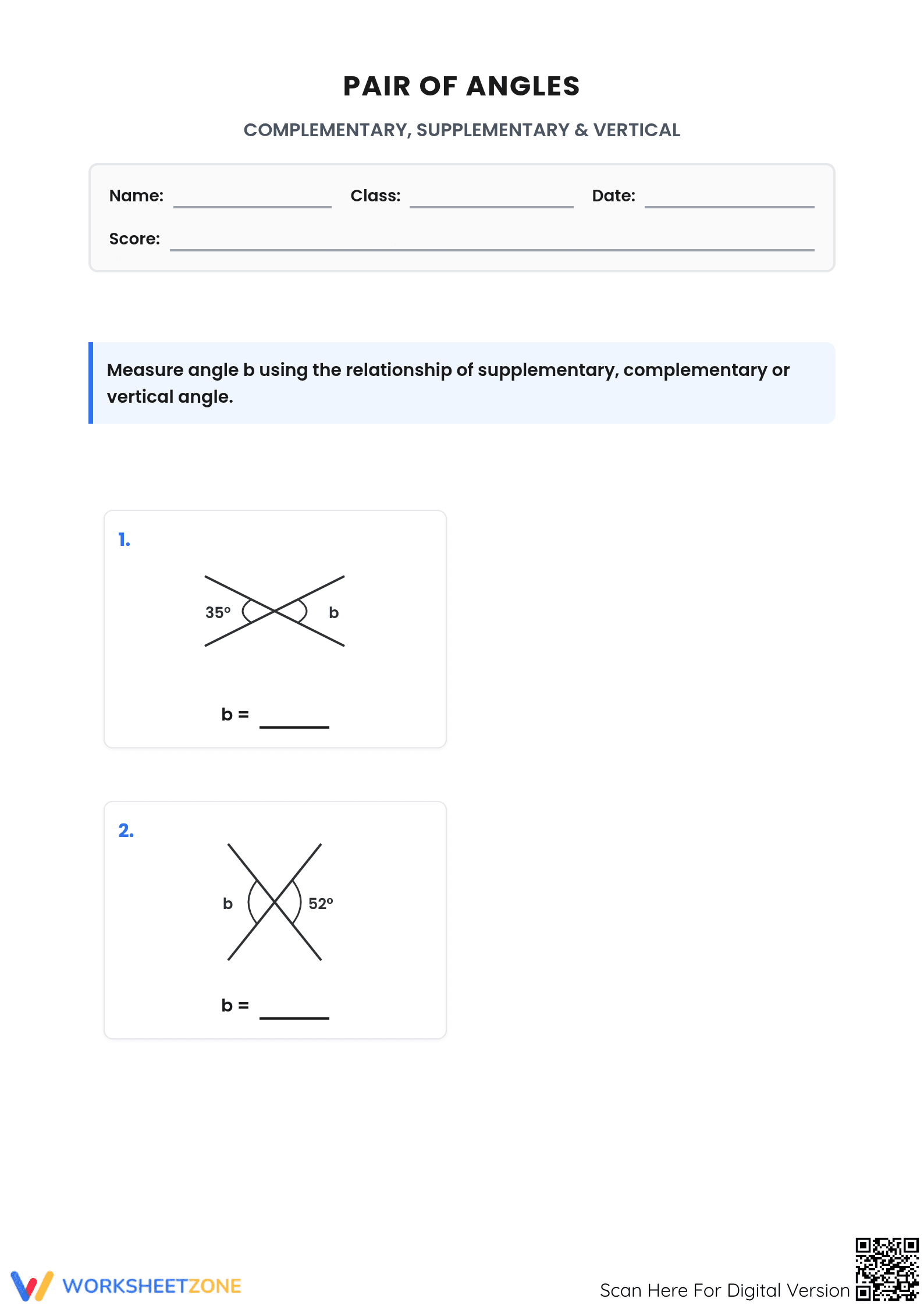
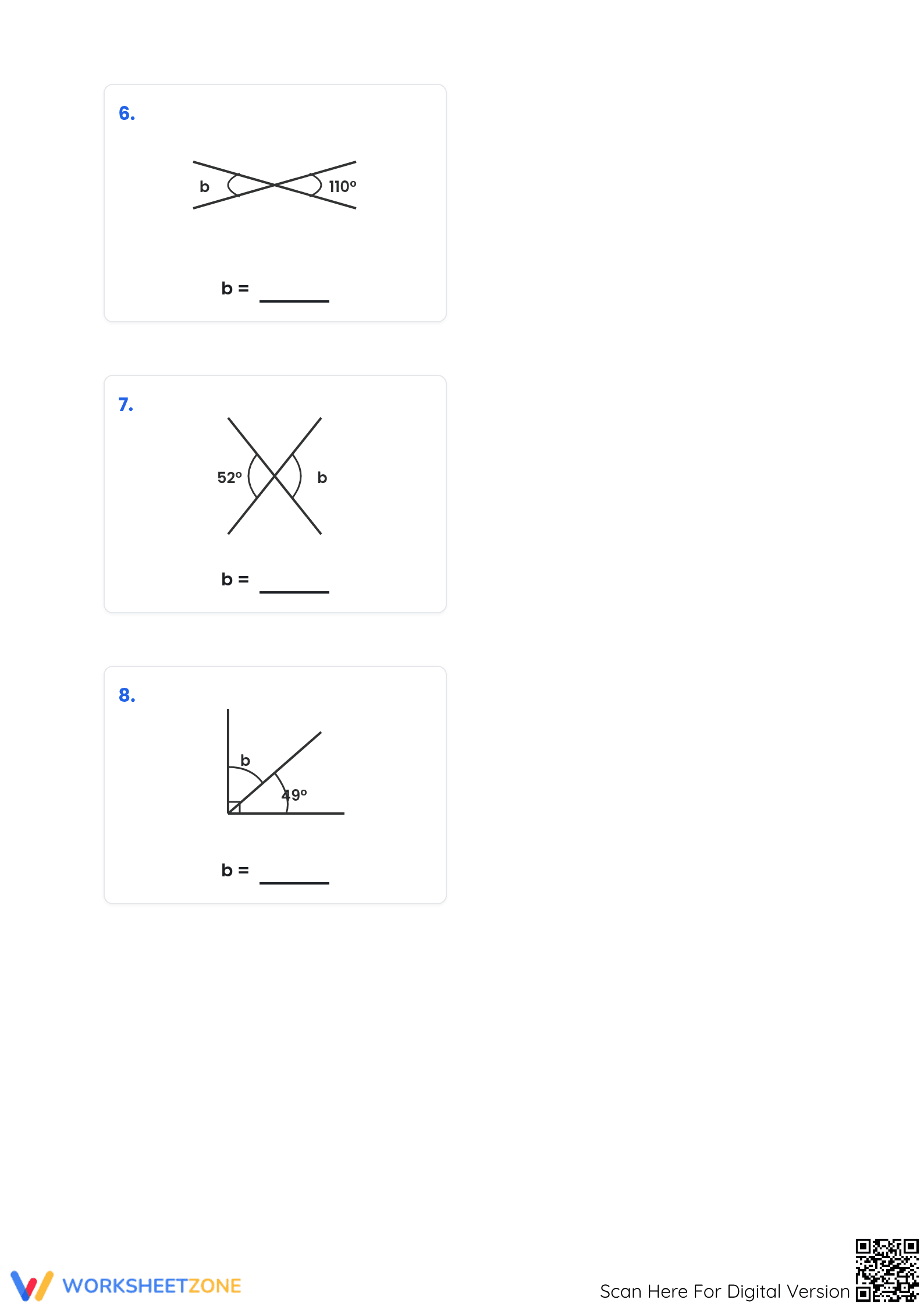
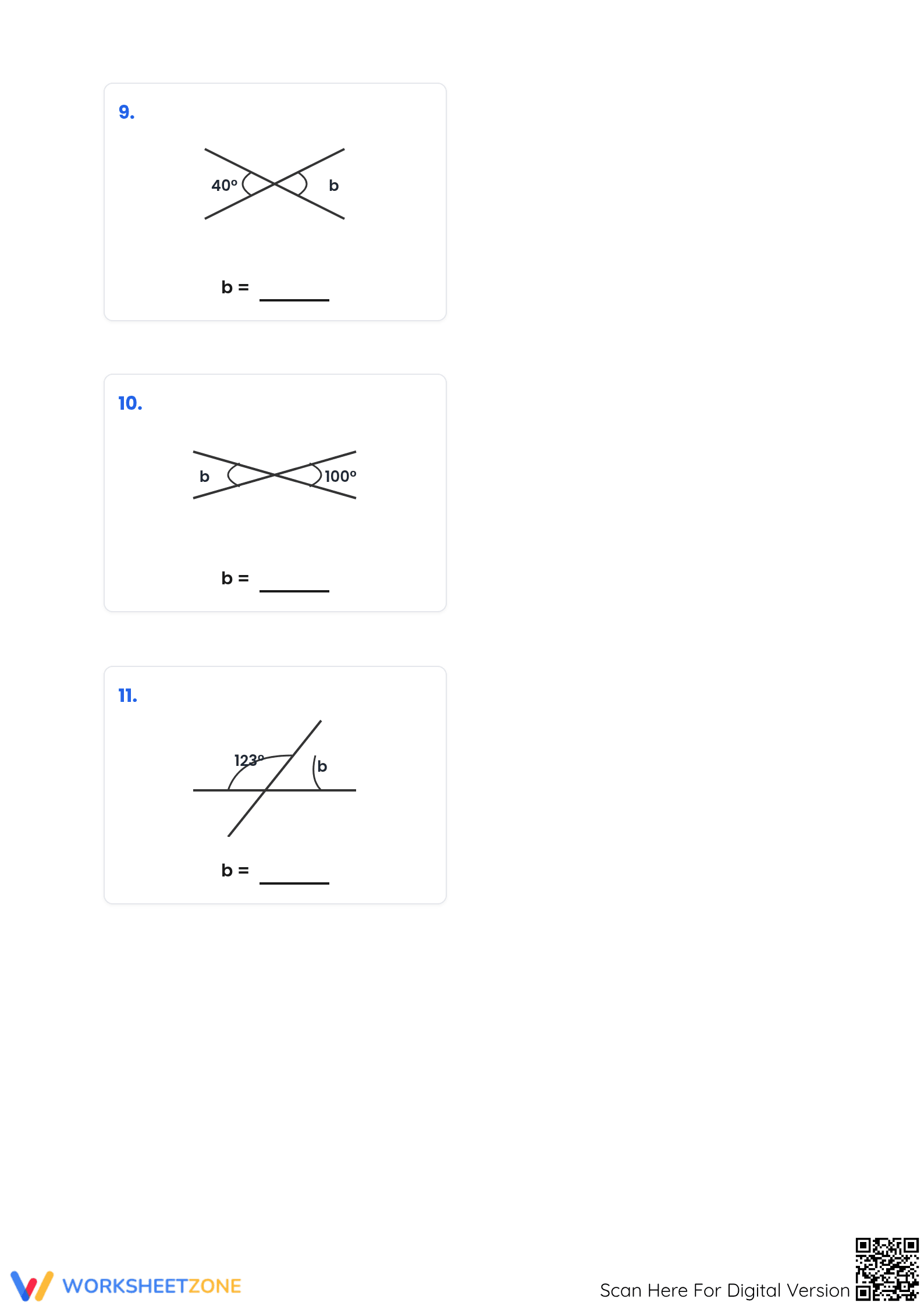
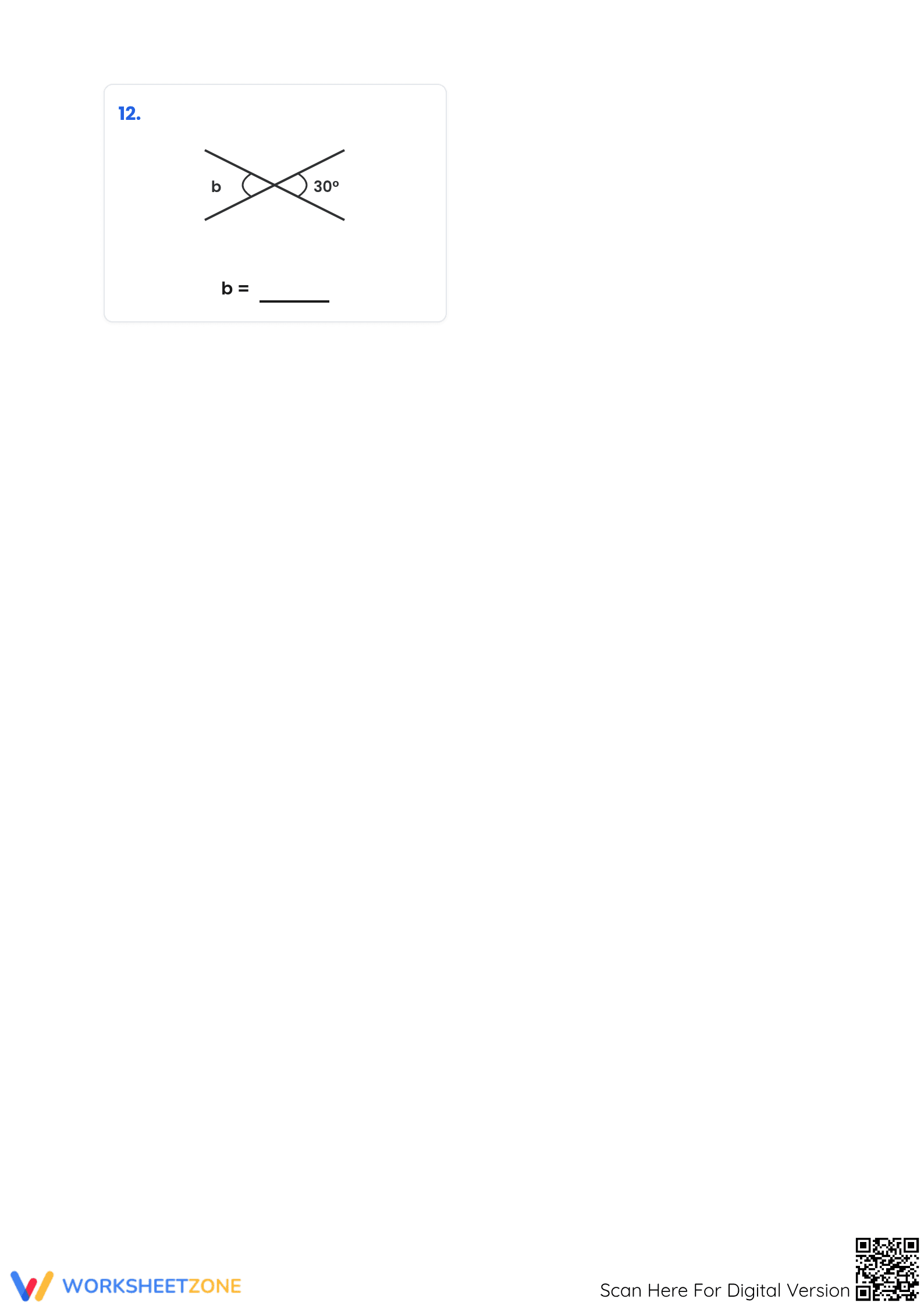
This comprehensive Grade 7 math worksheet helps students master geometric reasoning by identifying and calculating unknown angle measures. By applying properties of complementary, supplementary, and vertical angles, learners develop the spatial logic required for advanced geometry. This resource ensures students can solve for variable 'b' with accuracy and confidence in every problem.
At a Glance
- Grade: 7 · Subject: Math
- Standard:
CCSS.MATH.CONTENT.7.G.B.5— Use angle facts to write and solve equations for unknown angles in figures- Skill Focus: Angle Relationships
- Format: 5 pages · 12 problems · Answer key included · PDF
- Best For: Independent practice and formative assessment
- Time: 20–30 minutes
This 5-page PDF contains 12 distinct geometric diagrams where students must determine the value of angle 'b'. The worksheet covers vertical angles, linear pairs (supplementary), and right-angle relationships (complementary). Each page features clear, high-contrast diagrams with labeled degrees to minimize visual confusion. A full 5-page answer key is provided, mirroring the worksheet layout for rapid grading and student self-correction.
Zero-Prep Workflow
- Print: Select the specific pages needed for your lesson; the high-resolution PDF ensures crisp diagrams on any school printer (30 seconds).
- Distribute: Hand out the 12-problem set as a warm-up or independent practice session during your geometry unit (1 minute).
- Review: Use the included answer key to provide immediate feedback or display it on a projector for whole-class verification (1 minute).
Standards Alignment
The primary focus is CCSS.MATH.CONTENT.7.G.B.5, which requires students to use facts about supplementary, complementary, vertical, and adjacent angles in a multi-step problem to write and solve simple equations for an unknown angle in a figure. This worksheet provides the foundational visual practice necessary before moving into complex algebraic equations. Both standard codes can be copied directly into lesson plans, IEP goals, or district curriculum mapping tools.
How to Use It
Use this resource as a "Check for Understanding" immediately following direct instruction on angle pairs. It serves as an excellent formative assessment to identify students who struggle with the visual distinction between vertical and supplementary relationships. Alternatively, assign it as a structured homework task to reinforce geometric vocabulary and calculation skills. Expect students to complete the 12 problems in approximately 25 minutes.
Who It's For
This resource is designed for Grade 7 students but is highly effective for Grade 8 review or Grade 6 enrichment. It is particularly helpful for English Language Learners who benefit from the heavy visual scaffolding of the diagrams. Pair this worksheet with a protractor exploration activity or a digital geometry tool like GeoGebra to bridge the gap between measurement and calculation.
This Grade 7 geometry resource targets the mastery of CCSS.MATH.CONTENT.7.G.B.5 by requiring students to apply geometric theorems to find unknown measures. According to the RAND AIRS 2024 report on instructional materials, high-quality visual representations in mathematics are critical for reducing cognitive load during the acquisition of spatial reasoning skills. By isolating complementary, supplementary, and vertical angle relationships across 12 targeted tasks, this worksheet provides the repetitive, focused practice necessary for long-term retention. Research from Fisher & Frey (2014) emphasizes that gradual release of responsibility is most effective when students engage with clear, scaffolded diagrams that mirror real-world geometric configurations. This resource bridges the gap between conceptual understanding and procedural fluency, ensuring that middle school learners can accurately navigate complex figures. Educators can use these 5 pages to provide evidence of student progress toward state-mandated geometry benchmarks and proficiency standards.


