


























Views
Downloads

Essential Angle Properties Worksheet | Grade 8-10 Ready
Paste this activity's link or code into your existing LMS (Google Classroom, Canvas, Teams, Schoology, Moodle, etc.).
Students can open and work on the activity right away, with no student login required.
You'll still be able to track student progress and results from your teacher account.
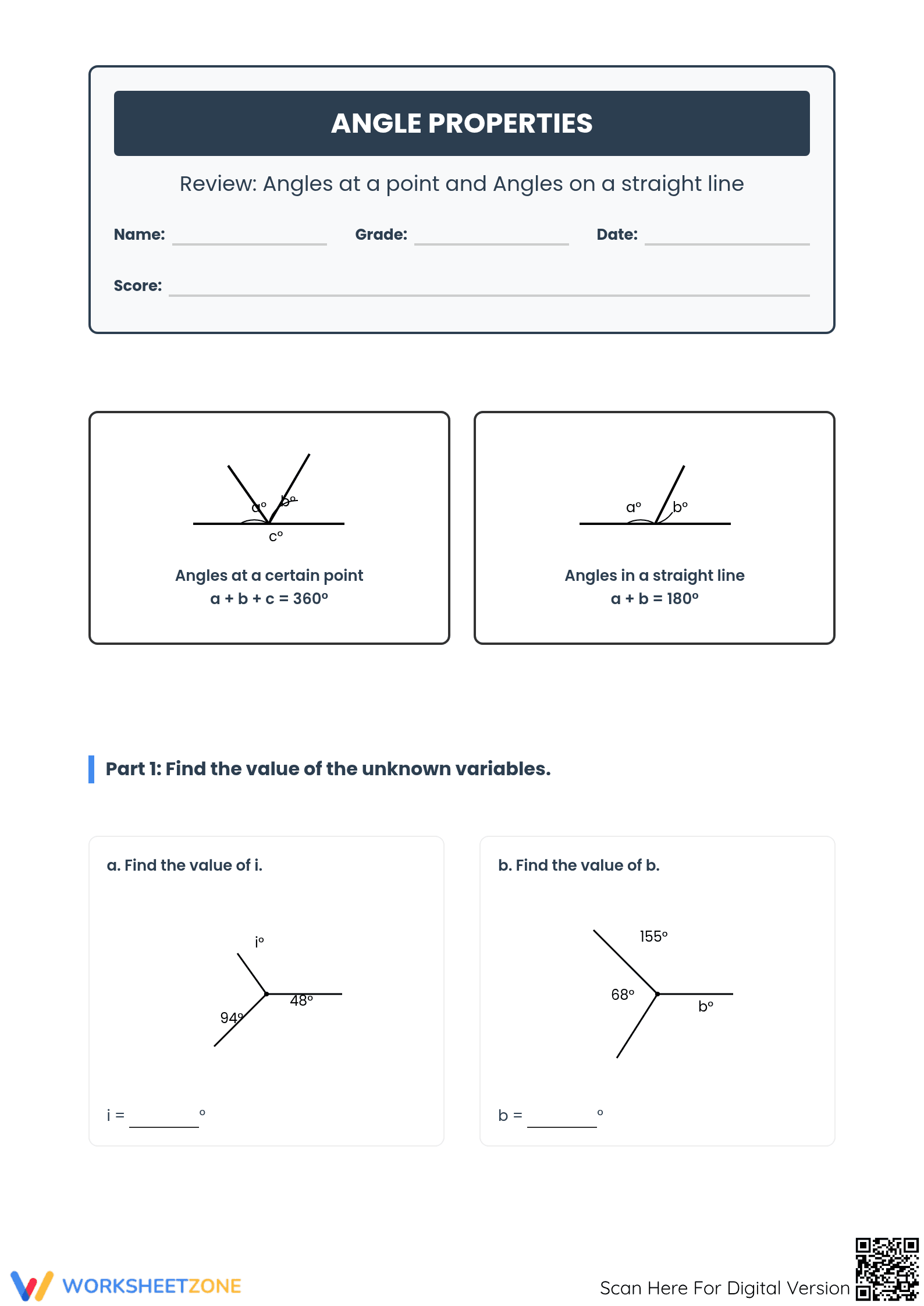
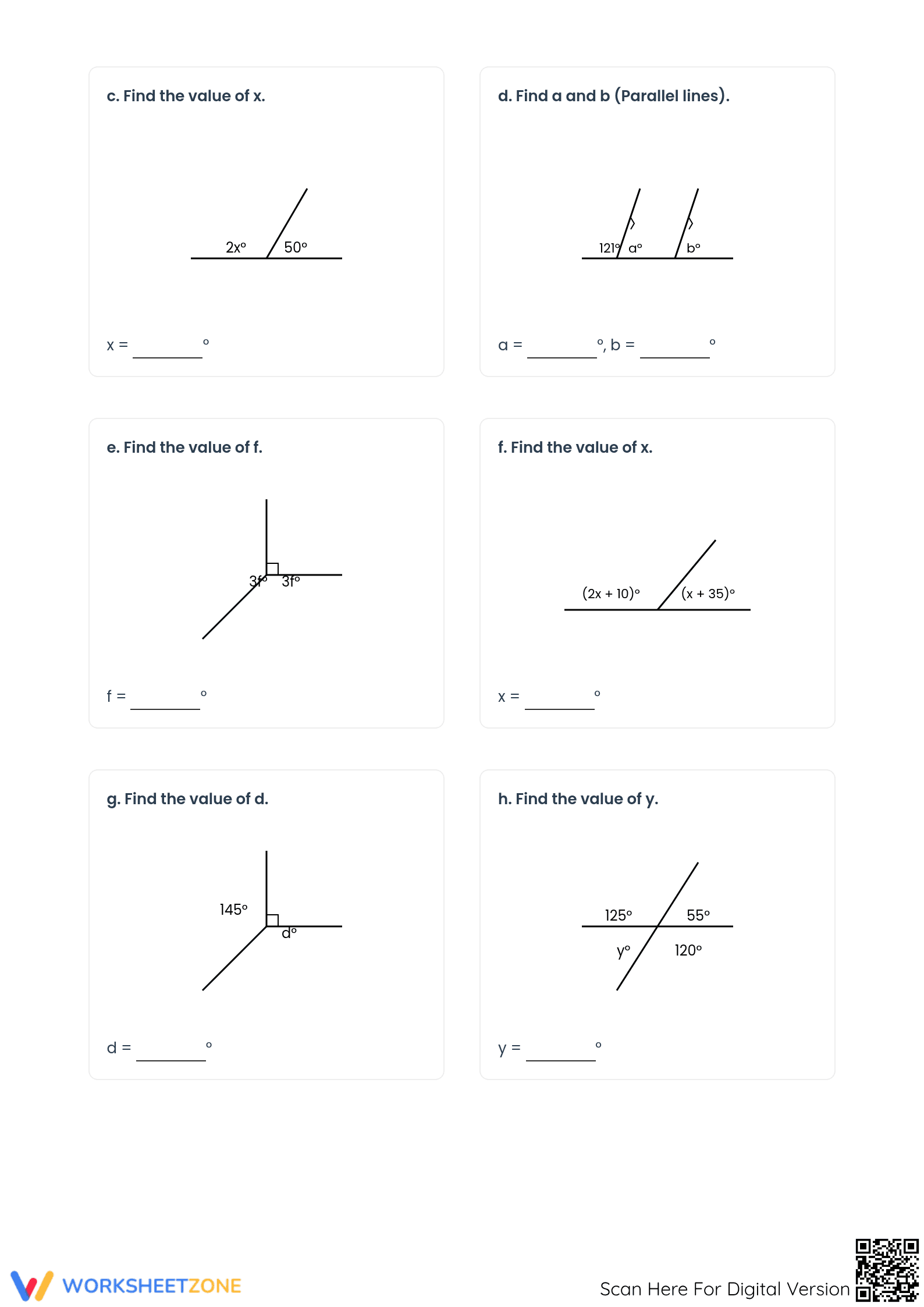
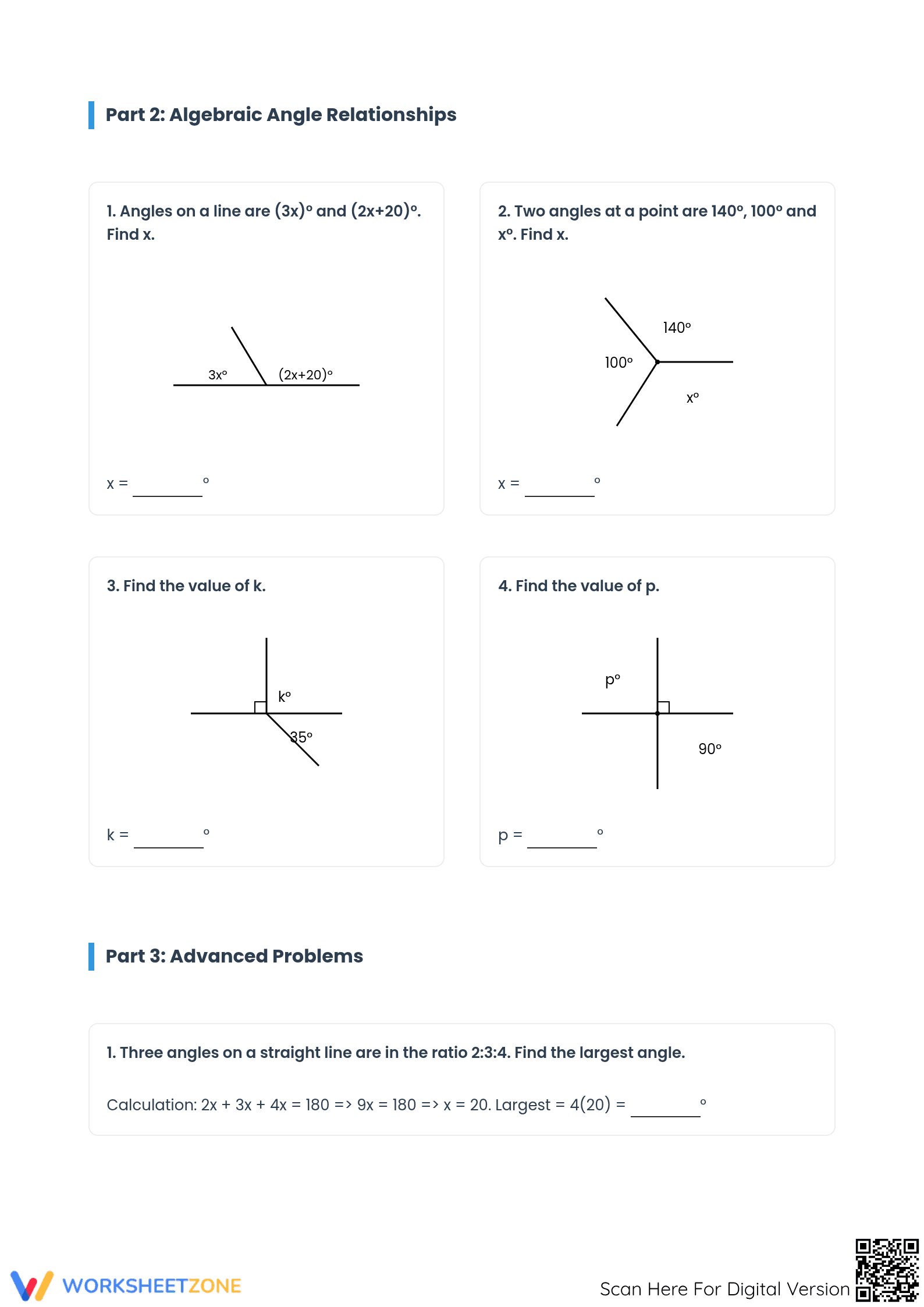
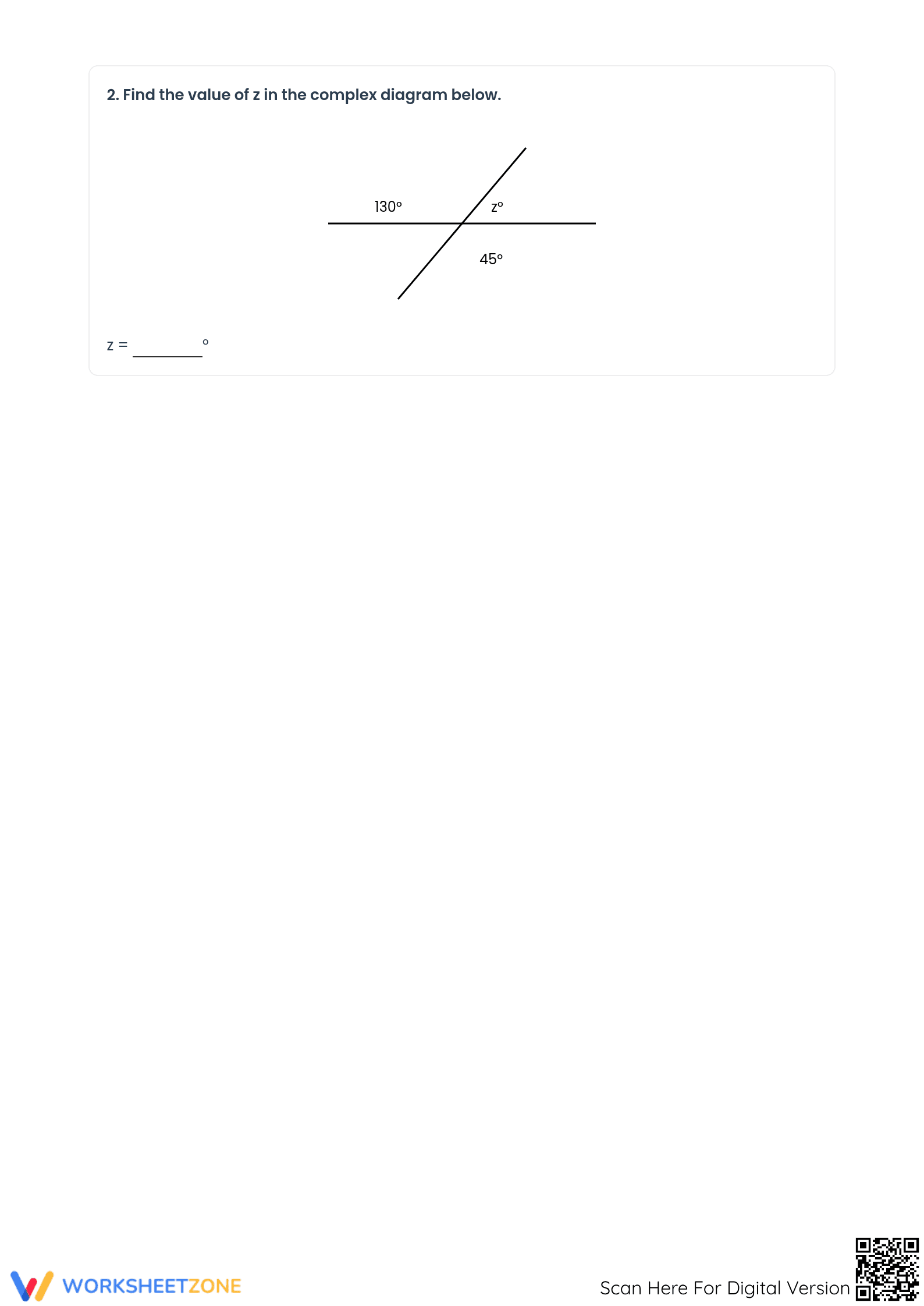
This Essential Angle Properties worksheet provides a comprehensive review of fundamental geometric principles, focusing on angles on a straight line and angles at a point. Students will calculate missing values using both numerical data and algebraic expressions, ensuring a deep understanding of spatial relationships and equation-solving within a geometric context. It is a perfect tool for achieving mastery.
At a Glance
- Grade: 8–10 · Subject: Math
- Standard:
CCSS.MATH.CONTENT.8.G.A.5— Use geometric properties to calculate unknown angles in complex diagrams and equations- Skill Focus: Angle relationships on lines and at points
- Format: 4 pages · 14 problems · Answer key included · PDF
- Best For: Independent practice or sub plans
- Time: 30–45 minutes
What's Inside
This 4-page PDF resource includes a structured progression of tasks designed to build student confidence. It begins with a clear visual review of core properties—specifically that angles on a straight line sum to 180 degrees and angles at a point sum to 360 degrees. The worksheet contains 14 distinct problems, ranging from simple one-step calculations to complex algebraic relationships and ratio-based challenges. A complete answer key is provided for immediate feedback.
Zero-Prep Workflow
- Print: Generate copies in under 60 seconds for the entire class.
- Distribute: Hand out to students for an immediate start; no extra tools required.
- Review: Grade or peer-review using the comprehensive answer key in less than two minutes.
The integrated review section serves as a built-in anchor chart, allowing students to work independently without teacher intervention, making it ideal for sub plans.
Standards Alignment
The primary focus of this worksheet is `CCSS.MATH.CONTENT.8.G.A.5`, which requires students to use informal arguments and geometric facts to establish relationships between angles. By requiring students to set up and solve equations based on angle properties, the resource also supports high school geometry standards involving line and angle proofs. Both standard codes can be copied directly into lesson plans, IEP goals, or district curriculum mapping tools.
How to Use It
Use this worksheet as a formative assessment during a unit on geometry or as a targeted intervention for students struggling with algebraic applications. For best results, assign the first two pages as guided practice, then use the advanced problems on pages three and four as independent mastery checks. Observe how students translate visual diagrams into algebraic equations to identify any misconceptions about variable manipulation. Completion typically takes 35 minutes.
Who It's For
This resource is designed for Grade 8 through Grade 10 students who are mastering geometric logic. It is particularly useful for learners who need a bridge between basic geometry and coordinate algebra. The inclusion of worked examples and clear diagrams supports English Language Learners and students with IEPs by providing visual scaffolds. It pairs naturally with a lesson on transversal lines or a geometry software demonstration.
Aligned to CCSS.MATH.CONTENT.8.G.A.5, this worksheet targets the critical skill of calculating unknown angles using geometric properties and algebraic reasoning. Research from Fisher & Frey (2014) emphasizes the importance of the gradual release of responsibility model, which is mirrored here through the progression from simple numerical tasks to complex ratio and algebraic challenges. By integrating spatial reasoning with symbolic representation, the worksheet helps students internalize the 180-degree and 360-degree constants necessary for higher-level trigonometry and calculus. Data from NAEP indicates that students who regularly practice multi-step geometric problem-solving show significantly higher proficiency in spatial visualization tasks. This 4-page document ensures students move beyond rote memorization into active application of mathematical theorems. It serves as a robust evidence-based tool for achieving standards-based mastery in middle and high school mathematics curricula.


