




























1 / 2
0
Views
0
Downloads


0.0
0
Save
0 Likes
Share
Anatomy of the Composite Cell Worksheet
0 Views
0 Downloads

Paste this activity's link or code into your existing LMS (Google Classroom, Canvas, Teams, Schoology, Moodle, etc.).
Students can open and work on the activity right away, with no student login required.
You'll still be able to track student progress and results from your teacher account.
Information
Description
What It Is:
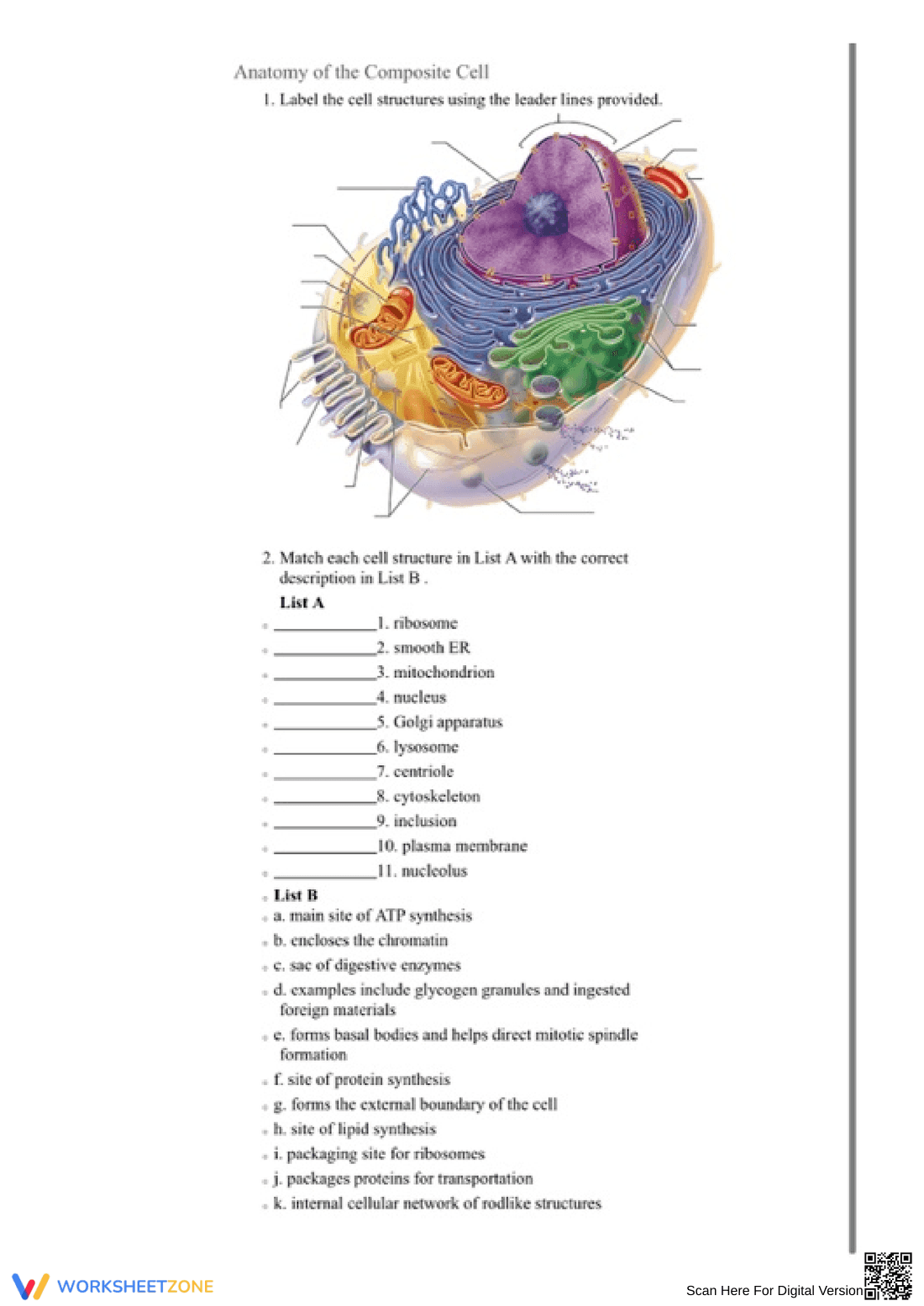
This is an educational worksheet focusing on the anatomy of a composite cell. The worksheet contains two activities: labeling cell structures using provided leader lines pointing to a cell diagram, and matching cell structures from a list (List A) with their correct descriptions from another list (List B). List A includes terms like ribosome, smooth ER, mitochondrion, nucleus, Golgi apparatus, lysosome, centriole, cytoskeleton, inclusion, plasma membrane, and nucleolus. List B contains descriptions like 'main site of ATP synthesis,' 'encloses the chromatin,' 'sac of digestive enzymes,' 'examples include glycogen granules and ingested foreign materials,' 'forms basal bodies and helps direct mitotic spindle formation,' 'site of protein synthesis,' 'forms the external boundary of the cell,' 'site of lipid synthesis,' 'packaging site for ribosomes,' 'packages proteins for transportation,' and 'internal cellular network of rodlike structures.'
Grade Level Suitability:
This worksheet is suitable for grades 9-12 (high school) and introductory college biology courses. The complexity of the cell structures and their functions requires a solid foundation in biology concepts.
Why Use It:
This worksheet reinforces understanding of cell structure and function through visual identification and matching exercises. It promotes active learning and helps students connect cell parts with their specific roles within the cell. It enhances vocabulary related to cell biology and critical thinking skills.
How to Use It:
First, students should label the cell diagram by identifying the structures pointed to by the leader lines. Next, students should match each cell structure in List A with its corresponding description in List B, writing the letter of the correct description in the blank space provided next to each item in List A.
Target Users:
This worksheet is designed for high school biology students, introductory college biology students, and teachers looking for supplemental materials to reinforce cell biology concepts. It is also useful for students preparing for biology exams.
This is an educational worksheet focusing on the anatomy of a composite cell. The worksheet contains two activities: labeling cell structures using provided leader lines pointing to a cell diagram, and matching cell structures from a list (List A) with their correct descriptions from another list (List B). List A includes terms like ribosome, smooth ER, mitochondrion, nucleus, Golgi apparatus, lysosome, centriole, cytoskeleton, inclusion, plasma membrane, and nucleolus. List B contains descriptions like 'main site of ATP synthesis,' 'encloses the chromatin,' 'sac of digestive enzymes,' 'examples include glycogen granules and ingested foreign materials,' 'forms basal bodies and helps direct mitotic spindle formation,' 'site of protein synthesis,' 'forms the external boundary of the cell,' 'site of lipid synthesis,' 'packaging site for ribosomes,' 'packages proteins for transportation,' and 'internal cellular network of rodlike structures.'
Grade Level Suitability:
This worksheet is suitable for grades 9-12 (high school) and introductory college biology courses. The complexity of the cell structures and their functions requires a solid foundation in biology concepts.
Why Use It:
This worksheet reinforces understanding of cell structure and function through visual identification and matching exercises. It promotes active learning and helps students connect cell parts with their specific roles within the cell. It enhances vocabulary related to cell biology and critical thinking skills.
How to Use It:
First, students should label the cell diagram by identifying the structures pointed to by the leader lines. Next, students should match each cell structure in List A with its corresponding description in List B, writing the letter of the correct description in the blank space provided next to each item in List A.
Target Users:
This worksheet is designed for high school biology students, introductory college biology students, and teachers looking for supplemental materials to reinforce cell biology concepts. It is also useful for students preparing for biology exams.


