


























Views
Downloads

Kidney Anatomy Worksheet | Printable Grade 10-12 Science
Paste this activity's link or code into your existing LMS (Google Classroom, Canvas, Teams, Schoology, Moodle, etc.).
Students can open and work on the activity right away, with no student login required.
You'll still be able to track student progress and results from your teacher account.
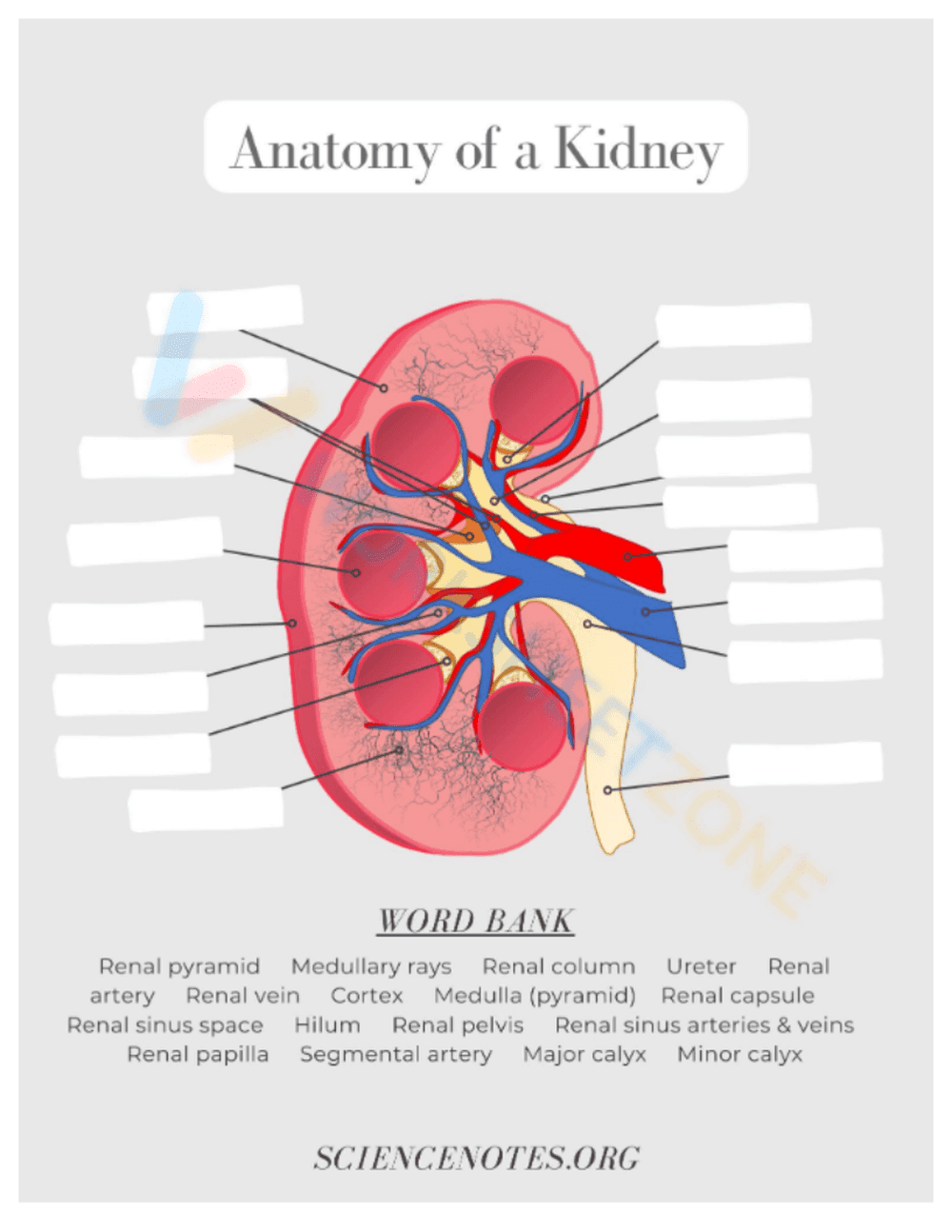
This high school biology worksheet provides students with a detailed diagram to master kidney anatomy. By matching anatomical terms from a word bank to their correct locations, learners solidify their understanding of the excretory system.
At a Glance
- Grade: 10 · Subject: Biology
- Standard:
HS-LS1-2— Illustrate the hierarchical organization of interacting systems providing specific functions.- Skill Focus: Labeling kidney anatomy
- Format: 1 printable page · 17 labeling problems · Answer key included · PDF
- Best For: Independent practice, review, and sub plans
- Time: 15–20 minutes of focused work
What's Inside
Inside this single-page resource, educators will find a full-color illustration of a cross-sectioned human kidney. The diagram features 17 blank labels pointing to critical structures like the renal pelvis, cortex, and medulla. A 17-term word bank provides necessary scaffolding, and a complete answer key ensures accurate grading.
Zero-Prep Workflow
This resource is designed for maximum efficiency with a zero-prep workflow:
- Print (1 min): Download the PDF and print a class set.
- Distribute (1 min): Hand out as a bell-ringer or homework task.
- Review (3 mins): Use the answer key to quickly check student work.
With total teacher prep time under two minutes, this is an excellent option for sub plans.
Standards Alignment
This activity aligns to HS-LS1-2, requiring students to develop a model illustrating the hierarchical organization of interacting systems that provide specific functions. By identifying specific tissues, students build foundational knowledge of how this organ filters blood. Both standard codes can be copied directly into lesson plans, IEP goals, or district curriculum mapping tools.
How to Use It
Deploy this diagram during direct instruction as a guided note-taking tool, or use it as a post-instruction formative assessment. As students work, observe whether they can distinguish between the renal artery and vein based on entry points. Expected completion time is 15 to 20 minutes.
Who It's For
Designed for high school biology and anatomy students, this resource includes a word bank that provides built-in differentiation for English Language Learners. It pairs perfectly with a direct instruction lesson on the excretory system or a dissection lab.
Mastering anatomical terminology is a critical step in developing scientific literacy and understanding complex physiological processes. According to a ScienceDirect TpT Analysis, visual modeling and diagram labeling significantly improve long-term retention of spatial relationships within biological systems. When students actively engage with a visual representation, such as this detailed kidney diagram, they bridge the gap between abstract concepts and concrete biological structures. This specific task supports HS-LS1-2 by requiring learners to illustrate the organization of interacting systems providing specific functions. By systematically identifying components like the renal cortex, medulla, and ureter, students construct a robust mental model of how these individual parts collaborate to filter waste and regulate fluid balance. Providing structured vocabulary practice alongside high-quality anatomical illustrations ensures that learners build the foundational knowledge necessary for advanced scientific inquiry and future coursework in the health sciences.


