




























Views
Downloads

Printable Heart Anatomy Worksheet | Grade 10 Biology

Paste this activity's link or code into your existing LMS (Google Classroom, Canvas, Teams, Schoology, Moodle, etc.).
Students can open and work on the activity right away, with no student login required.
You'll still be able to track student progress and results from your teacher account.
This Grade 10 biology worksheet provides students with a clear, visual method to identify and label the major structures of the human heart. By matching terms from a comprehensive word bank to specific anatomical locations, learners reinforce their understanding of cardiovascular organization and blood flow pathways.
At a Glance
- Grade: 10 · Subject: Biology
- Standard:
HS-LS1-2— Illustrate interacting systems providing specific functions- Skill Focus: Heart anatomy labeling
- Format: 1 page · 14 problems · Answer key included · PDF
- Best For: Independent practice or review
- Time: 15–20 minutes
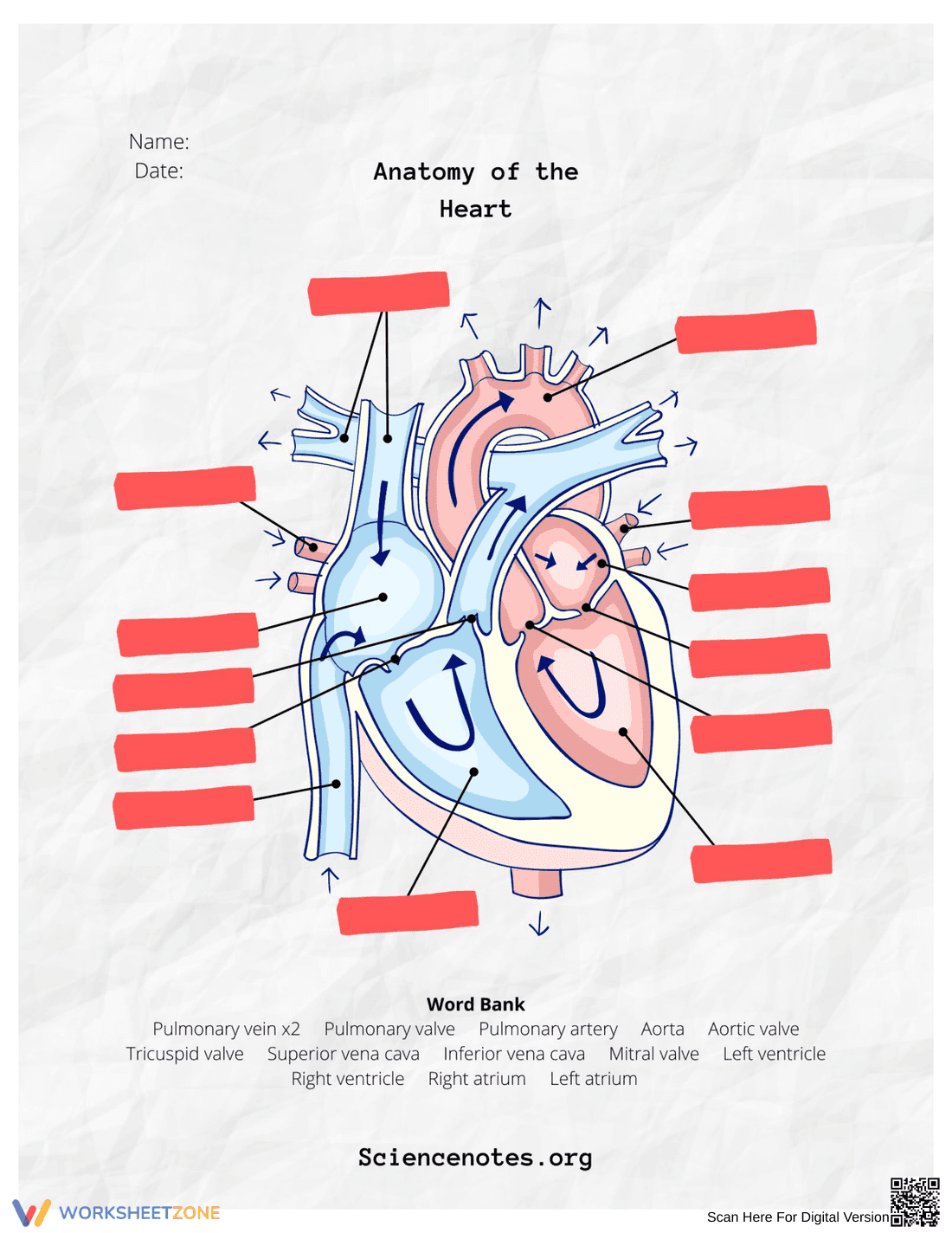
Inside this resource, educators will find a single-page diagram of the human heart featuring clear directional arrows indicating blood flow. The worksheet includes 14 blank identification boxes pointing to key structures such as the aorta, ventricles, atria, and specific valves. A built-in word bank scaffolds the activity, ensuring students have the exact terminology needed. A complete answer key is provided for rapid grading.
Zero-Prep Workflow
This resource is designed for immediate classroom implementation.
- Print (1 minute): The diagram prints clearly in grayscale, making it easy to produce class sets quickly.
- Distribute (1 minute): Hand out the single-page activity for an immediate bell-ringer.
- Review (3 minutes): Use the included answer key to project correct labels, allowing students to self-correct.
With a total teacher prep time of under two minutes, this worksheet is highly suitable for emergency sub plans.
Standards Alignment
This activity aligns with HS-LS1-2, requiring students to develop and use a model to illustrate the hierarchical organization of interacting systems that provide specific functions within multicellular organisms. By mapping the heart's chambers and valves, students visualize its function within the circulatory system. Both standard codes can be copied directly into lesson plans, IEP goals, or district curriculum mapping tools.
How to Use It
Deploy this worksheet during direct instruction as a guided note-taking tool, or assign it after a lecture to solidify vocabulary. As a formative assessment observation tip, watch whether students correctly distinguish between the left and right sides of the heart. The activity has an expected completion time range of 15 to 20 minutes.
Who It's For
This resource is designed for high school biology and anatomy students. The word bank provides built-in differentiation, supporting English Language Learners and students needing vocabulary scaffolding. It pairs naturally with a textbook passage on the circulatory system or a 3D heart model demonstration.
Mastering anatomical terminology requires repeated exposure and active recall. This worksheet supports HS-LS1-2 by having students illustrate interacting systems providing specific functions through targeted diagram labeling. According to a ScienceDirect TpT Analysis, visual mapping exercises combined with word banks significantly reduce cognitive overload, allowing students to focus on spatial relationships rather than rote memorization of spelling. By physically writing the terms next to their corresponding structures, learners build stronger neural pathways connecting the vocabulary to the visual model. This method of structured practice ensures that foundational knowledge of the heart's anatomy is secured before moving on to more complex physiological processes like cardiac cycles or systemic circulation. The clear, uncluttered design of this specific diagram further minimizes distractions, making it an effective tool for diverse learning profiles in the secondary science classroom.


