


























Views
Downloads

Printable Reading Comprehension Worksheet | Grade 4 ELA
Paste this activity's link or code into your existing LMS (Google Classroom, Canvas, Teams, Schoology, Moodle, etc.).
Students can open and work on the activity right away, with no student login required.
You'll still be able to track student progress and results from your teacher account.
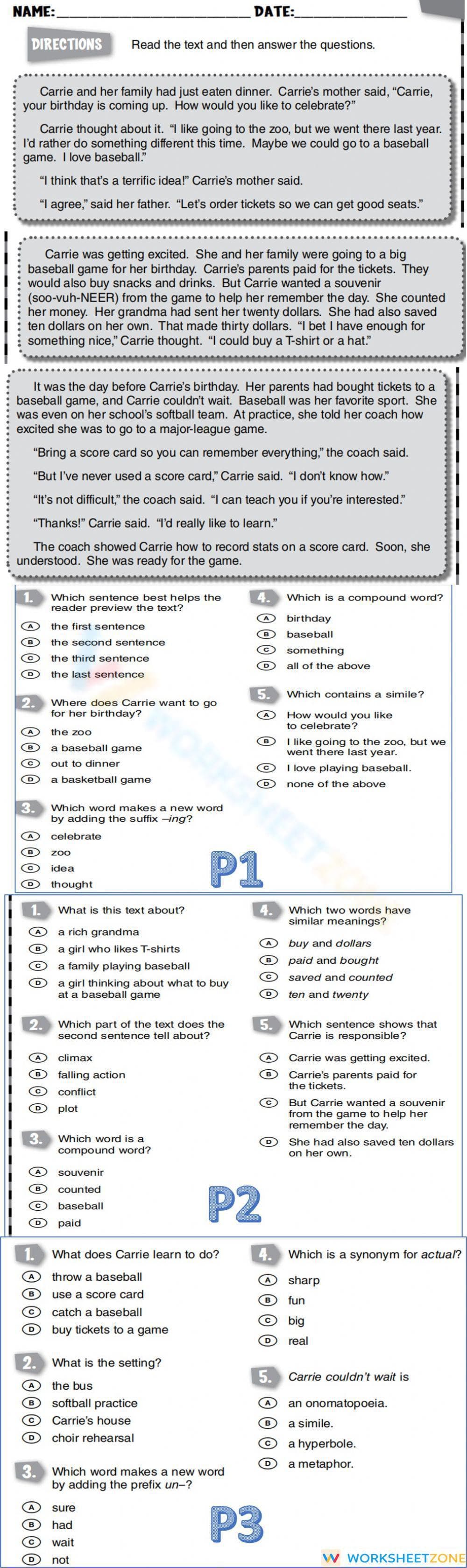
This Grade 4 reading comprehension worksheet provides focused practice on citing textual evidence, a critical ELA skill. Through an engaging short story, students answer 15 targeted questions that require them to refer back to details and examples in the passage, building a strong foundation for analytical reading and comprehension.
At a Glance
- Grade: 4 · Subject: ELA
- Standard:
CCSS.ELA-LITERACY.RL.4.1— Refer to details and examples in a text when explaining what it says.- Skill Focus: Reading Comprehension & Citing Text Evidence
- Format: 3 pages · 15 problems · Answer key included · PDF
- Best For: Independent practice or skill reinforcement
- Time: 25–35 minutes
What's Inside
This three-page PDF resource contains a complete short story, "An Amazing Birthday Present," followed by a sequence of 15 questions. The tasks are designed to guide students through the text, with questions covering literal recall, vocabulary in context (including compound words and suffixes), and inferential thinking. A full answer key is provided for easy grading.
Skill Progression
- Guided Practice: The initial questions focus on direct recall, helping students locate specific details and facts within the story to build confidence.
- Supported Practice: The middle section introduces more complex tasks, asking students to analyze character actions and determine the meaning of words from context.
- Independent Practice: The final questions challenge students with higher-order thinking, requiring them to draw inferences and explain their reasoning using evidence from the text.
This I Do, We Do, You Do structure ensures all learners can access the core skill of textual analysis.
Standards Alignment
This worksheet is directly aligned with CCSS.ELA-LITERACY.RL.4.1, requiring students to "Refer to details and examples in a text when explaining what the text says explicitly and when drawing inferences from the text." It also supports foundational vocabulary standards like CCSS.ELA-LITERACY.L.4.4. Both standard codes can be copied directly into lesson plans, IEP goals, or district curriculum mapping tools.
How to Use It
Use this worksheet as an independent practice activity after a direct instruction lesson on finding text evidence. It is also an effective formative assessment tool; observe which students can successfully navigate the move from literal to inferential questions. The expected completion time is between 25 and 35 minutes, making it suitable for a class period or a homework assignment.
Who It's For
Designed primarily for Grade 4 students, this resource can serve as an excellent enrichment tool for advanced Grade 3 readers or as a targeted intervention for Grade 5 students needing more practice with text evidence. It pairs well with an anchor chart that models how to quote and paraphrase information from a source.
This worksheet provides structured practice for CCSS.ELA-LITERACY.RL.4.1, a foundational ELA standard requiring students to cite textual evidence. By working through 15 scaffolded questions, students learn to move beyond surface-level recall to analytical comprehension. The gradual-release model, moving from explicit to inferential questions, is a proven method for building student independence. Research from Fisher & Frey (2014) highlights the effectiveness of this scaffolded approach in developing critical reading skills. The worksheet's focus on a single, high-leverage skill ensures that students receive the repeated, targeted practice necessary for mastery. This resource serves as a reliable tool for teachers to measure student progress on a key component of the Grade 4 reading literature standards, providing clear data for instructional planning and student feedback.


