


























Views
Downloads
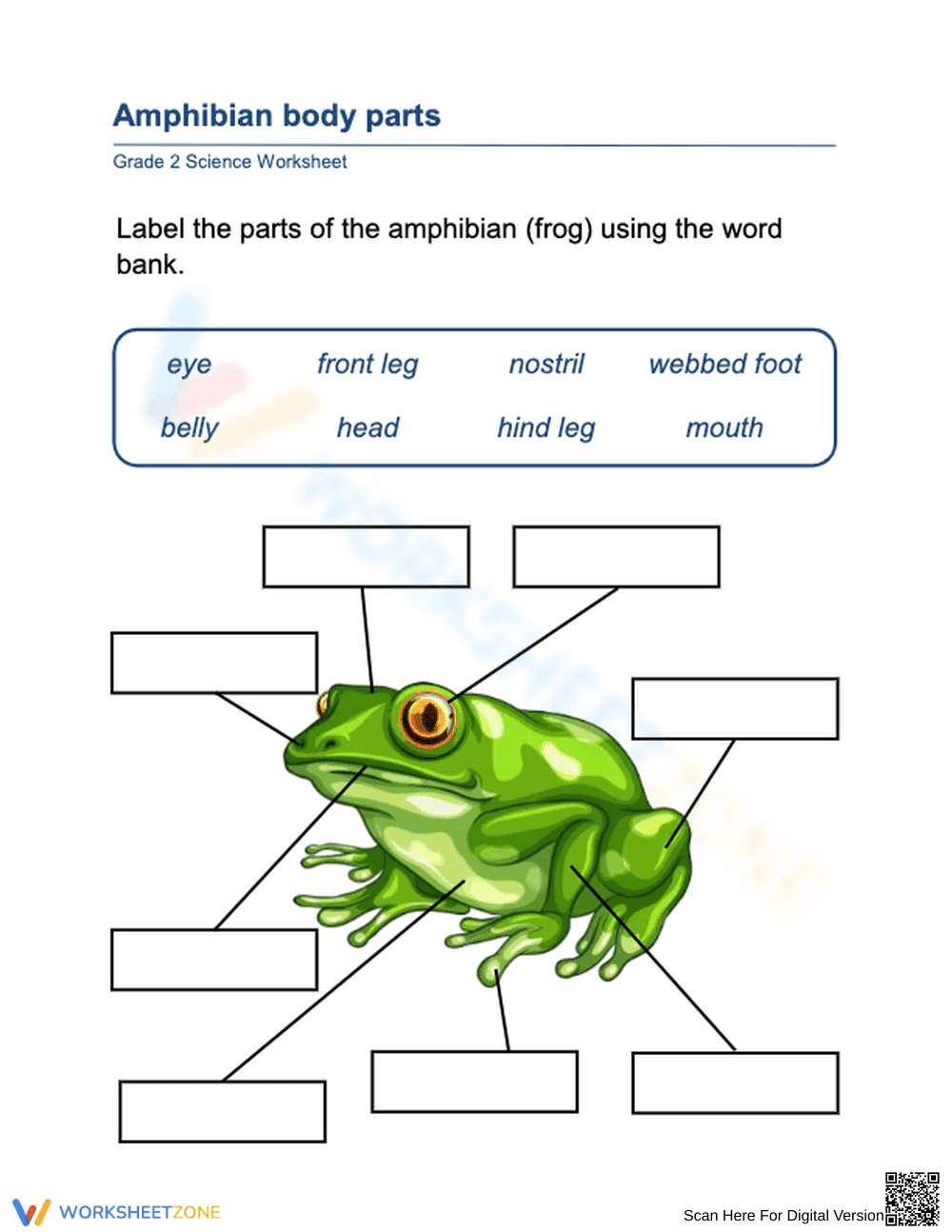

Printable Amphibian Body Parts Worksheet | Grade 2 Science
Paste this activity's link or code into your existing LMS (Google Classroom, Canvas, Teams, Schoology, Moodle, etc.).
Students can open and work on the activity right away, with no student login required.
You'll still be able to track student progress and results from your teacher account.
This Grade 2 science worksheet focuses on identifying specific amphibian anatomy through a focused labeling exercise. Students use a provided word bank to correctly name eight external features of a frog, reinforcing biological vocabulary and observational skills. This activity helps young learners build a foundational understanding of how different animal structures support life and movement in varied environments.
At a Glance
- Grade: 2 · Subject: Science
- Standard:
2-LS4-1— Make observations of animals to compare the diversity of life in different habitats- Skill Focus: Amphibian anatomy and biological labeling
- Format: 2 pages · 8 problems · Answer key included · PDF
- Best For: Individual practice or science center activity
- Time: 10–15 minutes
What's Inside
This two-page PDF includes a clean, high-resolution illustration of a frog with eight clear call-out boxes for labeling. A dedicated word bank contains terms like "hind leg," "webbed foot," and "nostril" to support developing readers. The second page features a complete answer key, allowing for rapid student self-correction or efficient teacher grading of the identifying tasks.
Zero-Prep Workflow
This resource is designed for immediate classroom implementation with zero teacher preparation required. First, print the single-page worksheet and answer key in under thirty seconds. Next, distribute the sheets for ten minutes of independent student work. Finally, use the visual answer key to review the correct biological terms with the class in less than two minutes. It is an ideal solution for emergency sub plans.
Standards Alignment
Aligned to 2-LS4-1, this worksheet encourages students to make observations of animals to compare the diversity of life. By focusing on the specific structures of an amphibian, students begin to understand how physical traits like webbed feet are adapted for specific habitats. Both standard codes can be copied directly into lesson plans, IEP goals, or district curriculum mapping tools.
How to Use It
Assign this worksheet during a life science unit after introducing the characteristics of amphibians. It serves as an excellent exit ticket to verify students can distinguish between different anatomical structures. Teachers should observe if students can differentiate between the front and hind legs, providing a formative check on their attention to detail and ability to use visual cues alongside the word bank.
Who It's For
This activity is perfect for Grade 2 students learning about animal classification and biology. The inclusion of a word bank makes it highly accessible for English Language Learners and students requiring additional literacy support. It pairs naturally with a non-fiction passage about frog life cycles or an anchor chart detailing the differences between reptiles and amphibians.
Identifying anatomical structures is a critical component of early life science education, serving as a gateway to understanding biological function and environmental adaptation. This Grade 2 science worksheet aligns with the 2-LS4-1 standard by requiring students to observe and label eight specific features of an amphibian, such as webbed feet and nostrils. According to the RAND AIRS 2024 report on elementary science instruction, structured labeling tasks with visual scaffolding significantly improve the retention of specialized academic vocabulary among young learners. By providing a clear frog illustration and a corresponding word bank, this resource reduces cognitive load while ensuring students engage deeply with the material. This instructional design supports the development of observational skills necessary for later scientific inquiry. Educators can utilize this 15-minute activity to generate measurable data on student mastery, ensuring learners are prepared for more complex comparisons of animal diversity in future grades.


