


























Views
Downloads
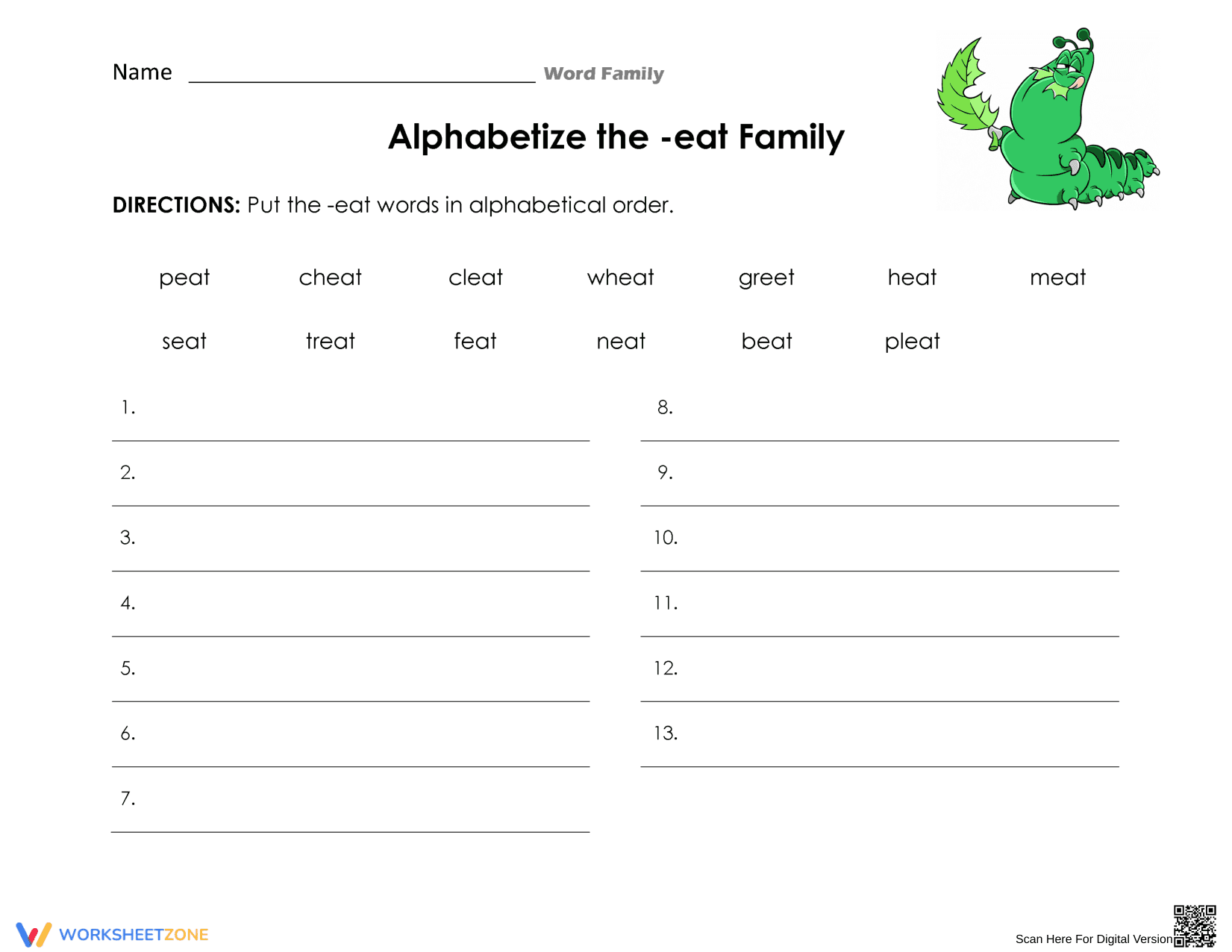

Essential Grade 1-2 Alphabetical Order -eat Family Worksheet
Paste this activity's link or code into your existing LMS (Google Classroom, Canvas, Teams, Schoology, Moodle, etc.).
Students can open and work on the activity right away, with no student login required.
You'll still be able to track student progress and results from your teacher account.
This Grade 1 and Grade 2 vocabulary worksheet provides essential practice in organizing words from the -eat family into alphabetical order. By focusing on a single phonics pattern, students can master the mechanics of alphabetizing without the distraction of varying spellings. This targeted exercise builds the foundation for dictionary usage and independent writing skills.
At a Glance
- Grade: 1–2 · Subject: English Language Arts
- Standard:
CCSS.ELA-LITERACY.L.2.2.E— Consult reference materials to check spellings and alphabetize words effectively- Skill Focus: Alphabetical Order & Phonics Families
- Format: 1 page · 13 problems · Answer key included · PDF
- Best For: Literacy centers and morning bell-ringers
- Time: 10–15 minutes
This single-page PDF features 13 distinct words from the -eat family, including peat, cheat, cleat, and wheat. The layout is clean and student-friendly, featuring a whimsical caterpillar illustration to maintain engagement. Students are provided with clear numbered lines to rewrite the word list in the correct sequence. The resource includes a comprehensive answer key for quick teacher review or student self-correction.
Zero-Prep Workflow
- Print (1 Minute): Select the number of copies needed and print directly from the PDF file.
- Distribute (1 Minute): Hand out the sheets during your morning work or literacy center rotation.
- Review (3 Minutes): Project the answer key to allow students to self-correct their sequencing.
The total teacher preparation time is under two minutes, making this an ideal resource for emergency sub plans or quick instructional transitions.
The primary alignment for this resource is CCSS.ELA-LITERACY.L.2.2.E, which requires students to consult reference materials and alphabetize words to check spelling. This activity also supports CCSS.ELA-LITERACY.L.1.4, focusing on vocabulary acquisition and structural patterns. Both standard codes can be copied directly into lesson plans, IEP goals, or district curriculum mapping tools.
Use this worksheet as a formative assessment after introducing the -eat word family or as a dedicated dictionary-skills station. During the activity, observe if students use the second or third letters for sorting, as this indicates a deeper understanding of alphabetical sequencing. It serves as a perfect transition task between direct phonics instruction and independent reading time.
This resource is tailored for first and second-grade students, English Language Learners (ELLs), and students requiring Tier 2 intervention for basic literacy skills. It pairs naturally with -eat family anchor charts or shared reading passages that highlight these specific phonemes, reinforcing the connection between isolated skill practice and real-world text engagement.
According to the RAND AIRS 2024 report on foundational literacy, repetitive engagement with consistent phonics patterns, such as the -eat word family, significantly accelerates orthographic mapping in early learners. This worksheet utilizes 13 targeted tasks to reinforce CCSS.ELA-LITERACY.L.2.2.E, bridging the gap between phonemic awareness and formal vocabulary organization. Research from Fisher & Frey (2014) emphasizes that alphabetizing tasks within a known word family reduce cognitive load, allowing students to focus on the procedural logic of sequencing. This structured approach ensures that Grade 1 and Grade 2 students develop the alphabetical principle necessary for advanced dictionary navigation and reference usage. By providing a clear, scaffolded environment for sorting, this tool serves as a reliable instrument for measuring student progress toward literacy mastery and standardized testing readiness. Educational practitioners can integrate this evidence-based practice to ensure all students meet essential fluency benchmarks.


