


























Views
Plays
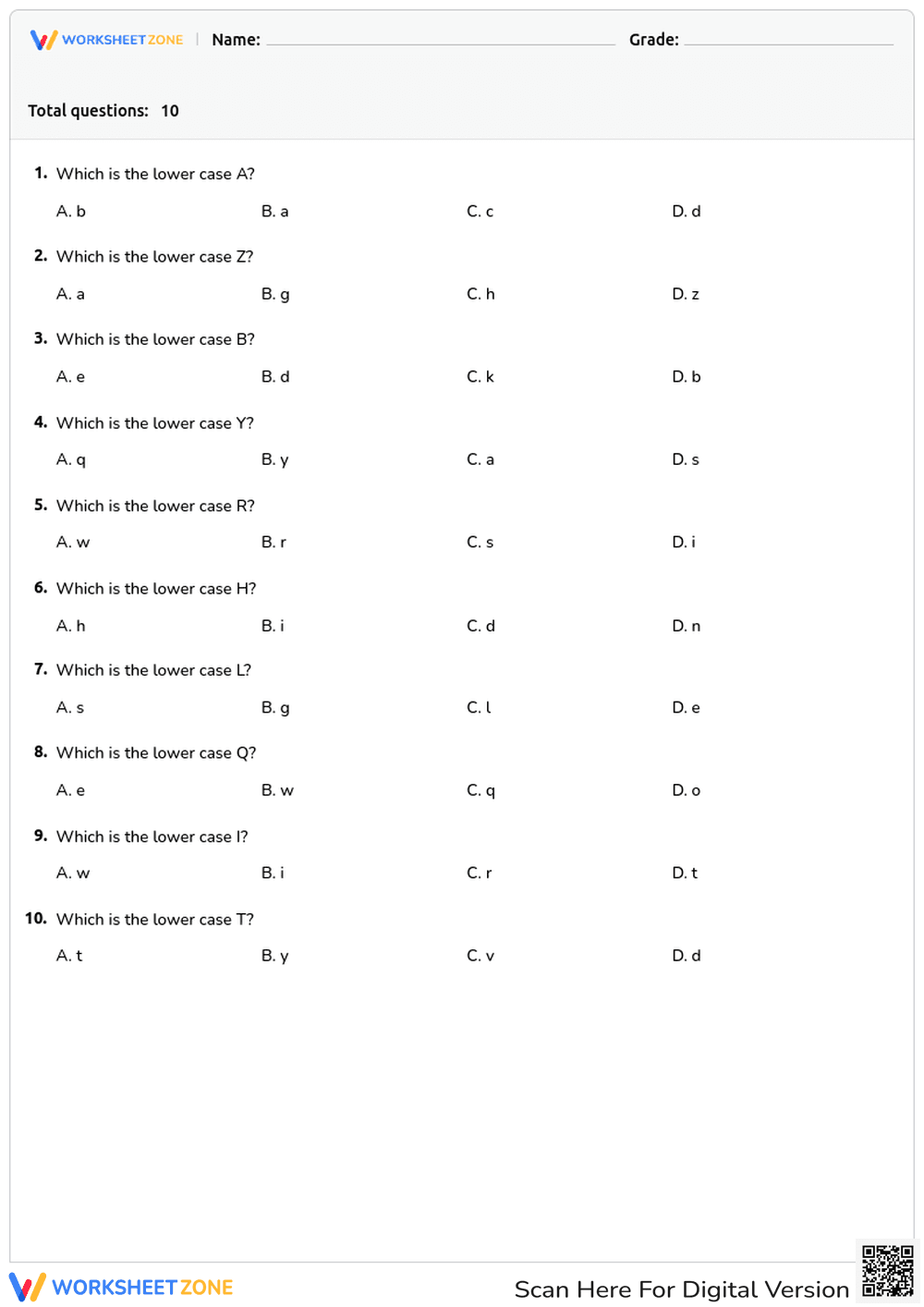

Printable Uppercase to Lowercase Letters Worksheet | Grade K
Paste this activity's link or code into your existing LMS (Google Classroom, Canvas, Teams, Schoology, Moodle, etc.).
Students can open and work on the activity right away, with no student login required.
You'll still be able to track student progress and results from your teacher account.
This Kindergarten letter matching worksheet helps early readers build foundational literacy skills by identifying lowercase equivalents of uppercase letters. Students practice visual discrimination and alphabet recognition through a straightforward, multiple-choice format, ensuring they can confidently transition between letter cases in early reading and writing tasks.
At a Glance
- Grade: K · Subject: ELA
- Standard:
CCSS.ELA-LITERACY.RF.K.1.D— Recognize and name all upper- and lowercase letters- Skill Focus: Uppercase to lowercase letter matching
- Format: 1 page · 10 problems · Answer key included · PDF
- Best For: Independent practice or morning work
- Time: 5–10 minutes
This single-page resource features 10 clear, multiple-choice questions designed specifically for early childhood and kindergarten learners. Each task presents a target uppercase letter and asks students to select the corresponding lowercase letter from four distinct options. The clean layout minimizes visual clutter, allowing young students to focus entirely on letter recognition without unnecessary distractions. A complete answer key is provided for quick grading.
Designed for immediate classroom implementation with a zero-prep workflow:
- Print (1 minute): Download the PDF and print. The black-and-white design is highly printer-friendly.
- Distribute (1 minute): Hand out during morning work, literacy centers, or as a quick transition activity.
- Review (3 minutes): Use the included answer key to rapidly check responses or conduct a whole-class review.
With teacher prep time under two minutes, this worksheet is an excellent addition to any emergency sub plan or last-minute literacy center.
This worksheet is directly aligned to CCSS.ELA-LITERACY.RF.K.1.D: Recognize and name all upper- and lowercase letters of the alphabet. By isolating the specific skill of matching uppercase to lowercase forms, it provides targeted practice on a critical early literacy milestone. Both standard codes can be copied directly into lesson plans, IEP goals, or district curriculum mapping tools.
Teachers can utilize this worksheet in multiple instructional moments. It serves as an effective formative assessment after direct instruction on specific letter pairs, allowing educators to quickly identify which students struggle with visually similar letters. Alternatively, it functions perfectly as an independent literacy center activity while the teacher conducts small group guided reading. When observing students complete the 10 problems, note whether they use process of elimination or immediately recognize the correct lowercase form. Expected completion time is between 5 and 10 minutes.
This resource is primarily designed for kindergarten students mastering their alphabet, but it is also highly effective for pre-K students ready for an advanced challenge or first-grade students needing foundational review. For students requiring differentiation, teachers can cross out two of the four multiple-choice options to reduce the cognitive load. This worksheet pairs naturally with classroom alphabet anchor charts or tactile letter-matching manipulatives.
Mastering the alphabet is a fundamental prerequisite for reading fluency and writing proficiency. This resource targets CCSS.ELA-LITERACY.RF.K.1.D, focusing on the ability to recognize and name all upper- and lowercase letters. According to Fisher & Frey (2014), explicit instruction and repeated practice in foundational literacy skills are essential for developing automaticity in early readers. When students can rapidly identify and match uppercase and lowercase letters without hesitation, they free up cognitive resources for more complex tasks like phonemic decoding and reading comprehension. This 10-question worksheet provides the exact type of focused, low-stakes repetition necessary to build that automaticity. By isolating the visual discrimination of letter forms, educators can ensure young learners establish the strong literacy foundation required for future academic success across all elementary subject areas.


