


























Views
Downloads
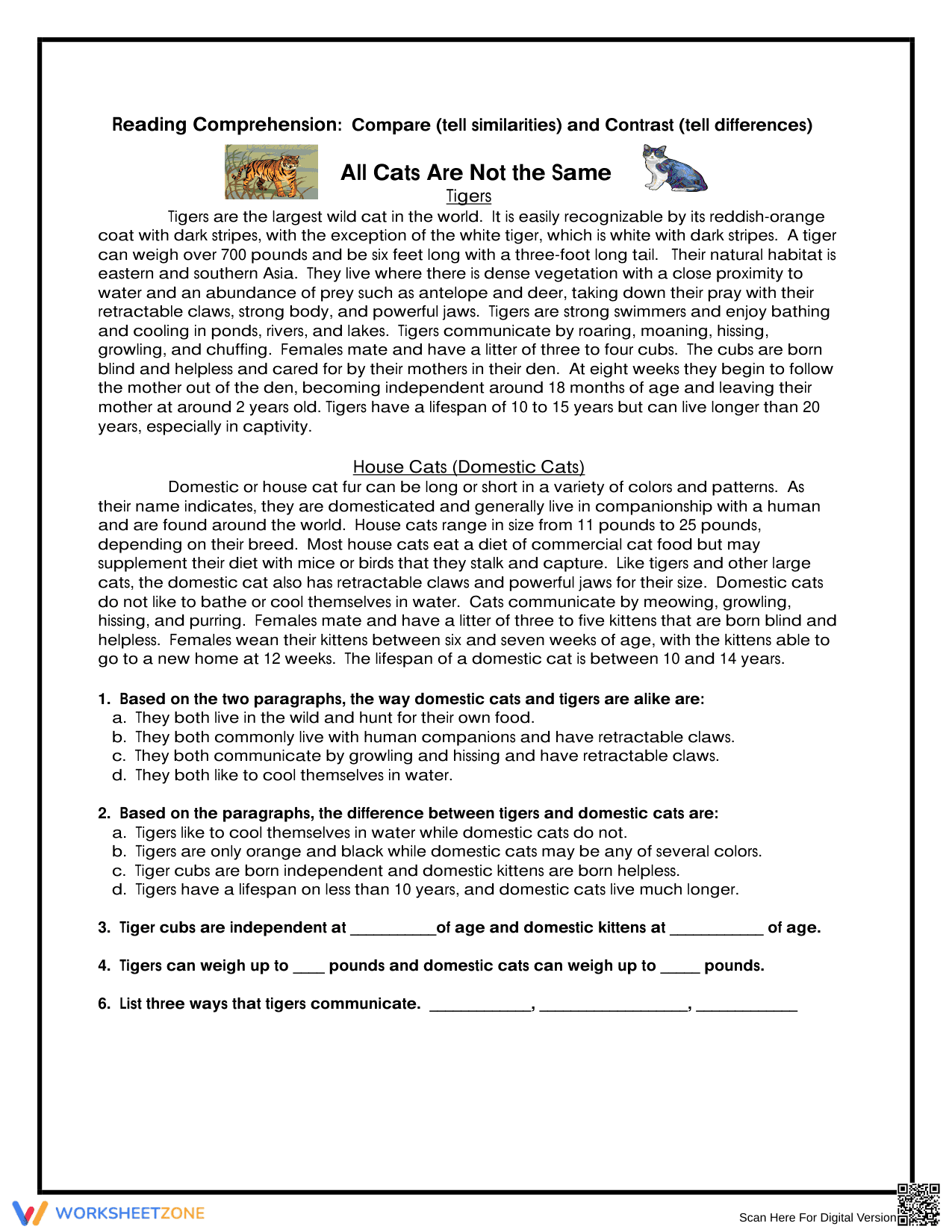

All Cats Are Not the Same Worksheet | Essential Grade 3 ELA
Paste this activity's link or code into your existing LMS (Google Classroom, Canvas, Teams, Schoology, Moodle, etc.).
Students can open and work on the activity right away, with no student login required.
You'll still be able to track student progress and results from your teacher account.
Mastering informational text structures is a cornerstone of elementary literacy. This All Cats Are Not the Same worksheet provides a focused reading comprehension experience where students identify specific similarities and differences between domestic cats and tigers. By engaging with two detailed descriptive paragraphs, learners build the critical thinking skills necessary to synthesize complex information across related topics.
At a Glance
- Grade: 3 · Subject: ELA
- Standard:
CCSS.ELA-LITERACY.RI.3.9— Compare and contrast important points and key details in a text- Skill Focus: Compare and Contrast
- Format: 1 page · 5 problems · Answer key included · PDF
- Best For: Independent reading or quick assessment
- Time: 15–20 minutes
This comprehensive one-page resource features two distinct reading passages: one detailing the physical traits, habitats, and behaviors of wild tigers, and another describing common domestic house cats. Following the text, students encounter five structured tasks, including multiple-choice questions that require distinguishing between facts and open-ended list-making. The layout is clean and focused, ensuring that students can easily refer back to the text to find evidence for their answers.
The zero-prep workflow is designed for maximum efficiency. First, print the single-sided PDF (10 seconds). Next, distribute the worksheet for independent practice (30 seconds). Finally, use the included answer key to review responses (60 seconds). This streamlined process requires less than two minutes of teacher preparation time, making it suitable for emergency sub plans or quick supplemental practice.
This resource is strictly aligned to CCSS.ELA-LITERACY.RI.3.9, which requires students to compare and contrast the most important points and key details presented in a text. It also supports CCSS.ELA-LITERACY.RI.3.1 by asking students to demonstrate understanding through explicit text evidence. Both standard codes can be copied directly into lesson plans, IEP goals, or district curriculum mapping tools.
For optimal results, use this worksheet after a direct instruction lesson on signal words such as "both," "unlike," and "similarly." Teachers should observe students as they work to see if they are physically underlining or circling facts in the text before selecting an answer; this formative observation helps identify who needs more support with evidence-based reading. Expect students to complete the full set of five questions in approximately 18 minutes.
This activity is tailored for students in Grade 3 and Grade 4, though it serves as an excellent enrichment tool for Grade 2 learners. It is particularly effective for students who benefit from clear, comparative text structures. We recommend pairing this resource with a Venn diagram or an anchor chart that lists common feline characteristics to help students visualize data before writing their final list of communication methods.
The ability to differentiate between similar yet distinct categories is a fundamental cognitive skill that supports long-term academic success in science and social studies. According to research from Fisher & Frey (2014) on close reading, providing students with short, high-interest informational texts like this comparison of cats encourages the repeated reading necessary for deep comprehension. By focusing on 5 specific tasks that map directly to standard RI.3.9, this worksheet ensures that practice time is high-yield. Educators can trust that the data extracted from these reading assessments provides a clear picture of a student's ability to quote accurately and explain informational interactions. This worksheet remains a staple for classrooms seeking rigorous, evidence-based ELA materials that fit into tight instructional blocks without sacrificing content depth. The inclusion of an answer key ensures consistent evaluation across diverse learning environments.


