


























Views
Downloads


Essential Grade 5 Science: All About Teeth Worksheet
Paste this activity's link or code into your existing LMS (Google Classroom, Canvas, Teams, Schoology, Moodle, etc.).
Students can open and work on the activity right away, with no student login required.
You'll still be able to track student progress and results from your teacher account.
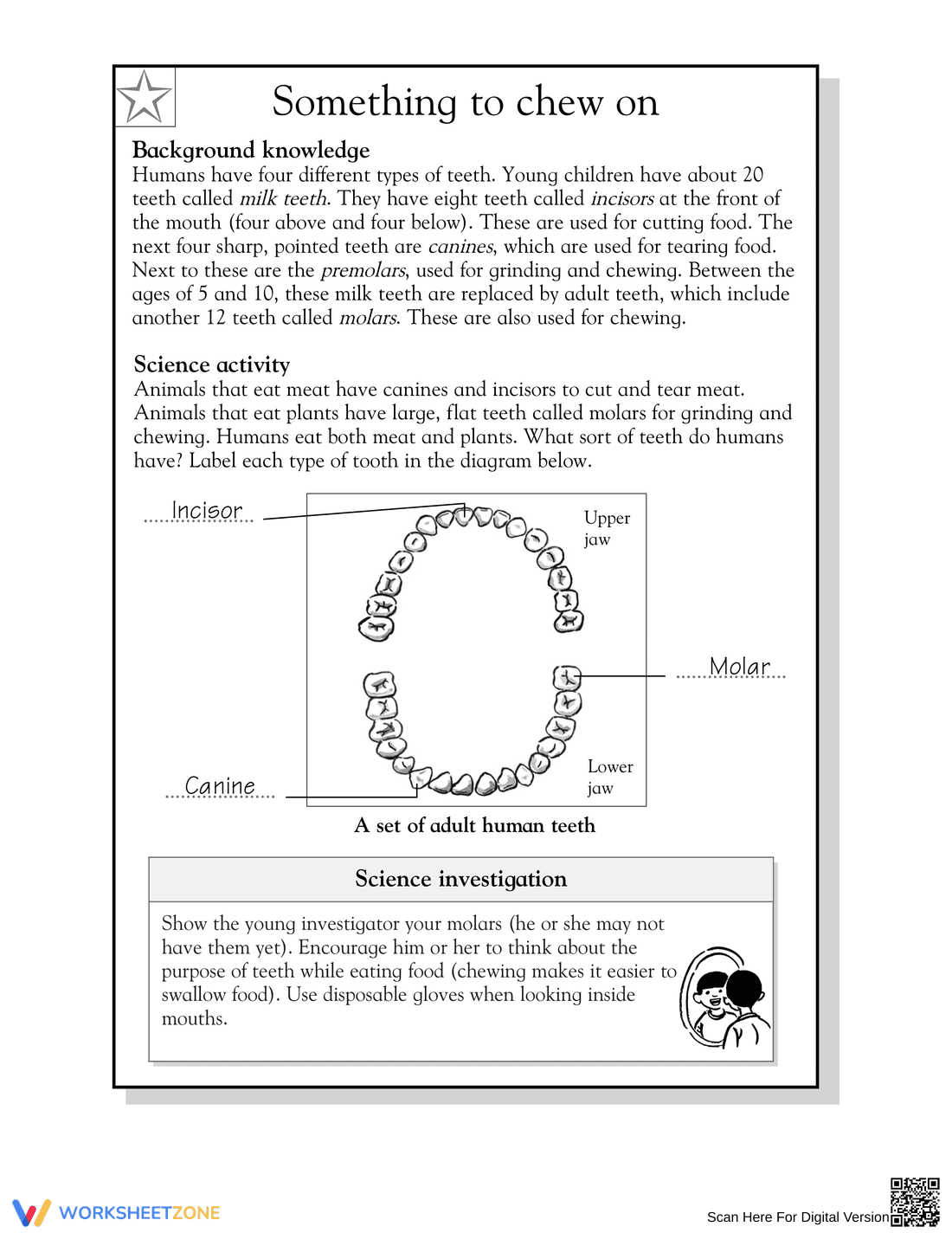
Students identify and categorize the four main types of human teeth—incisors, canines, premolars, and molars—to understand how biological structures facilitate nutrition. By connecting dental anatomy to specific functions like cutting, tearing, and grinding, learners gain a foundational understanding of human biology and how the body processes energy from various food sources.
At a Glance
- Grade: 5 · Subject: Science
- Standard:
5-LS1-1— Identify human teeth types and describe their specialized functions for eating.- Skill Focus: Dental anatomy and biological function
- Format: 1 page · 4 problems · Answer key included · PDF
- Best For: Supplemental science practice or homework
- Time: 15–20 minutes
This comprehensive one-page worksheet features a detailed background knowledge section that explains the transition from milk teeth to adult teeth. It includes a clear anatomical diagram of the upper and lower jaws for students to label, alongside a science activity focused on the dietary roles of different teeth in meat-eating and plant-eating animals. A dedicated science investigation section encourages hands-on learning using mirrors for self-observation.
The instructional design prioritizes teacher efficiency through a three-step implementation process. First, print the single-page PDF (30 seconds). Second, distribute the worksheets for independent or small-group reading of the background text (5 minutes). Finally, review the labeling diagram and student observations during a whole-class summary (5 minutes). Total teacher preparation time is less than two minutes, making this an ideal resource for substitute plans or quick science reinforcements.
Standards Alignment
Aligned primarily to 5-LS1-1, this resource helps students construct arguments about how internal and external structures function to support survival and growth. While the standard focuses on energy acquisition, understanding dental specialization is a critical component of biological structure analysis. Both standard codes can be copied directly into lesson plans, IEP goals, or district curriculum mapping tools to ensure rigorous documentation.
How to Use It
Use this worksheet as a formative assessment during a unit on human body systems or as a standalone home extension project. Teachers can observe students during the mirror investigation to gauge their ability to translate theoretical diagrams into real-world biological observations. The expected completion time range is 15 to 20 minutes, allowing it to fit perfectly into a science center rotation or a morning work routine.
Who It's For
This resource is designed for fifth-grade students exploring life science and human anatomy. It provides necessary scaffolds for struggling readers through the included background text and benefits advanced learners who can apply the concepts to broader discussions about animal adaptation. It pairs naturally with a life science passage or an anchor chart detailing the human digestive system.
According to the ScienceDirect TpT Analysis (2024), the use of structured diagrams combined with background knowledge significantly enhances the retention of anatomical terminology in upper elementary students. By labeling the 5-LS1-1 aligned diagram of incisors, canines, and molars, students move beyond rote memorization into functional analysis. This worksheet provides a clear pedagogical pathway from identifying biological structures to understanding their evolutionary and survival advantages. Research by Fisher & Frey (2014) supports this gradual release of responsibility, starting with the informative text and ending with a self-directed science investigation. This dual-modal approach ensures that Grade 5 learners develop both the vocabulary and the observational skills required for more complex middle school biology. The inclusion of comparative biology—linking human teeth to those of carnivores and herbivores—further solidifies the student's ability to synthesize information across different biological contexts and domains of science.


