




























Views
Downloads




Aligned Personification in Context Worksheet | Grade 6 ELA

Paste this activity's link or code into your existing LMS (Google Classroom, Canvas, Teams, Schoology, Moodle, etc.).
Students can open and work on the activity right away, with no student login required.
You'll still be able to track student progress and results from your teacher account.
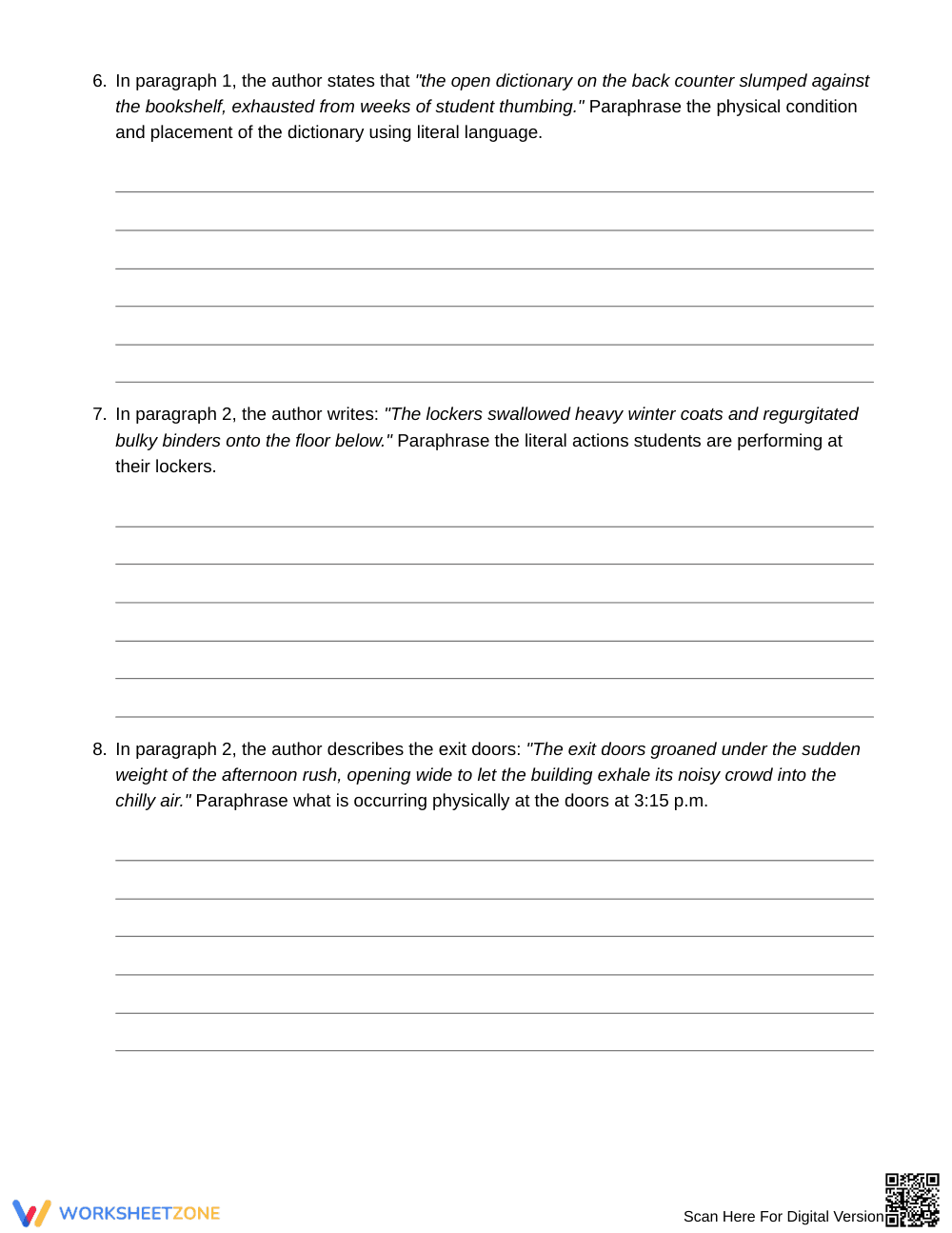
This Grade 6 figurative language worksheet guides students to identify, interpret, and analyze personification in narrative texts. Students examine nonhuman subjects, translate figurative statements into literal observations, and evaluate how human characteristics enhance descriptive imagery. The activity prepares sixth-grade readers for rigorous literary analysis.
At a Glance
- Grade: 6 · Subject: ELA
- Standard:
L.6.5.a— Interpret figures of speech, including personification, in literary context- Skill Focus: Personification in Context
- Format: 5 pages · 10 problems · Complete 2-page answer key included · Printable PDF
- Best For: Mid-unit figurative language practice, independent reading, and targeted skill intervention
- Time: 30–45 minutes
This 5-page worksheet opens with a concise reference box defining personification and a three-step interpretation guide, followed by two narrative passages. Across 10 text-dependent tasks, students identify personified traits, paraphrase literal meanings, and compare figurative statements to literal revisions. A complete 2-page answer key provides full model responses.
Skill Progression
- Guided practice (Part A, 3 items): Students identify nonhuman objects and extract specific human actions using text evidence and the introductory reference guide.
- Supported practice (Part B, 5 items): Learners paraphrase personified sentences into clear, literal statements explaining actual events within the setting.
- Independent practice (Part C, 2 items): Students evaluate figurative excerpts against literal revisions, analyzing how descriptive language enhances reader visualization.
This sequence mirrors the gradual release of responsibility model, guiding students from basic feature recognition to complex stylistic evaluation.
Standards Alignment
This worksheet aligns directly with `L.6.5.a`: "Interpret figures of speech (e.g., personification) in context." It also reinforces supporting standard `RL.6.4` by requiring students to determine the meaning of figurative words in literary text. Both standard codes can be copied directly into lesson plans, IEP goals, or district curriculum mapping tools.
How to Use It
Deploy this worksheet after direct instruction on figurative language for focused skill practice. Alternatively, use it in small-group reading intervention to guide students through the Part B paraphrasing tasks. For formative assessment, check whether students can translate figurative sentences into literal meanings without simply repeating personified phrasing. Students typically complete all 10 tasks in 30 to 45 minutes.
Who It's For
This resource supports sixth-grade ELA students mastering literary analysis and English learners who benefit from explicit practice translating idioms into literal language. For differentiation, provide highlighters so students can isolate human verbs before writing. Pair this activity with a figurative language anchor chart or an introductory lesson on poetic devices.
According to research by Fisher & Frey (2014), structured figurative language instruction that combines explicit definitions, contextual modeling, and scaffolded text-dependent analysis significantly accelerates adolescent reading comprehension and analytical writing. Aligned with Common Core standard L.6.5.a, this Grade 6 worksheet guides middle school students to interpret figures of speech, specifically personification, within authentic narrative contexts. By analyzing how human traits and actions animate nonhuman elements across two contrasting passages, learners develop the interpretive fluency required to unpack figurative language rather than reading text solely at a literal level. The ten-item exercise builds evidentiary reasoning through systematic identification, translation into literal terms, and comparative critique. Educators seeking rigorous, standards-based materials can deploy this comprehensive five-page resource to support close reading routines, evaluate student mastery of nonliteral nuances, and strengthen core middle school textual analysis.


