


























Views
Downloads




Aligned Defending Writing Decisions Worksheet | Grade 6 ELA
Paste this activity's link or code into your existing LMS (Google Classroom, Canvas, Teams, Schoology, Moodle, etc.).
Students can open and work on the activity right away, with no student login required.
You'll still be able to track student progress and results from your teacher account.
This Grade 6 argument writing worksheet helps middle school writers move beyond simple claim generation by teaching them to justify structural and textual choices. Working from an authentic school policy proposal, students scope defensible claims, integrate relevant data, and defend their compositional reasoning in complete written arguments.
At a Glance
- Grade: 6 · Subject: ELA
- Standard:
W.6.1.b— Support claims with clear reasons and relevant evidence using credible sources- Skill Focus: Explain and Defend a Writing Decision
- Format: 5 pages · 8 problems · Answer key included · PDF
- Best For: Argumentative writing workshops and revision units
- Time: 40–55 minutes
What's Inside
This 5-page resource features an informational proposal text, a Writer's Guide, and 8 scaffolded tasks. Students analyze trade-offs, draft reasoning chains, compose a paragraph, and defend revisions. A comprehensive 3-page answer key provides exemplar claims, sample defenses, and an annotated model response.
Skill Progression
- Guided practice (Tasks 1–2): Students establish an arguable baseline by scoping a claim and defending why specific focus enhances persuasive clarity.
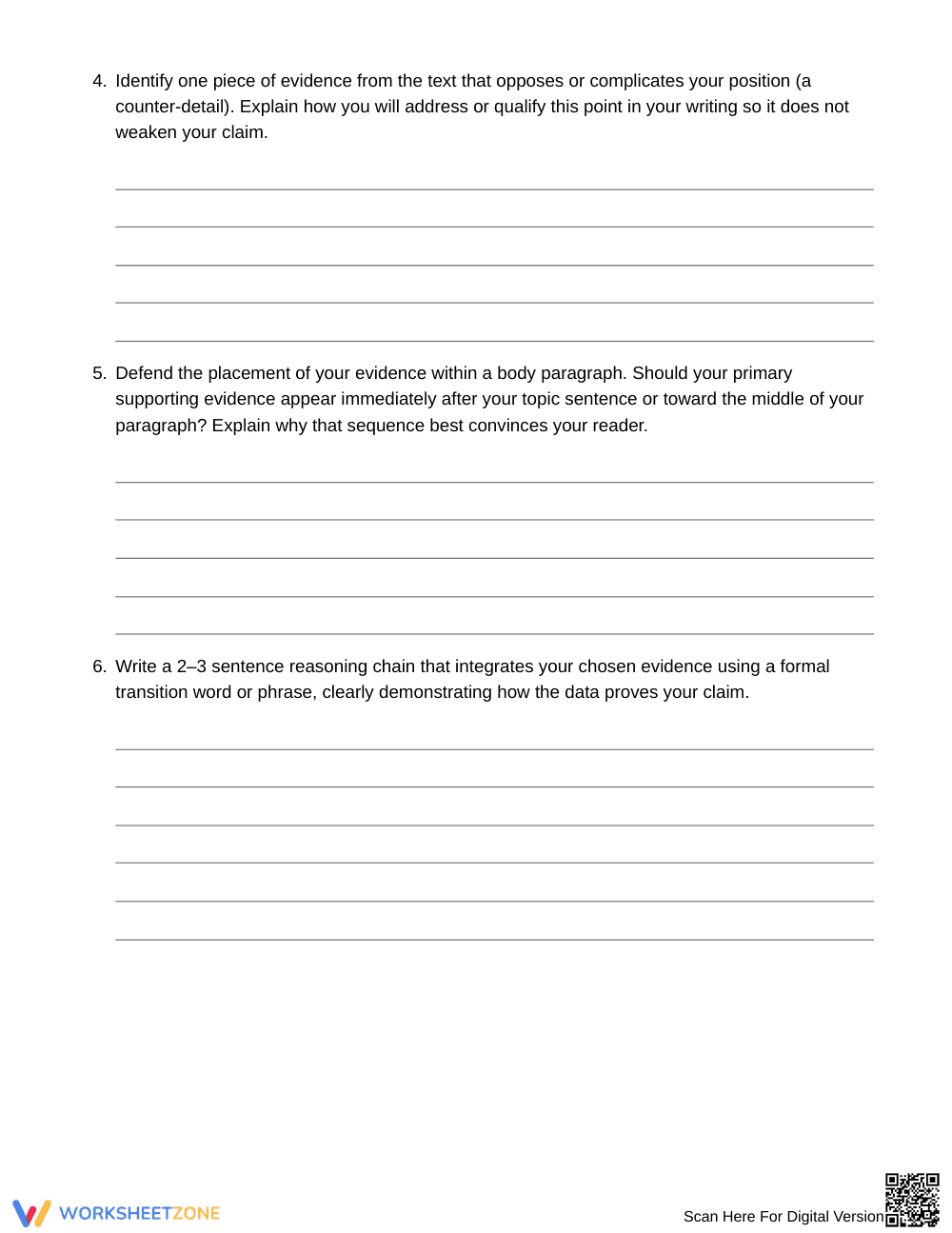
- Supported practice (Tasks 3–6): Learners evaluate evidence, address counter-details, defend evidence placement, and write structured reasoning chains.
- Independent practice (Tasks 7–8): Students draft an argumentative paragraph and defend a specific revision that improved logical coherence.
This gradual release sequence transitions students from foundational scoping to independent metacognitive defense.
Standards Alignment
This worksheet directly aligns with W.6.1.b: Support claim(s) with clear reasons and relevant evidence, using credible sources and demonstrating an understanding of the text. It also supports W.6.1.a by focusing on logical organization. Both standard codes can be copied directly into lesson plans, IEP goals, or district curriculum mapping tools.
How to Use It
Use this worksheet during mid-unit argument instruction or as an intensive pre-writing workshop. During independent work, check Task 4 formatively to verify that students appropriately address counter-evidence rather than ignoring opposing data. Expect student completion to take 40 to 55 minutes.
Who It's For
This activity is designed for sixth-grade ELA classrooms, writing intervention groups, and advanced fifth-grade students. Pair this printable with an evidence-integration anchor chart for optimal classroom scaffolding.
Explicit metacognitive instruction in argument writing substantially accelerates middle school literacy achievement. According to Fisher & Frey (2014), students demonstrate higher writing mastery when required to articulate and justify their compositional decisions rather than completing isolated writing prompts. This 5-page curriculum resource directly targets standard W.6.1.b by requiring sixth-grade writers to support claims with relevant textual evidence and defend their organizational choices. By engaging with balanced source data across 8 structured tasks, students practice scoping claims, positioning evidence strategically, and evaluating paragraph revisions. This structured design transforms drafting into active logical reasoning, ensuring students understand how evidence substantiates a central viewpoint. Teachers can utilize this standards-aligned worksheet to collect formative data on student reasoning, ensuring emerging writers develop essential analytical skills mandated by grade-level standards.


