




























Views
Downloads




Aligned Big Bang Defense Worksheet | Grade 12 Science

Paste this activity's link or code into your existing LMS (Google Classroom, Canvas, Teams, Schoology, Moodle, etc.).
Students can open and work on the activity right away, with no student login required.
You'll still be able to track student progress and results from your teacher account.
This comprehensive Grade 12 Earth and space science worksheet equips students to defend cosmic expansion by synthesizing empirical evidence from galactic redshift, cosmic microwave background radiation, and primordial nucleosynthesis. High school seniors analyze quantitative astronomical spectra, calculate recessional velocities using Hubble's Law, and construct evidence-based arguments that successfully refute competing cosmological models.
At a Glance
- Grade: 12 · Subject: Earth & Space Science
- Standard: Empirical Argumentation — Defend cosmic expansion models using empirical spectral and observational evidence
- Skill Focus: Defend a Conclusion Using Multiple Evidence Lines
- Format: 5 pages · 8 problems · Answer key included · PDF
- Best For: Advanced astrophysics and cosmology exam review
- Time: 45–60 minutes
What's Inside
The five-page student document features eight problems across three parts, paired with a two-page answer key detailing full mathematical solutions and scientific explanations. Students analyze synthetic survey tables, rest-wavelength spectral shifts, and cosmic thermal radiation, supported by a reference header containing redshift formulas, Hubble's constant, and the three pillars of Big Bang cosmology.
Skill Progression
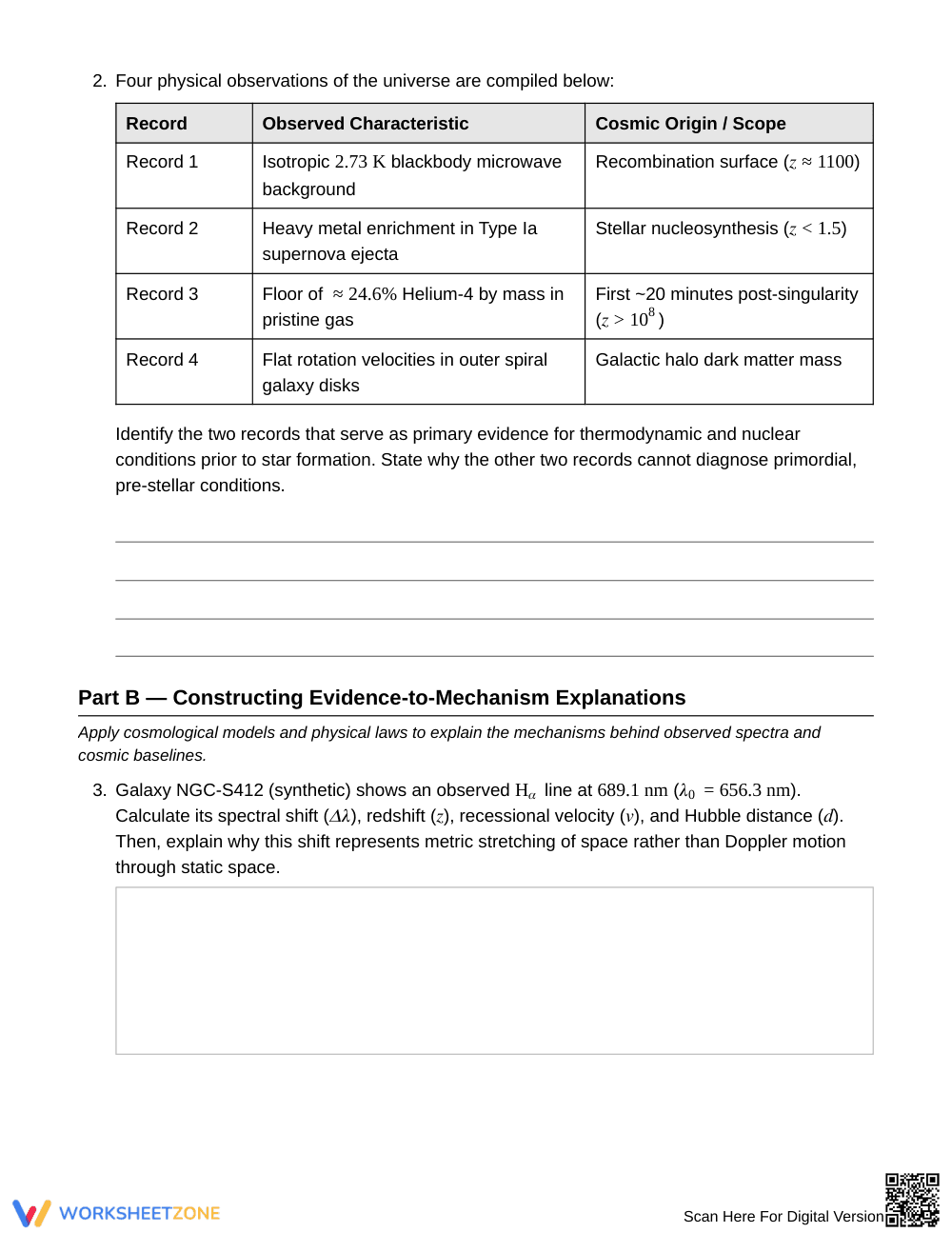
- Guided practice (Tasks 1–2): Students evaluate survey datasets and pristine gas compositions with formula cues to isolate empirical evidence for expansion and nucleosynthesis.
- Supported practice (Tasks 3–6): Learners calculate redshift and recessional velocity for Cluster Beta, distinguish metric expansion from Doppler shifts, apply Wien's Law to cosmic background radiation, and analyze the deuterium bottleneck.
- Independent practice (Tasks 7–8): Students synthesize observational data to systematically refute the Tired Light and Steady State cosmological models.
This sequence follows a gradual-release model transitioning learners from scaffolded data interpretation to independent argumentation.
Standards Alignment
This worksheet aligns with high school Earth and space science standards requiring students to defend the Big Bang model using spectra, redshift, and cosmic background radiation. Supporting standards emphasize evaluating competing explanations using empirical evidence. Both standard codes can be copied directly into lesson plans, IEP goals, or district curriculum mapping tools.
How to Use It
Deploy this resource following instruction on galactic spectra and cosmic expansion. For formative assessment, inspect student calculations in Part B to verify that learners convert rest-wavelength differences into proper velocity units before beginning the refutations in Part C. Alternatively, assign the worksheet as an end-of-unit review activity completed in 45 to 60 minutes.
Who It's For
This resource serves Grade 12 students in Earth and Space Science or advanced physics courses. Teachers can differentiate by providing a Doppler calculation reference guide for struggling students or prompting advanced learners to evaluate cosmic acceleration. Pair this worksheet directly with a stellar spectroscopy lab or absorption spectrum reference chart.
Designed for Grade 12 Earth and space science curricula, this instructional resource builds mastery in defending scientific conclusions using multiple lines of empirical evidence. By coordinating galactic redshift calculations, cosmic microwave background thermal observations, and light-element nucleosynthesis data, students develop sophisticated arguments supporting cosmic expansion while refuting competing hypotheses. Grounded in the gradual release of responsibility framework synthesized by Fisher & Frey (2014), the structured eight-problem sequence guides learners through progressive cognitive tiers, moving from identifying valid empirical observations in astronomical surveys to independently dismantling alternative models such as the Steady State and Tired Light theories. This evidence-based progression ensures high school seniors synthesize quantitative data and astrophysical concepts into defensible scientific arguments, solidifying foundational science practices that meet secondary standards and prepare students for advanced post-secondary coursework in introductory physics and observational astronomy.


