


























Views
Downloads
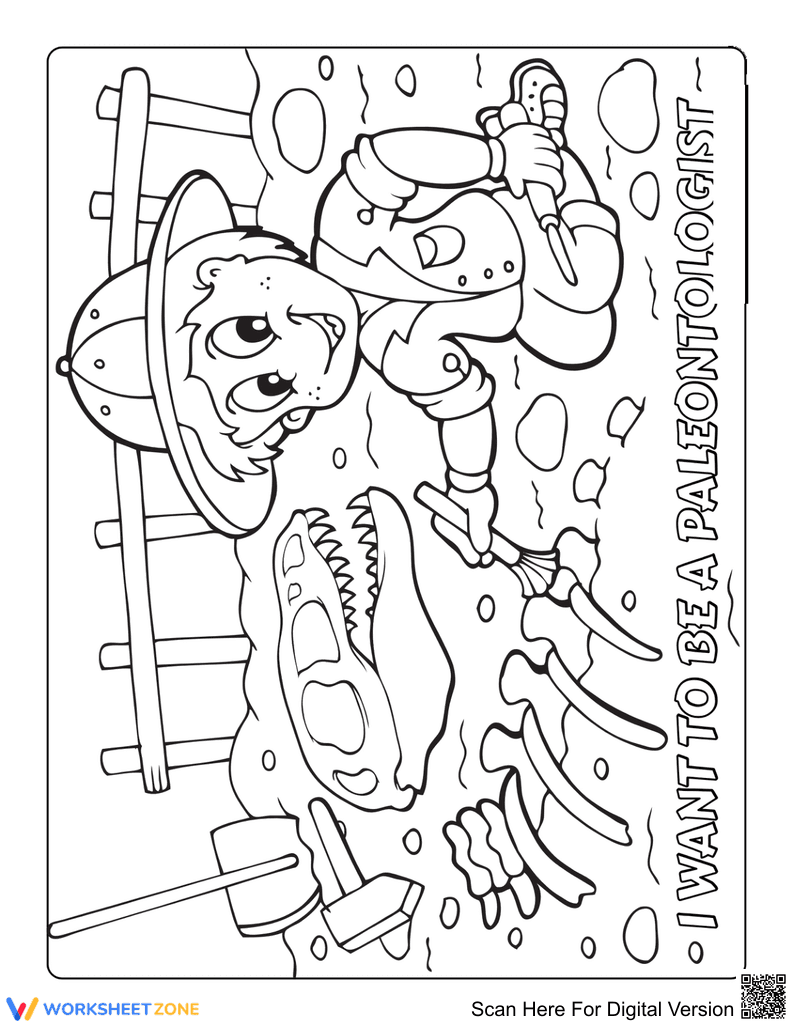

Dinosaur Fossil Coloring Page | Essential Kindergarten Art
Paste this activity's link or code into your existing LMS (Google Classroom, Canvas, Teams, Schoology, Moodle, etc.).
Students can open and work on the activity right away, with no student login required.
You'll still be able to track student progress and results from your teacher account.
This printable dinosaur fossil coloring page provides Kindergarten students with a creative way to explore the world of paleontology. By engaging with the detailed illustration of a scientist excavating a skeleton, children develop essential fine motor control and hand-eye coordination. It serves as an excellent introductory tool for science units focused on history and the natural world.
At a Glance
- Grade: Kindergarten · Subject: Arts & Science
- Standard:
K-ESS3-1— Use observations to describe patterns of what plants and animals need to survive- Skill Focus: Fine motor development and vocabulary
- Format: 1 page · 1 task · No answer key required · PDF
- Best For: Early finisher activity or science centers
- Time: 15–20 minutes
Inside this resource, you will find a high-quality, single-page PDF featuring a cartoon paleontologist at a dig site. The image includes a large dinosaur skull, rib cage, and various excavation tools like a brush and hammer. The clear, bold outlines are specifically designed for young learners who are still mastering the ability to color within lines, providing a satisfying and successful artistic experience.
The zero-prep workflow for this worksheet is designed for maximum efficiency in a busy classroom. First, print the single-page PDF (30 seconds). Second, distribute the sheets along with crayons or colored pencils to your students (1 minute). Third, allow students to work independently while you provide verbal prompts about the tools shown (0 minutes of additional prep). Total teacher preparation time is under two minutes, making it an ideal emergency sub plan or transition activity.
This activity aligns with K-ESS3-1, where students use observations to understand the natural world. While primarily an art activity, it supports the standard by prompting discussion about how we learn about animals from the past through fossils. It also supports CCSS.ELA-LITERACY.L.K.6 by introducing domain-specific vocabulary like "paleontologist" and "excavation." Both standard codes can be copied directly into lesson plans, IEP goals, or district curriculum mapping tools.
Use this worksheet during a "Dinosaur Week" theme or as a quiet-time activity following a read-aloud about fossils. It works best during the independent practice phase of a lesson where students can reflect on what they have learned about scientists. For a formative assessment, observe how students grip their coloring tools and whether they can identify the different parts of the dinosaur skeleton as they color. Completion typically takes 15 to 20 minutes.
This resource is tailored for Kindergarten students but is also suitable for Preschool or Grade 1 learners needing fine motor practice. It is particularly effective for English Language Learners (ELLs) as it provides a visual anchor for new science vocabulary. Pair this coloring page with a non-fiction picture book about Mary Anning or a classroom fossil dig sensory bin for a comprehensive learning experience.
This Kindergarten science and art resource centers on the K-ESS3-1 standard, facilitating student engagement with animal history through paleontology. By focusing on the fine motor task of coloring a detailed excavation scene, the worksheet supports the development of small muscle groups necessary for early writing. According to the Fisher & Frey (2014) framework, providing creative outlets like this coloring page allows students to internalize complex concepts—such as how scientists study the past—before moving into abstract scientific reasoning. Research suggests that integrating arts into core subjects like science improves student retention and interest in STEM fields. This 1-page PDF is a practical tool for educators looking to bridge the gap between creative play and standards-based observation in early childhood settings, ensuring foundational skills are met through high-interest topics.


