


























Views
Downloads

Adverbs of Time Worksheet | Grade 4 Essential Practice
Paste this activity's link or code into your existing LMS (Google Classroom, Canvas, Teams, Schoology, Moodle, etc.).
Students can open and work on the activity right away, with no student login required.
You'll still be able to track student progress and results from your teacher account.
Adverbs of time are critical for establishing chronological order and providing temporal context in student writing. This worksheet helps Grade 4 students master words like yesterday, soon, and recently to clarify when actions occur. By completing these exercises, learners improve their ability to sequence events and enhance the narrative flow of their compositions.
At a Glance
- Grade: 4 · Subject: ELA
- Standard:
CCSS.ELA-LITERACY.L.4.1— Demonstrate command of the conventions of standard English grammar and usage when writing- Skill Focus: Adverbs of Time
- Format: 3 pages · 20 problems · Answer key included · PDF
- Best For: Independent grammar practice and sequencing skills
- Time: 20–30 minutes
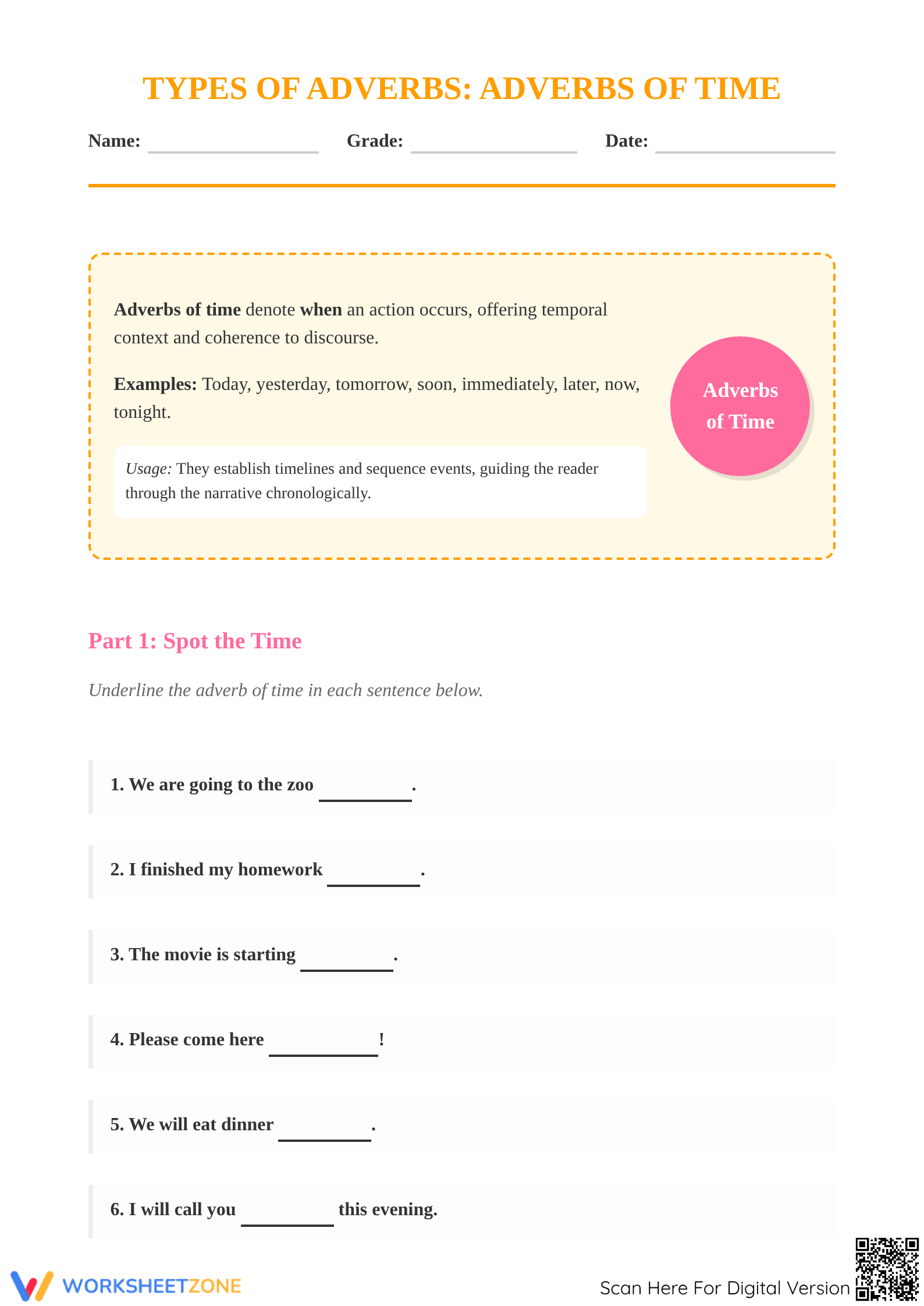
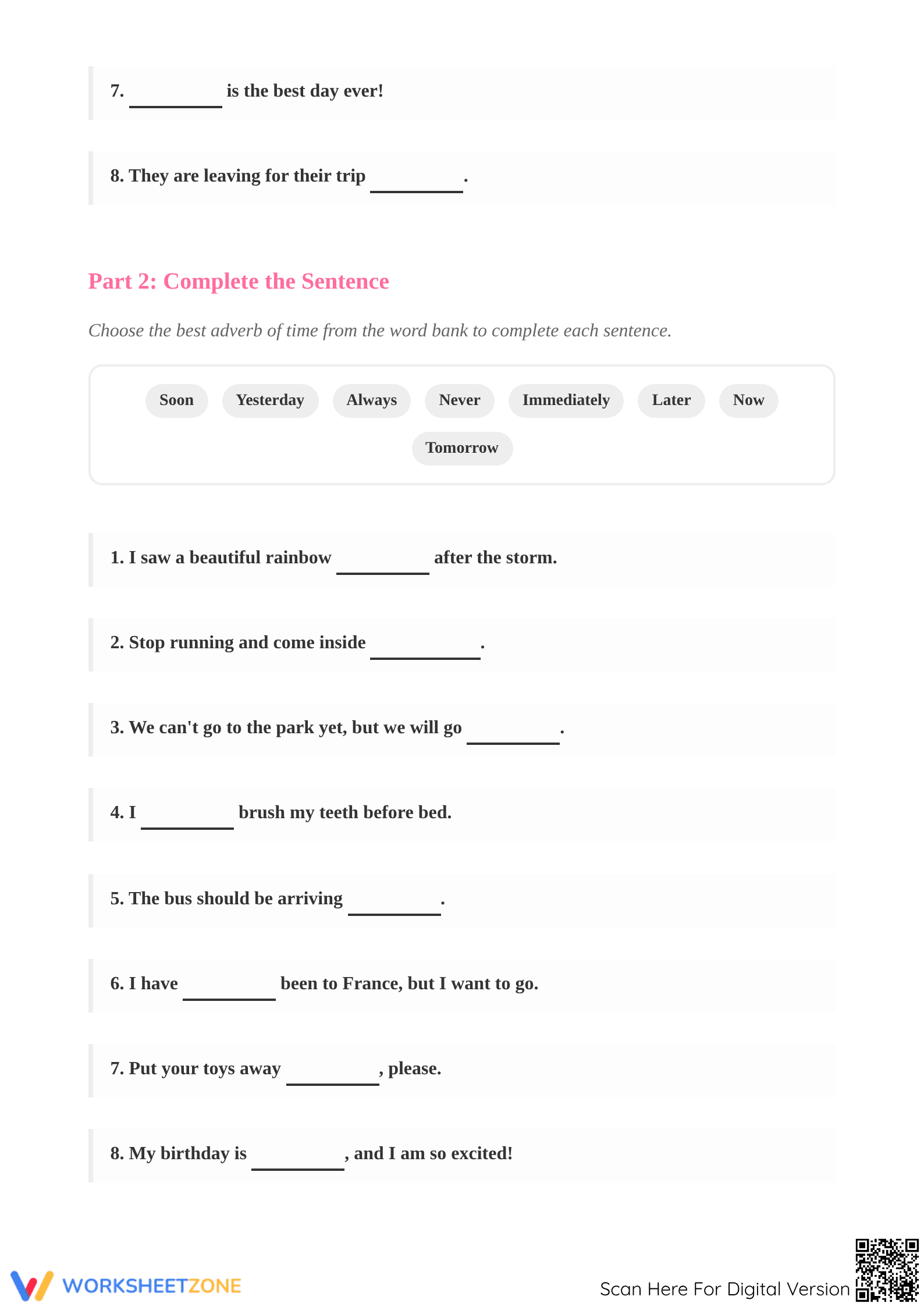
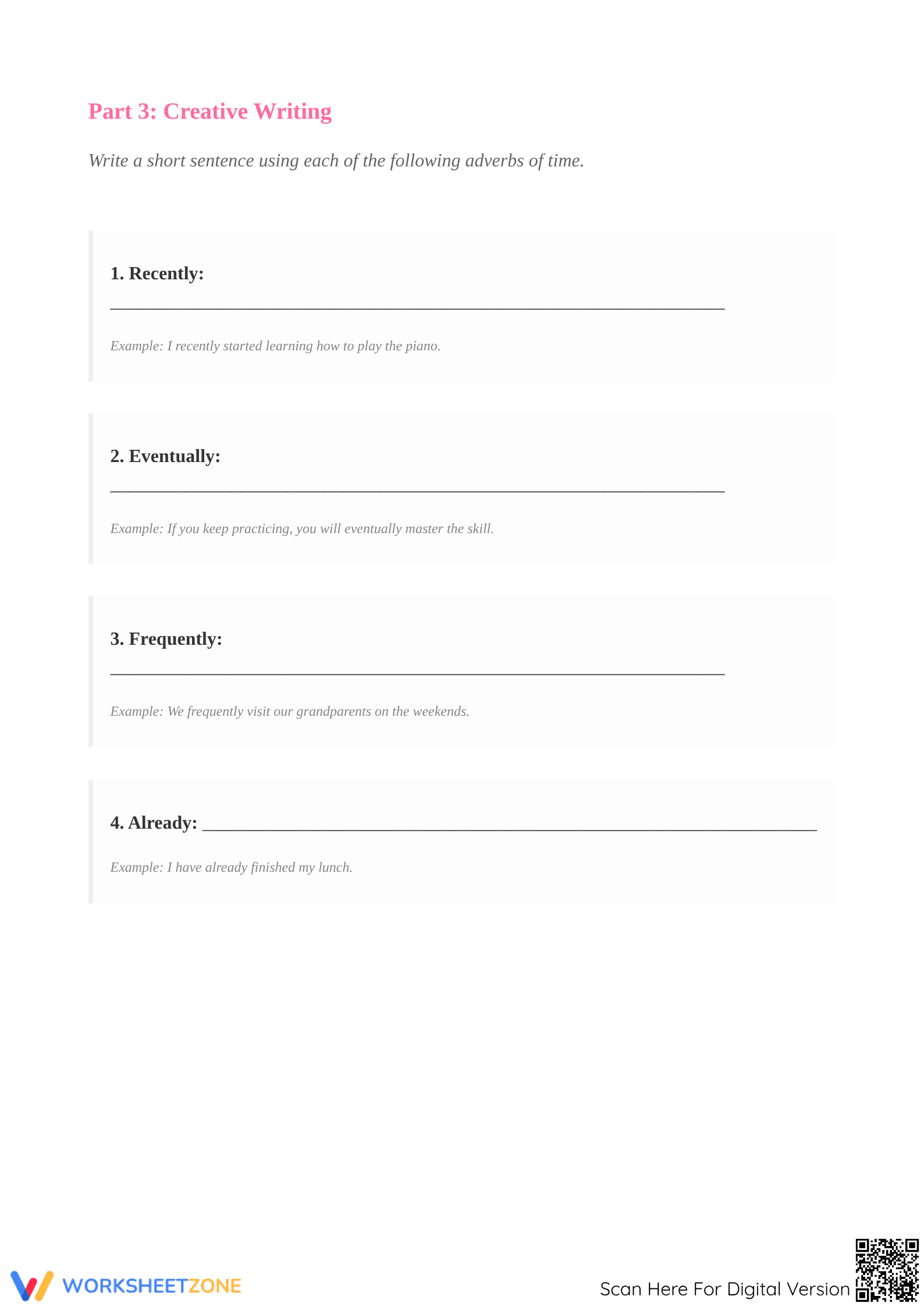
This comprehensive 3-page resource includes three distinct sections designed to build confidence. Part 1 features 8 identification tasks where students underline adverbs in context. Part 2 provides a word bank with 8 fill-in-the-blank sentences to test selection accuracy. Part 3 concludes with 4 creative writing prompts, requiring students to generate original sentences using specific temporal adverbs like eventually and frequently. A full answer key is provided for quick grading.
Skill Progression
- Guided Identification: 8 sentences focus on recognizing adverbs of time within simple and compound sentences, providing immediate success through underlining.
- Supported Selection: 8 tasks utilize a word bank (including Soon, Yesterday, and Immediately) to help students choose the most logical temporal marker for a given scenario.
- Independent Application: 4 open-ended prompts challenge students to apply advanced adverbs in their own writing, moving from recognition to creation.
This gradual-release model ensures students move from passive recognition to active, correct usage in their daily writing.
This resource is aligned with CCSS.ELA-LITERACY.L.4.1, which requires students to demonstrate command of the conventions of standard English grammar and usage. Specifically, it addresses the nuances of adverbial usage to clarify when actions occur. Both standard codes can be copied directly into lesson plans, IEP goals, or district curriculum mapping tools.
Use this worksheet as a formative assessment following a direct instruction lesson on parts of speech. It is particularly effective during the independent practice phase of a lesson. Teachers should observe if students can distinguish between adverbs of time and adverbs of manner. Completion typically takes 20 to 30 minutes, making it an ideal choice for morning work or a literacy center rotation.
This practice set is designed for Grade 4 students but serves as an excellent intervention tool for Grade 5 students needing a mechanics refresher. It is also highly beneficial for English Language Learners (ELL) who are mastering English verb tenses and temporal sequencing. Pair this with a narrative writing prompt or a timeline-based reading passage for maximum impact.
According to the RAND AIRS 2024 report on literacy instruction, explicit grammar practice focused on functional parts of speech significantly improves student writing clarity and syntactic variety. This worksheet targets the specific skill of using adverbs of time to establish coherence, a foundational requirement for meeting Grade 4 writing standards. By isolating temporal adverbs across 20 varied tasks, the resource provides the repetitive exposure necessary for long-term retention. Research suggests that when students can accurately identify and apply temporal markers, their ability to construct complex narratives increases. This alignment with evidence-based practices ensures that the worksheet is not just a filler activity but a targeted tool for linguistic development. The inclusion of a clear answer key and multi-modal tasks supports diverse learning needs within the standard classroom environment.


