


























Views
Downloads



Adverbs of Frequency Worksheet | Grade 4 Printable
Paste this activity's link or code into your existing LMS (Google Classroom, Canvas, Teams, Schoology, Moodle, etc.).
Students can open and work on the activity right away, with no student login required.
You'll still be able to track student progress and results from your teacher account.
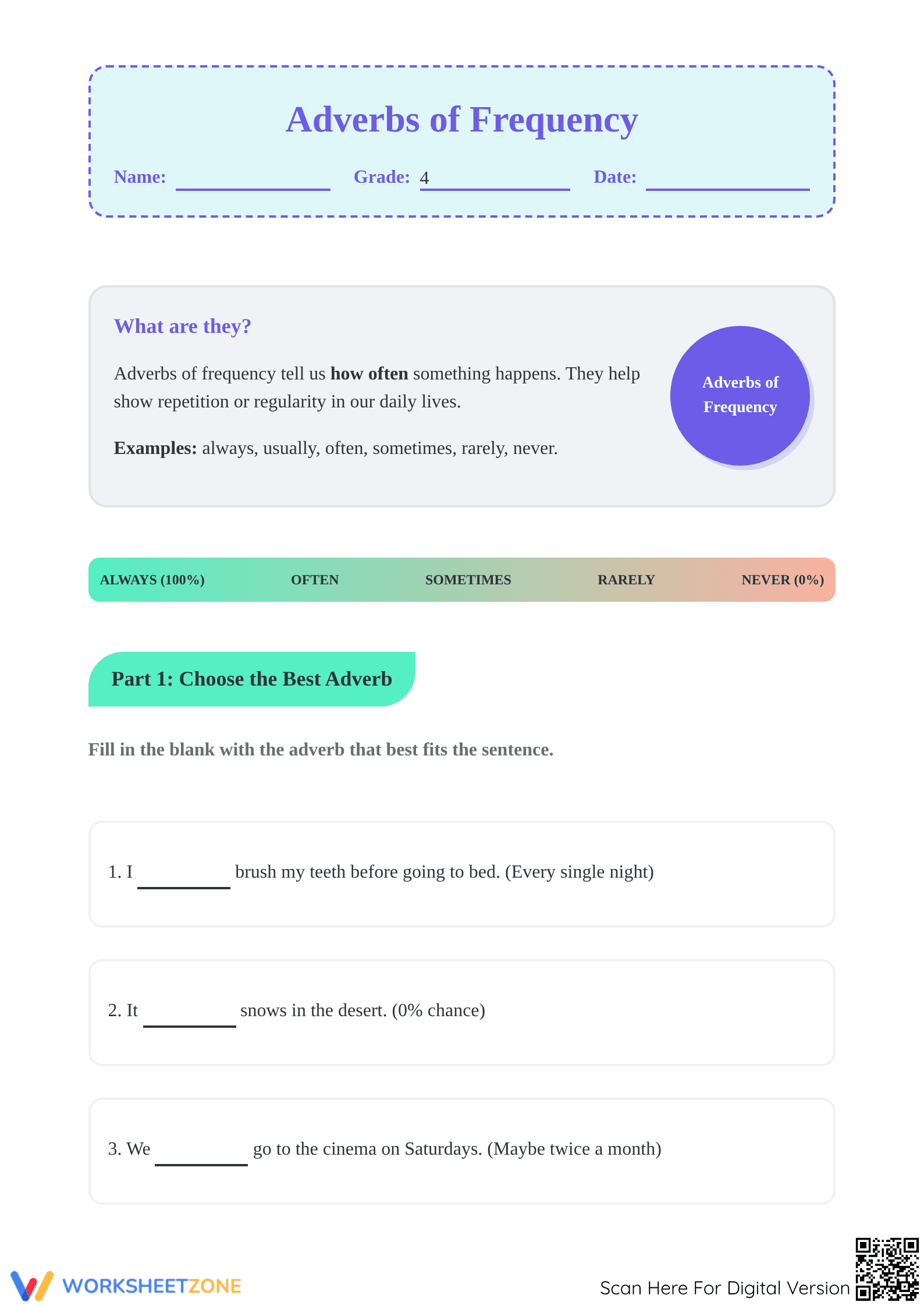
This Grade 4 grammar worksheet provides targeted practice with adverbs of frequency, helping students understand how to express the repetition or regularity of actions. By completing these exercises, learners will confidently use words like "always," "sometimes," and "never" to add detail and precision to their everyday writing.
At a Glance
- Grade: 4 · Subject: ELA
- Standard:
CCSS.ELA-LITERACY.L.4.1— Use standard English grammar and usage when writing- Skill Focus: Adverbs of frequency
- Format: 3 pages · 13 problems · Answer key included · PDF
- Best For: Independent practice
- Time: 15–20 minutes
This three-page resource features a clear introductory guide explaining adverbs of frequency alongside a helpful visual scale from 100% (always) to 0% (never). Students will work through 13 distinct tasks divided into three sections: fill-in-the-blank sentences, word scrambles, and original sentence creation. A complete answer key is provided for the first two sections to ensure quick and accurate grading.
- Guided practice: The first section offers 5 fill-in-the-blank problems where students select the correct adverb based on contextual clues provided in parentheses.
- Supported practice: The second section challenges students with 4 sentence scramble tasks, requiring them to place the adverb correctly before the main verb.
- Independent practice: The final section prompts students to write 4 original sentences about their own routines using specific frequency adverbs.
This gradual-release approach ensures students build confidence before applying the skill independently.
Aligned to primary standard CCSS.ELA-LITERACY.L.4.1: Demonstrate command of the conventions of standard English grammar and usage when writing or speaking. This resource specifically targets the correct application and placement of adverbs within sentence structures. Both standard codes can be copied directly into lesson plans, IEP goals, or district curriculum mapping tools.
Use this worksheet as an independent practice activity following direct instruction on parts of speech, or assign it as a meaningful homework task. As a formative assessment tip, review the sentence scramble section to quickly identify if students understand that adverbs of frequency typically precede the main verb. Expected completion time is 15 to 20 minutes.
This resource is designed for fourth-grade general education students, English Language Learners (ELLs), and students needing grammar intervention. The visual frequency scale provides excellent scaffolding for ELLs who are mastering English vocabulary nuances. Pair this worksheet with a daily routine anchor chart or a short reading passage to identify adverbs in context.
Mastering grammar conventions, specifically through standard CCSS.ELA-LITERACY.L.4.1, requires students to use standard English grammar and usage when writing. Explicit instruction in parts of speech, such as adverbs of frequency, significantly improves reading comprehension and writing clarity. According to Fisher & Frey (2014), providing students with structured, gradual-release practice allows them to internalize complex grammar rules more effectively than isolated memorization. When learners transition from identifying words to constructing their own sentences, they develop a deeper, more functional understanding of language mechanics. This targeted practice ensures that students not only recognize words like usually or rarely but also understand their syntactic placement and semantic impact. By integrating these exercises into regular instruction, educators can foster stronger, more expressive communicators who are well-prepared for advanced writing tasks.


