


























Views
Downloads

Adverb Placement Rules Printable Worksheet | Grade 4 ELA
Paste this activity's link or code into your existing LMS (Google Classroom, Canvas, Teams, Schoology, Moodle, etc.).
Students can open and work on the activity right away, with no student login required.
You'll still be able to track student progress and results from your teacher account.
This Grade 4 grammar worksheet helps students master adverb placement rules to improve sentence clarity. By working through targeted exercises, learners understand exactly where to position adverbs in relation to verbs, adjectives, and other adverbs, enhancing their overall writing proficiency.
At a Glance
- Grade: 4 · Subject: ELA
- Standard:
CCSS.ELA-LITERACY.L.4.1— Use standard English grammar and usage when writing.- Skill Focus: Adverb Placement
- Format: 3 pages · 20 problems · Answer key included · PDF
- Best For: Independent practice and grammar review
- Time: 20–30 minutes
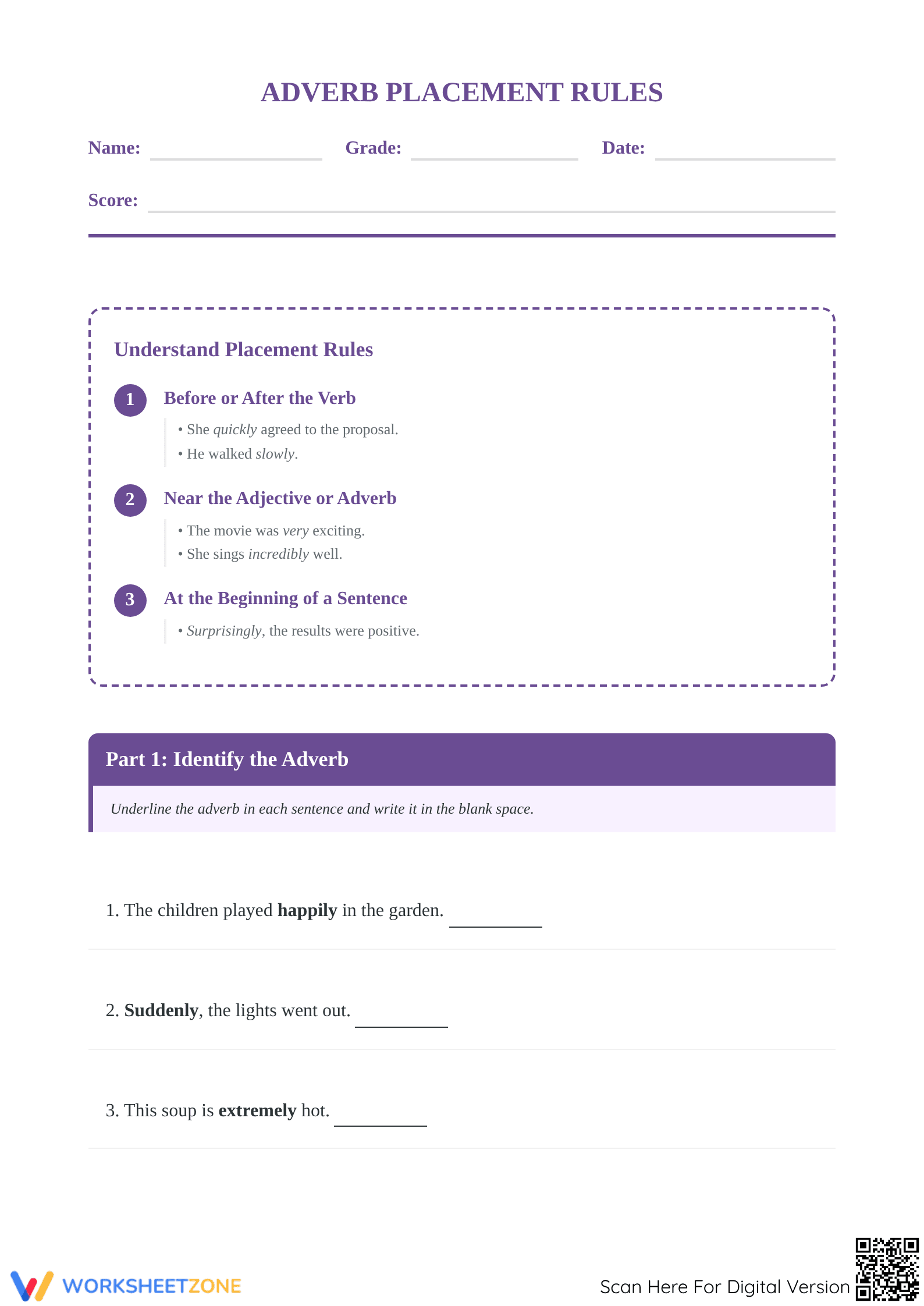
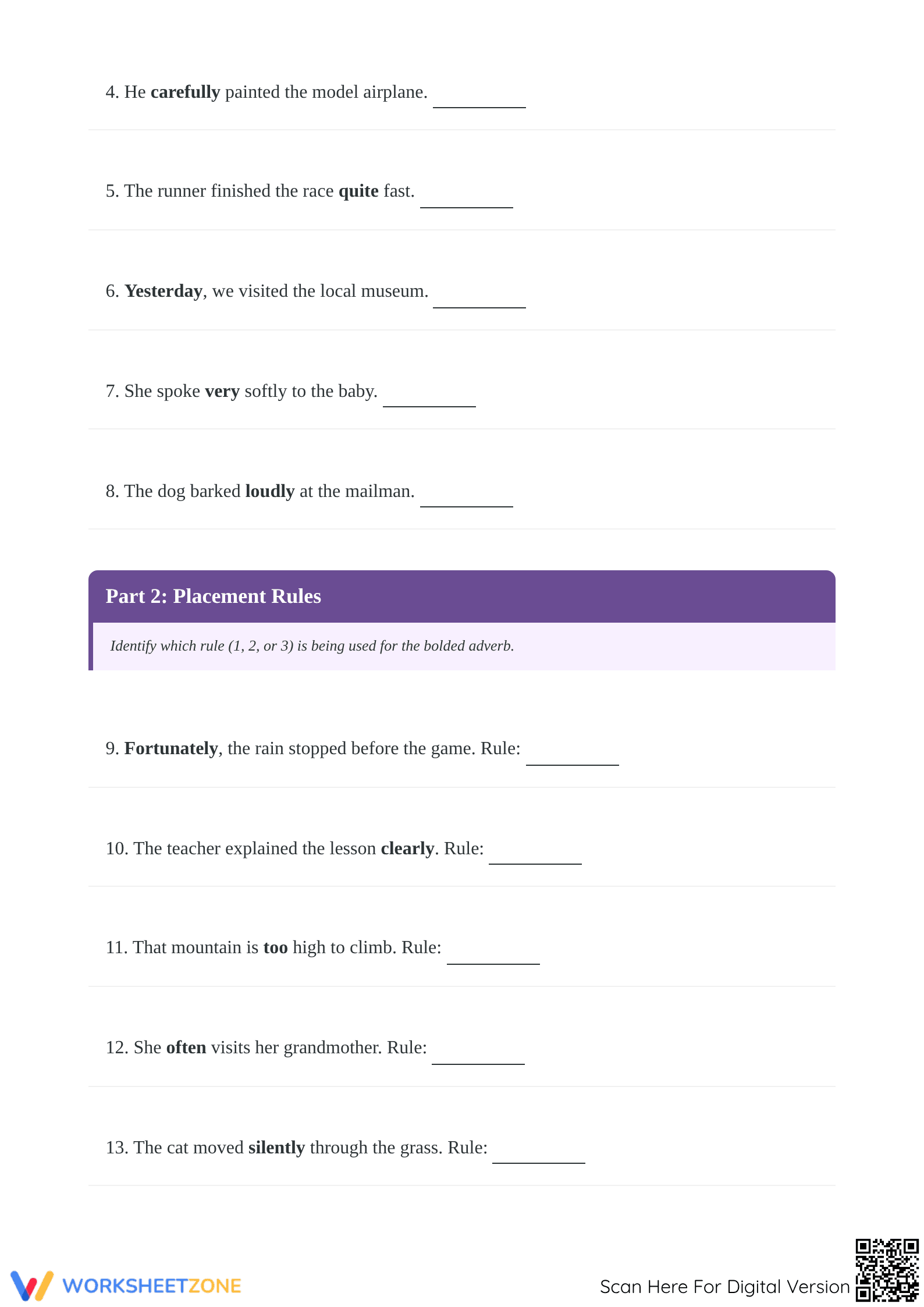
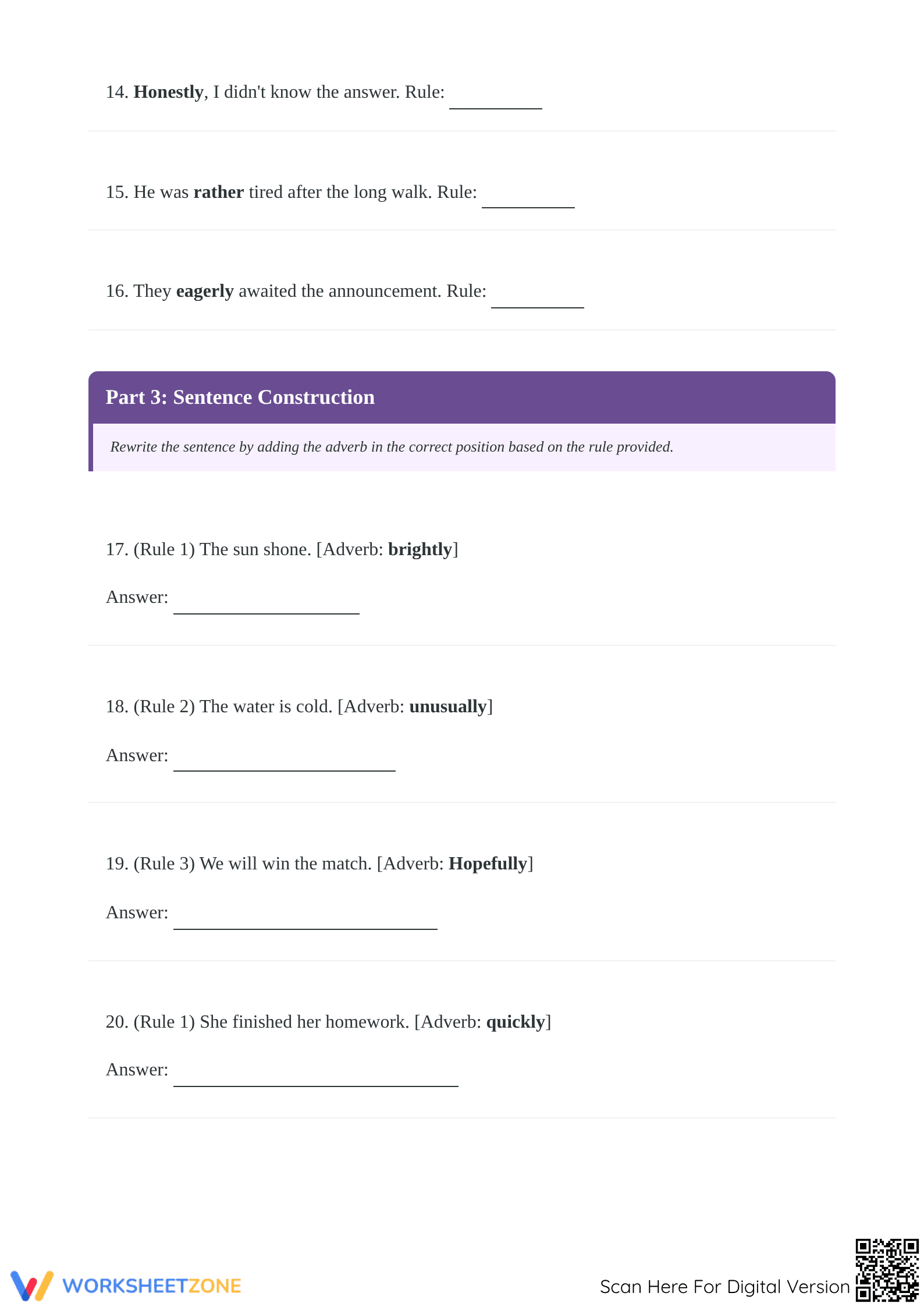
This three-page resource features a clear instructional reference box outlining three primary rules for adverb placement. Students complete 20 problems divided into three sections: identifying adverbs, categorizing the placement rule, and rewriting sentences to include an adverb correctly. A complete answer key is provided for accurate grading.
The worksheet follows a gradual-release model to build student confidence:
- Guided practice: The first 8 problems require students to identify and underline the adverb, reinforcing basic recognition.
- Supported practice: The next 8 problems ask learners to analyze bolded adverbs and match them to the specific placement rule.
- Independent practice: The final 4 problems challenge students to rewrite sentences, inserting a provided adverb into the correct position.
This structured approach ensures steady skill acquisition.
This resource is aligned to primary standard CCSS.ELA-LITERACY.L.4.1, requiring students to demonstrate command of the conventions of standard English grammar and usage when writing. By focusing on the precise placement of modifiers, it supports broader language comprehension. Both standard codes can be copied directly into lesson plans, IEP goals, or district curriculum mapping tools.
Deploy this worksheet following direct instruction on parts of speech to solidify understanding. It serves perfectly as a morning work assignment or a literacy center activity. While students work on the sentence construction section, teachers can use this as a formative assessment opportunity to observe if learners place adverbs logically. Expect students to complete the sequence in 20 to 30 minutes.
Designed primarily for fourth-grade students, this material provides excellent review for fifth graders needing grammar reinforcement. The explicit rule box makes it accessible for English Language Learners who benefit from visual syntax rules. Pair this worksheet with a mentor text read-aloud so students can hunt for adverbs in published literature.
Mastering standard English grammar and usage when writing is a critical component of elementary literacy development, directly addressed by CCSS.ELA-LITERACY.L.4.1. Explicit grammar instruction, particularly concerning the syntactic placement of modifiers like adverbs, significantly improves students' reading comprehension and expressive writing clarity. According to Fisher & Frey (2014), providing students with structured, progressive practice that moves from basic identification to active sentence construction is essential for transferring grammar skills from isolated exercises into authentic writing tasks. This resource facilitates that cognitive transfer by requiring learners to locate adverbs, justify their placement, and generate new sentences. By integrating clear rule definitions with immediate application, educators can effectively reduce syntactic errors and help students develop a more sophisticated command of written English.


