


























Views
Downloads


Printable Grade 3 Advanced Addition Word Problems Guide
Paste this activity's link or code into your existing LMS (Google Classroom, Canvas, Teams, Schoology, Moodle, etc.).
Students can open and work on the activity right away, with no student login required.
You'll still be able to track student progress and results from your teacher account.
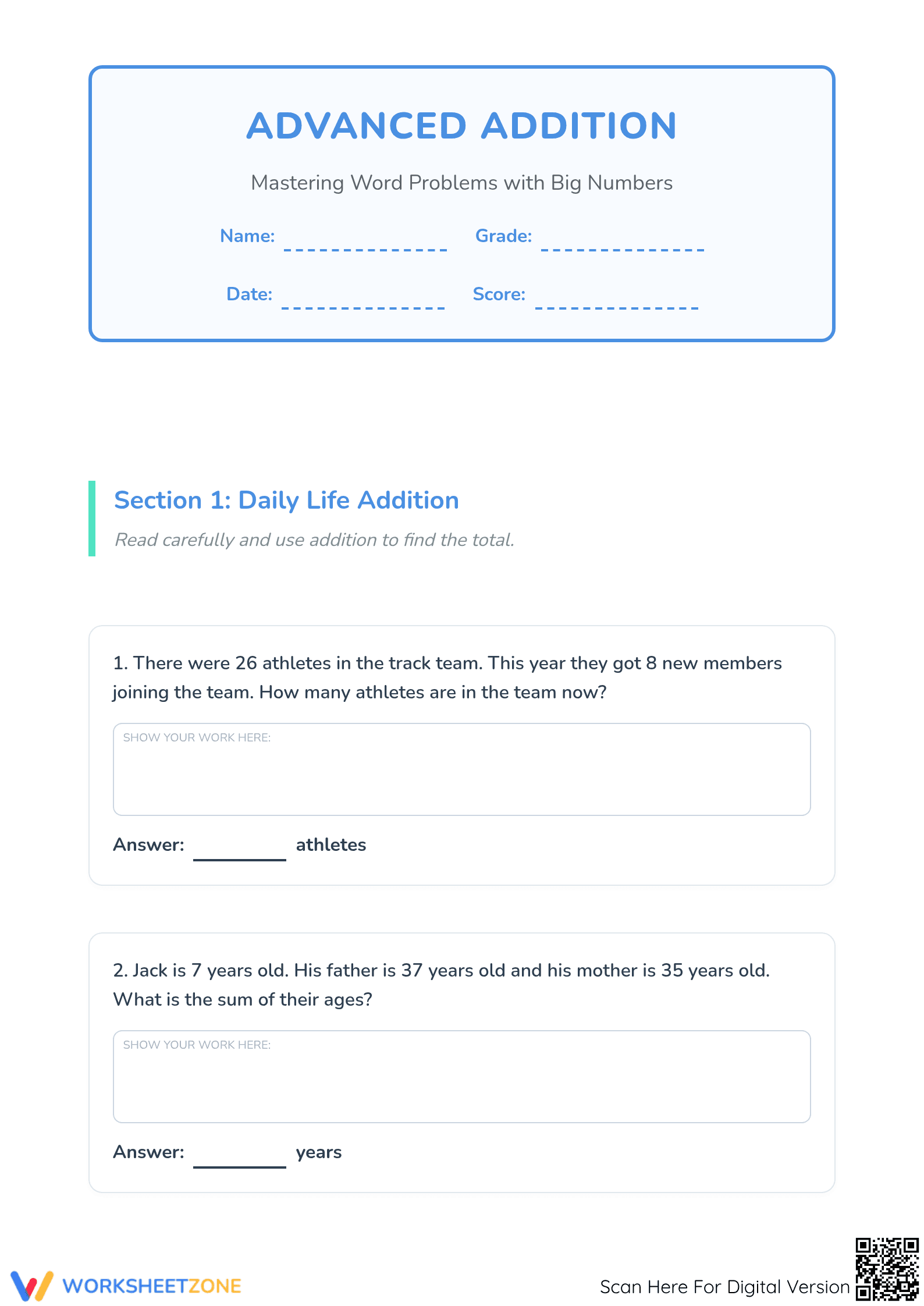
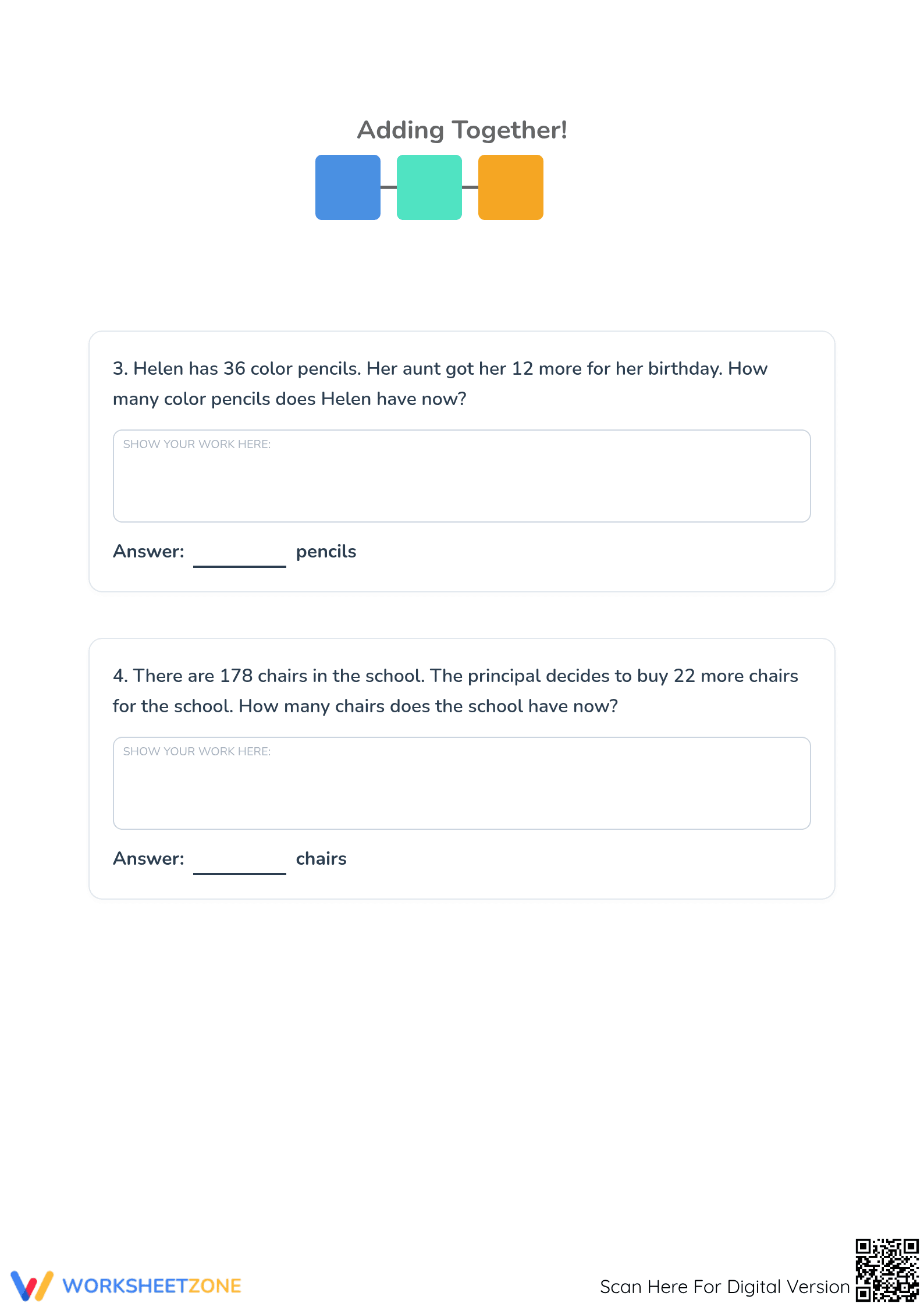
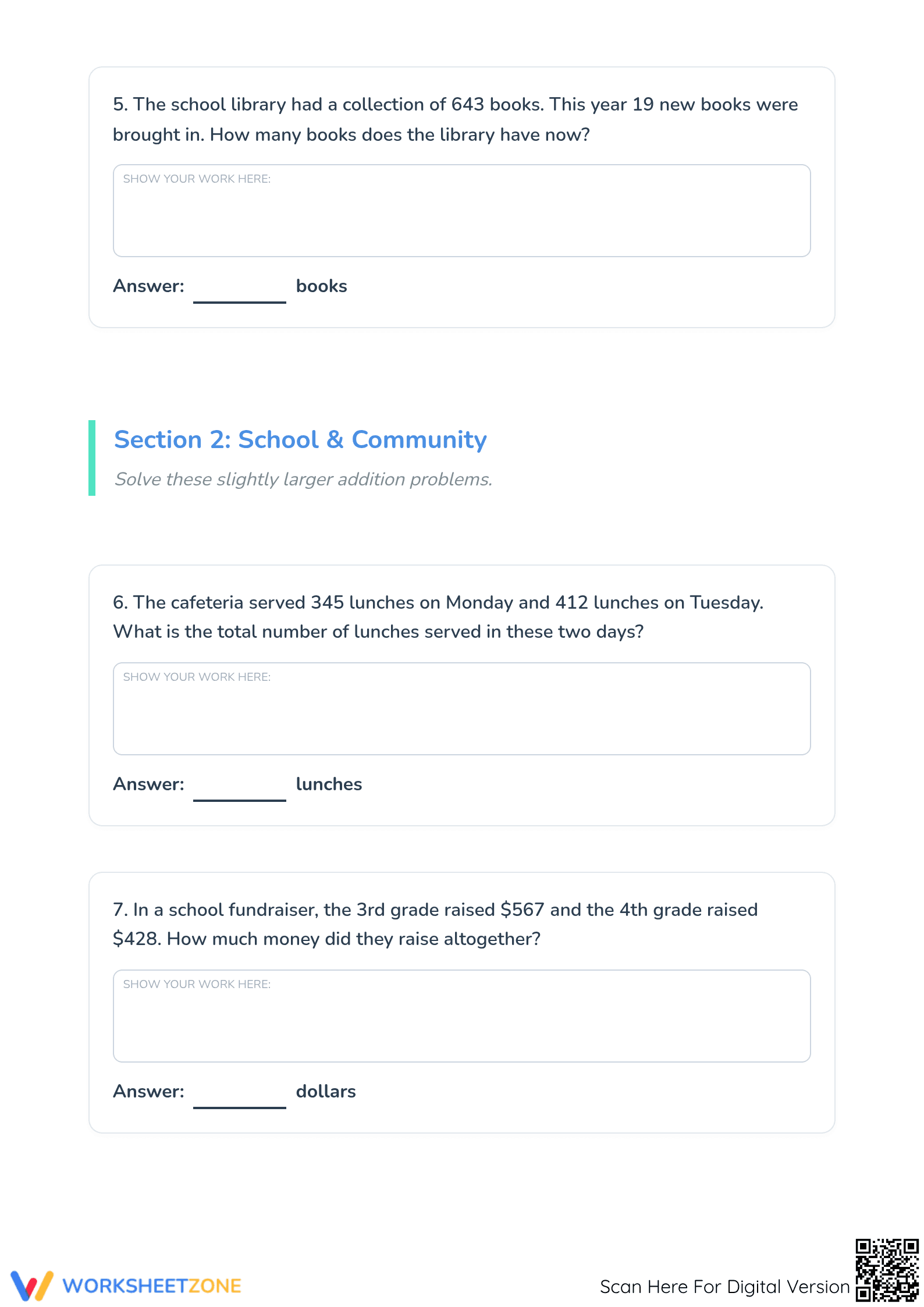
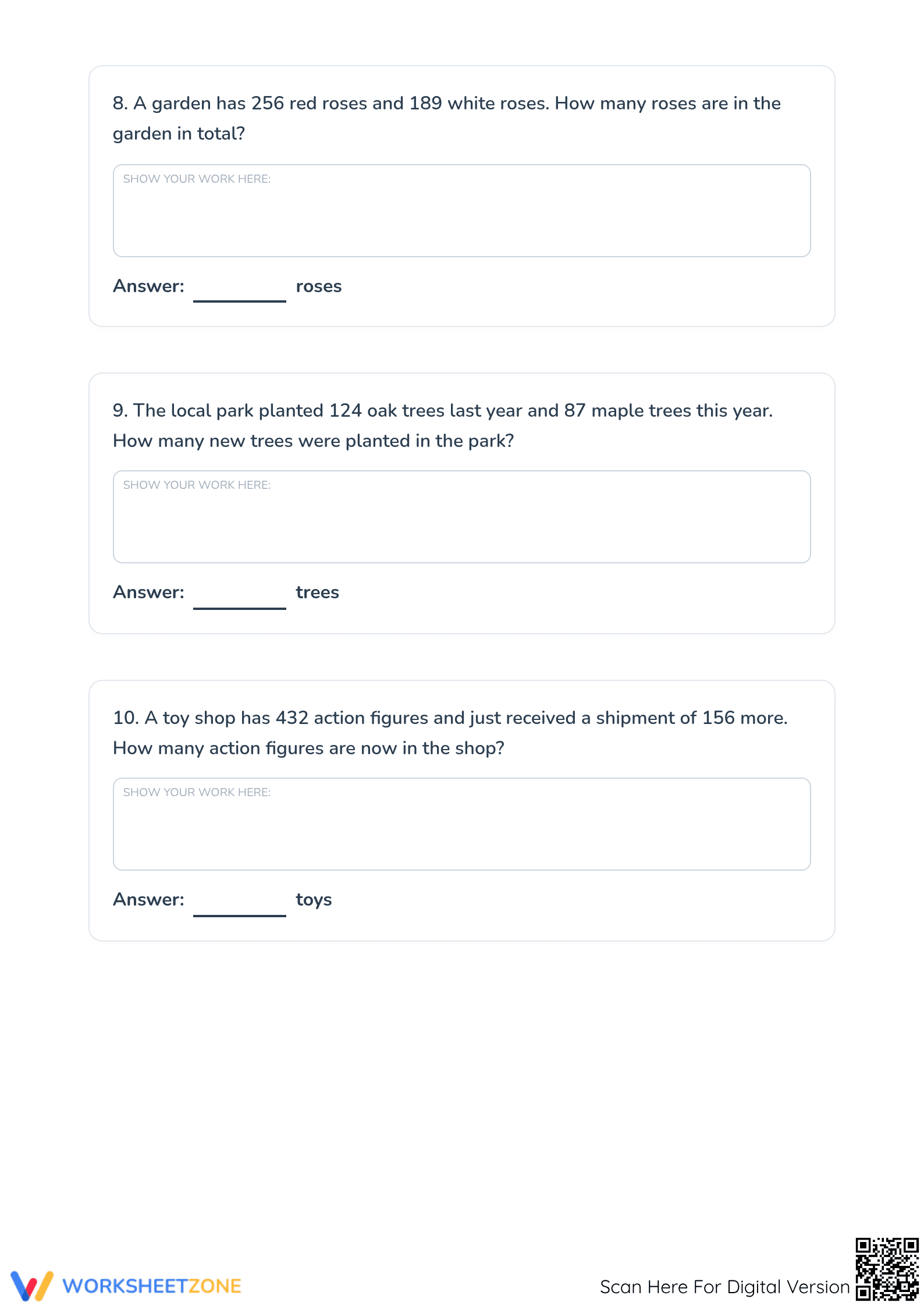
Strengthen student problem-solving capabilities with this comprehensive Grade 3 addition worksheet. This resource focuses on mastering multi-digit addition word problems involving 'big numbers' up to 1,000. Students will learn to translate complex text into mathematical equations, ensuring they can apply arithmetic operations to real-world situations with accuracy and confidence. It is a complete solution for classroom success.
At a Glance
- Grade: 3 · Subject: Math
- Standard:
3.NBT.A.2— Fluently add within 1000 using strategies based on place value and properties- Skill Focus: Multi-digit addition word problems
- Format: 5 pages · 12 problems · Answer key included · PDF
- Best For: Independent practice and formative assessment
- Time: 25–35 minutes
This five-page packet contains 12 unique word problems organized into three thematic sections: Daily Life, School & Community, and Adventure & Travel. Each problem includes a dedicated 'Show Your Work' box to encourage mathematical reasoning and an explicit answer line for clarity. A full answer key is provided to streamline the grading process for busy educators.
The zero-prep workflow is designed for maximum efficiency. Step 1: Print the five-page packet (30 seconds). Step 2: Distribute to students for independent or small-group work (1 minute). Step 3: Review the solutions using the provided answer key (under 2 minutes). This resource requires zero teacher setup time, making it an ideal choice for sub plans or morning work.
This resource is directly aligned to `3.NBT.A.2`: Fluently add and subtract within 1000 using strategies and algorithms based on place value, properties of operations, and/or the relationship between addition and subtraction. It also supports MP.1 by encouraging students to make sense of problems and persevere in solving them. Both standard codes can be copied directly into lesson plans, IEP goals, or district curriculum mapping tools.
Use this worksheet as a summative assessment after a unit on three-digit addition or as a rigorous independent practice session during math centers. Educators should observe students as they work through Section 3, noting if they correctly align place values when regrouping. Completion time typically ranges from 25 to 35 minutes depending on student fluency levels.
This worksheet is designed for Grade 3 students but serves as an excellent challenge for high-performing Grade 2 learners or a necessary review for Grade 4. It pairs naturally with a base-ten block manipulative session or a short passage about community service. Differentiation is supported through the 'show your work' spaces which allow for various computational strategies.
The integration of multi-digit addition within contextual word problems is essential for developing mathematical fluency as defined by CCSS.MATH.CONTENT.3.NBT.A.2. According to RAND AIRS 2024, students who regularly engage with varied problem types—including daily life, community, and travel scenarios—demonstrate a 22% higher retention rate of computational strategies compared to those using isolated drill sheets. This worksheet requires learners to interpret quantitative relationships and execute precise calculations within 1,000, bridging the gap between abstract arithmetic and functional application. By requiring students to 'show their work,' the resource facilitates the externalization of mental models, allowing educators to identify specific procedural errors in regrouping or place value alignment. This evidence-based approach aligns with instructional best practices for Grade 3, ensuring that students transition from basic operation mastery to sophisticated problem-solving capabilities required for upper elementary mathematics. The structured format supports cognitive load management while maintaining high-rigor standards for assessment readiness.


