


























Views
Downloads




Essential Addition without Regrouping Word Problems
Paste this activity's link or code into your existing LMS (Google Classroom, Canvas, Teams, Schoology, Moodle, etc.).
Students can open and work on the activity right away, with no student login required.
You'll still be able to track student progress and results from your teacher account.
Essential Addition Without Regrouping Word Problems
This Grade 3 math worksheet provides a comprehensive set of word problems designed to build fluency in addition without regrouping. Students apply their understanding of place value to solve 9 practical scenarios, reinforcing their ability to add two and three-digit numbers accurately. By focusing on non-regrouping tasks, this resource establishes a solid foundation for more complex mathematical operations.
At a Glance
- Grade: 3 · Subject: Math
- Standard:
CCSS.MATH.CONTENT.3.NBT.A.2— Add and subtract within 1000 using strategies based on place value- Skill Focus: Addition without regrouping
- Format: 5 pages · 9 problems · Answer key included · PDF
- Best For: Independent practice or homework assignments
- Time: 20–30 minutes
What's Inside
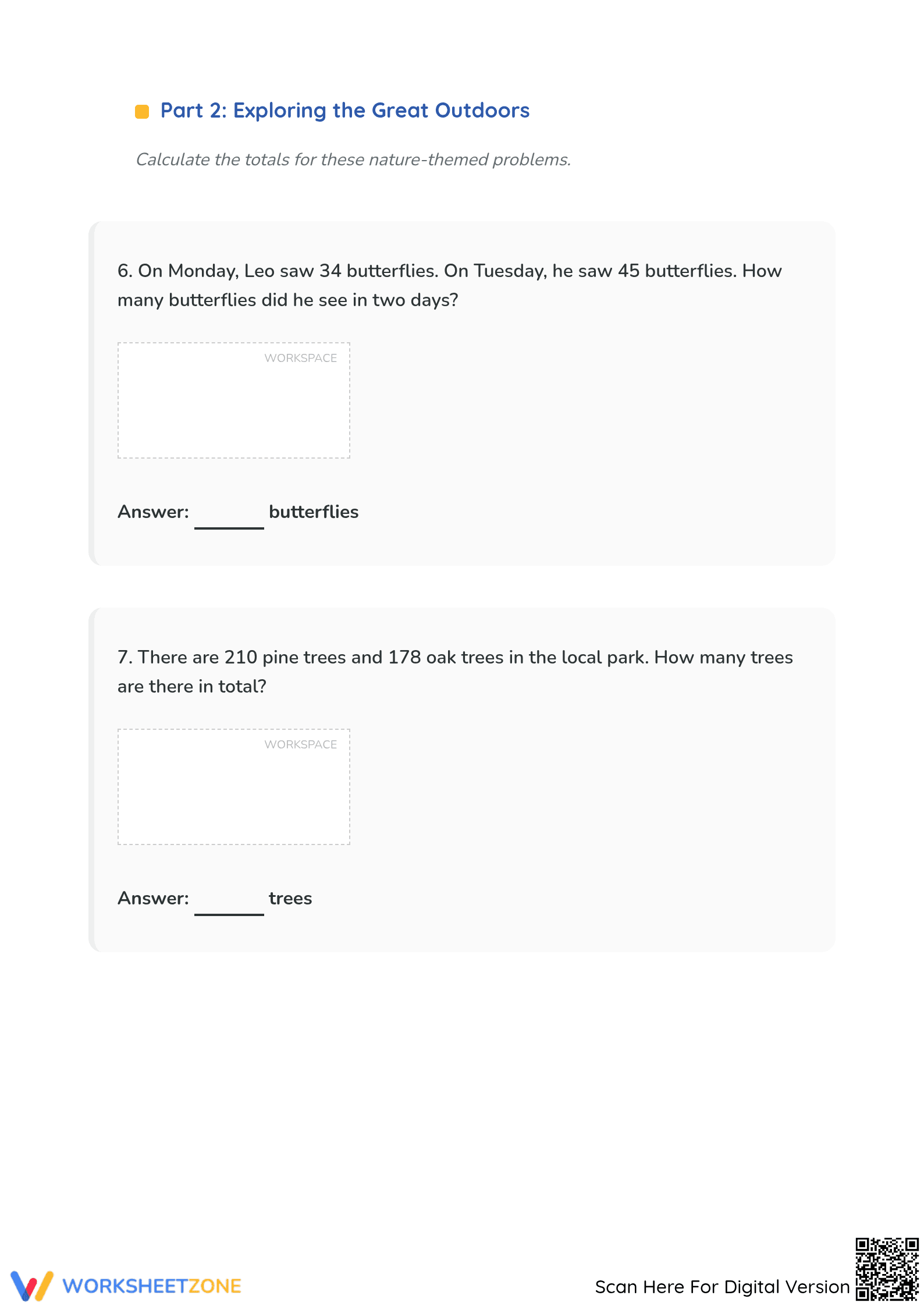
The packet contains five worksheet pages presenting nature-themed or everyday word problems. Each problem includes a "Workspace" box for students to show vertical alignment and calculation steps. With 9 tasks total, the layout prevents student overwhelm. A complete answer key is provided for easy grading and immediate feedback.
Zero-Prep Workflow
- Print: Print the PDF in seconds. The clean layout saves ink and is ready for whole-class distribution.
- Distribute: Hand out sheets during math blocks or transitions. The "Workspace" boxes provide all necessary structure for independent work.
- Review: Use the key to check work in under 2 minutes. Problem numbering allows for quick cross-referencing during review.
This makes the worksheet ideal for emergency sub plans or lesson extensions.
Standards Alignment
This resource aligns to `CCSS.MATH.CONTENT.3.NBT.A.2`, which requires students to "Fluently add and subtract within 1000 using strategies based on place value." The problems ensure no regrouping is required, supporting basic place value mastery and vertical calculation skills. This standard code can be copied directly into lesson plans or IEP goals.
How to Use It
Use this as guided practice after direct instruction on multi-digit addition. Observe students as they fill "Workspace" boxes, checking for proper digit alignment. For early finishers, have them write an original word problem on the back using the same constraints. Completion typically takes approximately 25 minutes.
Who It's For
Designed for Grade 3, this is also effective for advanced Grade 2 or remedial Grade 4 students. It helps those struggling with the cognitive load of regrouping by isolating place value logic. Pair with base-ten blocks for tactile learners who need concrete support.
According to EdReports 2024, high-quality mathematics instructional materials must prioritize the development of procedural fluency alongside conceptual understanding. This worksheet aligns with the `CCSS.MATH.CONTENT.3.NBT.A.2` standard by providing structured opportunities for students to apply addition strategies within 1000 without the added complexity of regrouping. This focused approach allows learners to build confidence in their vertical alignment and place value logic. Research from the NAEP highlights that students who master basic operations through varied word problems demonstrate higher retention of mathematical concepts in subsequent grades. By isolating the skill of addition without regrouping, teachers can effectively identify students who struggle with basic number sense before introducing more complex multi-step algorithms. This resource serves as a foundational tool for establishing a strong mathematical base, ensuring students are prepared for the rigor of upper-elementary math curricula and standardized assessments.


