


























Views
Downloads


Essential Multi-Digit Addition Worksheet | Grade 3 Math
Paste this activity's link or code into your existing LMS (Google Classroom, Canvas, Teams, Schoology, Moodle, etc.).
Students can open and work on the activity right away, with no student login required.
You'll still be able to track student progress and results from your teacher account.
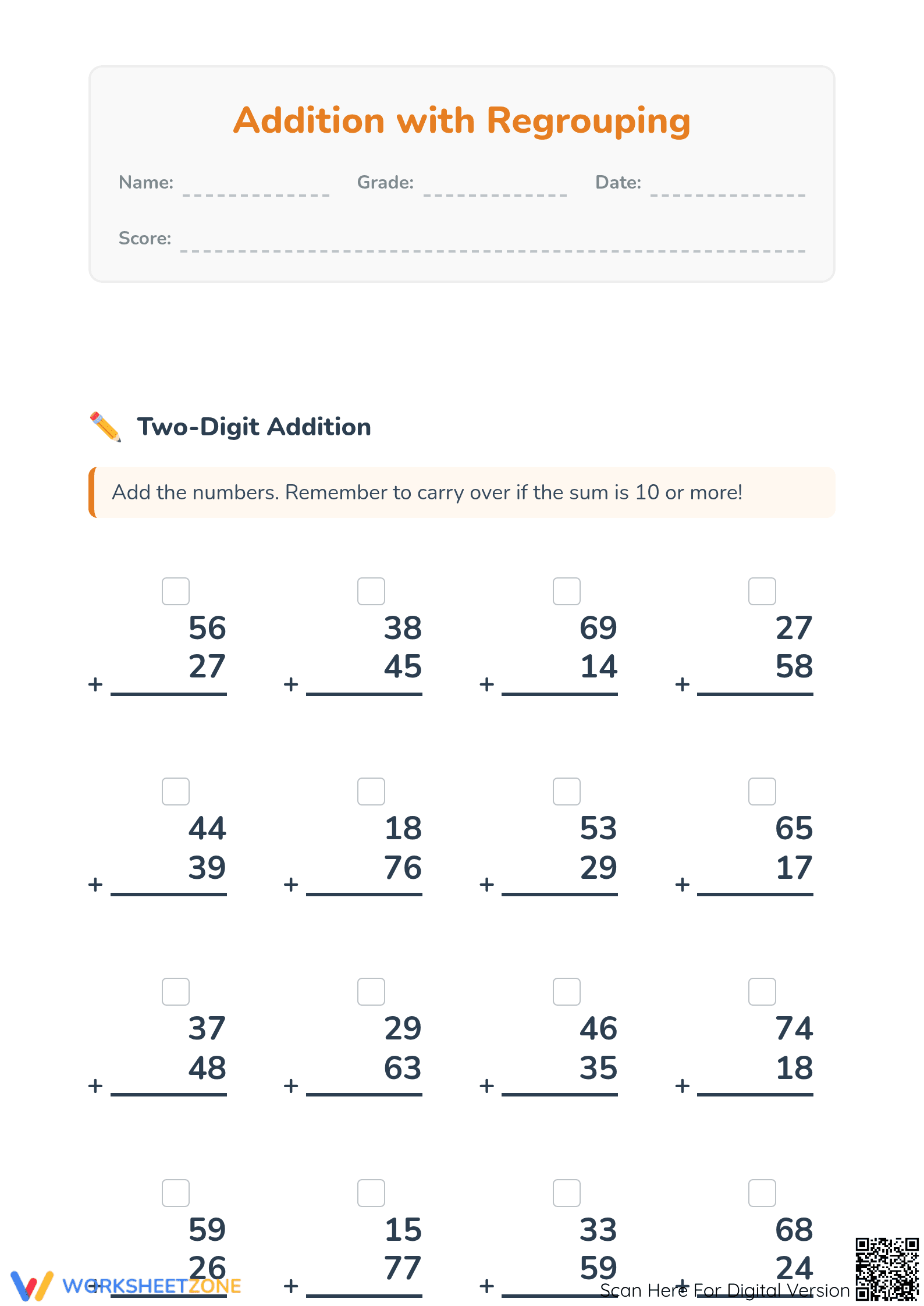
This two-page math worksheet provides focused practice on multi-digit addition with regrouping, a critical skill for third-grade students. It contains 28 carefully sequenced problems that guide learners from two-digit to three-digit addition, building confidence and fluency with the standard algorithm. It's a complete resource designed for effective, independent practice.
At a Glance
- Grade: 3 · Subject: Math
- Standard:
CCSS.MATH.CONTENT.3.NBT.A.2— Fluently add within 1000 using the standard algorithm.- Skill Focus: Multi-digit addition with regrouping
- Format: 2 pages · 28 problems · Answer key included · PDF
- Best For: Independent practice or skill reinforcement
- Time: 15–25 minutes
What's Inside
This resource includes a two-page worksheet and a full answer key. The first page has 16 two-digit addition problems requiring regrouping. The second page presents eight three-digit problems and four mixed-digit problems to ensure students apply the concept flexibly. The layout provides ample space for calculations.
A Gradual Release of Responsibility
The worksheet uses a proven gradual-release model to build student independence.
- Guided Practice: The first 16 two-digit problems let students apply the concept of regrouping in a controlled, familiar context, focusing on carrying over from the ones to the tens place.
- Supported Practice: The next eight three-digit problems offer supported practice, extending the regrouping skill to the hundreds place and sometimes requiring multiple 'carries' in a single problem.
- Independent Practice: A final set of four mixed problems assesses fluent application of the algorithm, serving as a quick exit ticket to gauge mastery.
Standards Alignment
This worksheet is directly aligned with CCSS.MATH.CONTENT.3.NBT.A.2, which requires students to fluently add and subtract within 1000 using strategies and algorithms based on place value. It also supports foundational second-grade skills (2.NBT.B.7) and prepares students for more complex calculations in fourth grade (4.NBT.B.4). Both standard codes can be copied directly into lesson plans, IEP goals, or district curriculum mapping tools.
How to Use It
Use this worksheet for independent practice after a direct instruction lesson on addition with regrouping, in a math center rotation, or as homework to reinforce the skill. For a formative assessment, observe which students are consistently remembering to 'carry' and which are struggling with the transition from two- to three-digit problems. Most students will complete the worksheet in 15 to 25 minutes.
Who It's For
This resource is designed for third-grade students solidifying their understanding of the standard addition algorithm. It can be used for advanced second graders ready for a challenge or for fourth-grade students needing targeted review. Pair this worksheet with a place value anchor chart to provide visual support for students who need to track the value of regrouped tens and hundreds.
Procedural fluency with operations like multi-digit addition is a cornerstone of elementary mathematics, directly impacting future success in algebra and beyond. This worksheet supports the development of this fluency as outlined in CCSS.MATH.CONTENT.3.NBT.A.2. By providing a structured sequence of 28 problems, from two-digit to three-digit regrouping, it employs the principle of deliberate practice. Research from the `RAND AIRS 2024` study on foundational skills emphasizes that such practice, when combined with a clear progression of complexity, is highly effective for building automaticity. The worksheet's design, which isolates the skill of regrouping while gradually increasing the place value demands, allows students to internalize the standard algorithm. This targeted approach ensures learners not only find the correct sum but also build a durable, replicable understanding of place value concepts in action, which is essential for more advanced mathematical reasoning.


