


























Views
Downloads
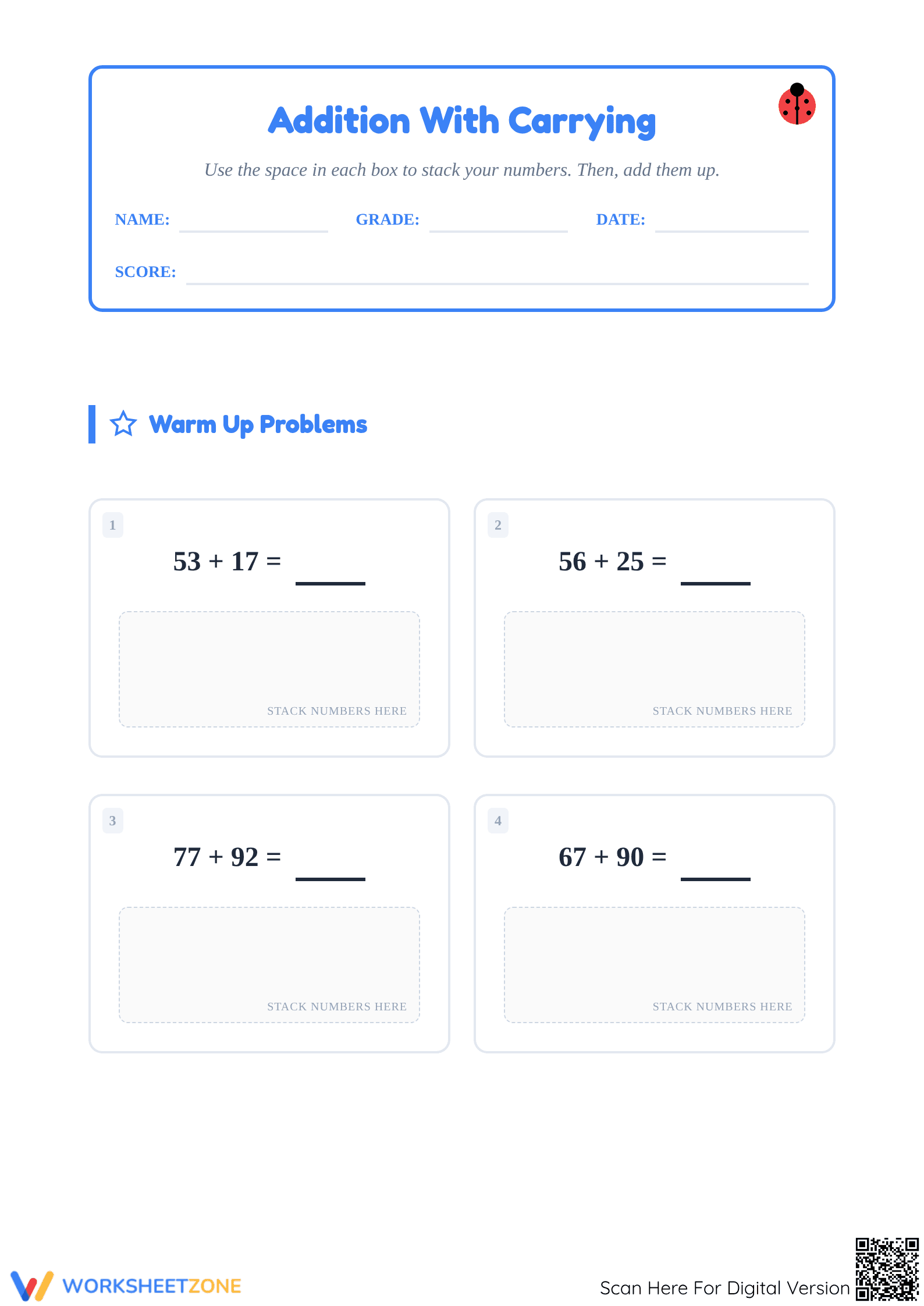


Printable 2-Digit Addition with Carrying Worksheet | Grade 2
Paste this activity's link or code into your existing LMS (Google Classroom, Canvas, Teams, Schoology, Moodle, etc.).
Students can open and work on the activity right away, with no student login required.
You'll still be able to track student progress and results from your teacher account.
Mastering 2-Digit Addition with Regrouping
This Grade 2 mathematics resource provides targeted practice for students learning to navigate the complexities of addition with carrying. By focusing on the structural requirement of vertical alignment, students develop the procedural fluency necessary to solve multi-digit problems with confidence and accuracy. The worksheet guides learners through eighteen specific addition tasks designed to reinforce place value concepts.
At a Glance
- Grade: 2 · Subject: Math
- Standard:
2.NBT.B.7— Add within 1000 using strategies based on place value and regrouping- Skill Focus: 2-Digit Addition with Carrying
- Format: 4 pages · 18 problems · Answer key included · PDF
- Best For: Individual practice or morning work sessions
- Time: 20–30 minutes
What's Inside
The packet includes four distinct pages containing eighteen addition problems. Each page features clear, designated workspaces labeled "Stack Numbers Here," encouraging students to rewrite horizontal equations into vertical form. This structural support ensures that ones and tens columns are properly aligned before the calculation begins. A full answer key is provided for immediate feedback and grading efficiency.
Skill Progression
- Guided Practice: The "Warm Up Problems" section contains 4 tasks where students begin the process of vertical stacking with simple carrying requirements.
- Supported Practice: Ten "More Practice" problems provide the repetition needed to internalize the carrying algorithm across varied number pairs.
- Independent Practice: Four "Super Challenge" problems at the end require students to apply their skills to larger sums, testing mastery of the regrouping process.
This progression follows the gradual-release model, moving from initial scaffolded attempts to independent execution of the standard addition algorithm.
Standards Alignment
This resource is specifically aligned to 2.NBT.B.7, which requires students to add and subtract within 1000 using concrete models or drawings and strategies based on place value. The worksheet focuses on the standard algorithm for two-digit numbers, emphasizing that in adding two-digit numbers, one adds tens and tens, ones and ones, and sometimes it is necessary to compose a ten. This standard code can be copied directly into lesson plans or IEP goals.
How to Use It
This worksheet is ideal for the "You Do" phase of a lesson following direct instruction on regrouping. Assign the warm-up section during a small-group rotation to check for place value alignment. For a formative assessment tip, observe students during the "More Practice" section to ensure they are correctly placing the "carried" ten above the tens column. Most students will complete the eighteen problems within 25 minutes.
Who It's For
This resource is designed for second-grade students who have mastered basic addition facts and are ready to transition to multi-digit operations. It serves as an excellent intervention tool for third-grade students who require a refresher on regrouping. Pair this worksheet with place-value blocks or an anchor chart showing the step-by-step regrouping process for maximum instructional impact.
Research emphasizes that the transition to multi-digit addition with regrouping is critical in early elementary mathematics. This Grade 2 worksheet provides a structured bridge for students mastering 2.NBT.B.7 by requiring the explicit stacking of numbers, which reinforces place value understanding. By providing 18 distinct problems across Warm Up, More Practice, and Super Challenge tiers, the resource facilitates a gradual release of responsibility. This specific pedagogical approach—moving from scaffolded vertical stacking to independent calculation—aligns with evidence-based practices for procedural fluency. Teachers can utilize the clear workspace to identify exactly where place value misconceptions occur, specifically during the regrouping phase. As a standalone resource, this addition with carrying worksheet offers the high-repetition practice necessary to internalize the standard algorithm for addition within 100, ensuring students are prepared for more complex three-digit calculations in subsequent units.


