


























Views
Downloads


Addition with Carrying Worksheet | Essential Grade 2 Math
Paste this activity's link or code into your existing LMS (Google Classroom, Canvas, Teams, Schoology, Moodle, etc.).
Students can open and work on the activity right away, with no student login required.
You'll still be able to track student progress and results from your teacher account.
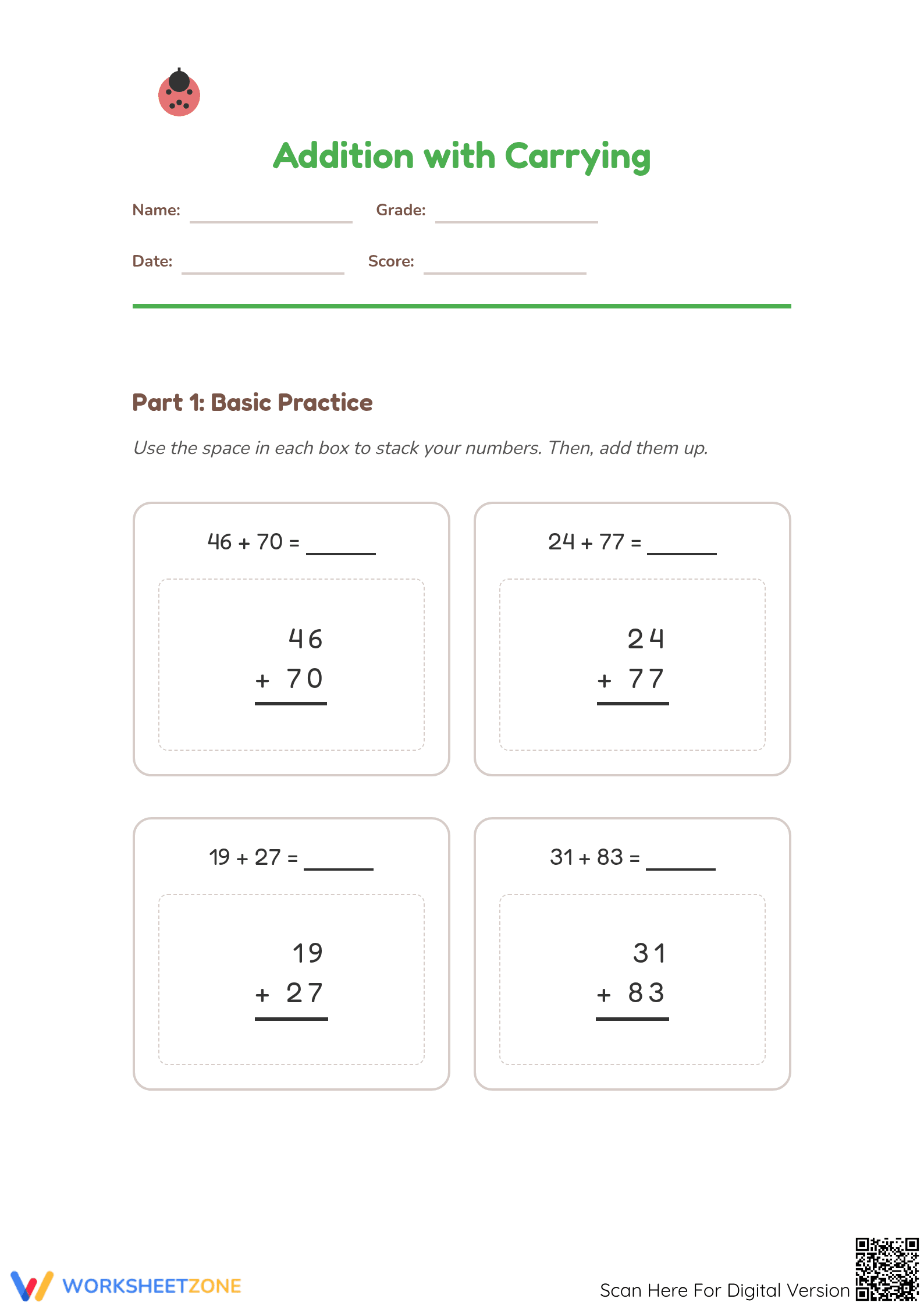
This Grade 2 math worksheet helps students master two-digit addition with regrouping through a structured, multi-page progression. By solving 20 carefully sequenced problems, learners build the computational fluency required for multi-digit operations. This printable resource ensures students move from basic vertical addition to more complex challenge problems with confidence and accuracy.
At a Glance
- Grade: 2 · Subject: Math
- Standard:
2.NBT.B.7— Add within 1000 using strategies based on place value and properties of operations- Skill Focus: 2-Digit Addition with Carrying
- Format: 4 pages · 20 problems · Answer key included · PDF
- Best For: Independent practice and formative assessment
- Time: 25–35 minutes
What's Inside
This comprehensive PDF pack contains four pages of targeted addition practice. It includes 20 vertical addition expressions, ranging from basic introductory problems to a dedicated "Challenge Zone" with larger two-digit numbers. The layout provides ample white space for students to show their carrying/regrouping marks. A complete four-page answer key is included for rapid grading or student self-check.
Zero-Prep Workflow
Teachers can implement this resource in three simple steps. First, print the four-page packet (30 seconds). Second, distribute to students as a morning work assignment or independent center activity (1 minute). Third, use the included answer key to verify student accuracy or facilitate a peer-review session (1 minute). This efficient workflow makes it an ideal choice for emergency sub plans or last-minute homework assignments.
Standards Alignment
This resource is directly aligned to 2.NBT.B.7, which requires students to add and subtract within 1000 using concrete models or strategies based on place value. While focused on two-digit numbers, it serves as the foundational bridge to three-digit operations. This standard code can be copied directly into lesson plans, IEP goals, or district curriculum mapping tools to ensure instructional compliance.
How to Use It
Use this worksheet during the "independent practice" phase of a lesson on regrouping. After direct instruction, assign the first page to observe if students are correctly placing the carried ten in the tens column. For students who finish early, the "Challenge Zone" provides an immediate extension. A quick scan of the carrying marks serves as a powerful formative assessment indicator for small-group intervention.
Who It's For
This resource is designed for Grade 2 students learning the standard algorithm for addition. It is also highly effective for Grade 3 students requiring remedial support or Grade 1 students ready for enrichment. Pair this worksheet with base-ten blocks or place-value mats to provide concrete scaffolding for learners struggling with the abstract concept of carrying.
The mastery of multi-digit addition with regrouping is a critical milestone in primary mathematics, as identified by standard 2.NBT.B.7. This skill requires students to understand that the ten created by adding ones must be composed and relocated to the tens place—a concept known as carrying. Research by Fisher & Frey (2014) emphasizes the importance of "gradual release" in mathematics, where students move from highly supported examples to independent application. This worksheet applies that principle by providing a "Basic Practice" section followed by a "Challenge Zone," allowing students to solidify their procedural fluency before tackling more complex numeric combinations. By providing 20 unique problems, the resource ensures sufficient repetition to move the regrouping process into long-term procedural memory. The inclusion of a clear answer key further supports the instructional cycle by providing immediate feedback, which is essential for correcting misconceptions early in the learning process.


