




























Views
Downloads



Printable Base-10 Block Addition Worksheet | Grade 1-2 Math

Paste this activity's link or code into your existing LMS (Google Classroom, Canvas, Teams, Schoology, Moodle, etc.).
Students can open and work on the activity right away, with no student login required.
You'll still be able to track student progress and results from your teacher account.
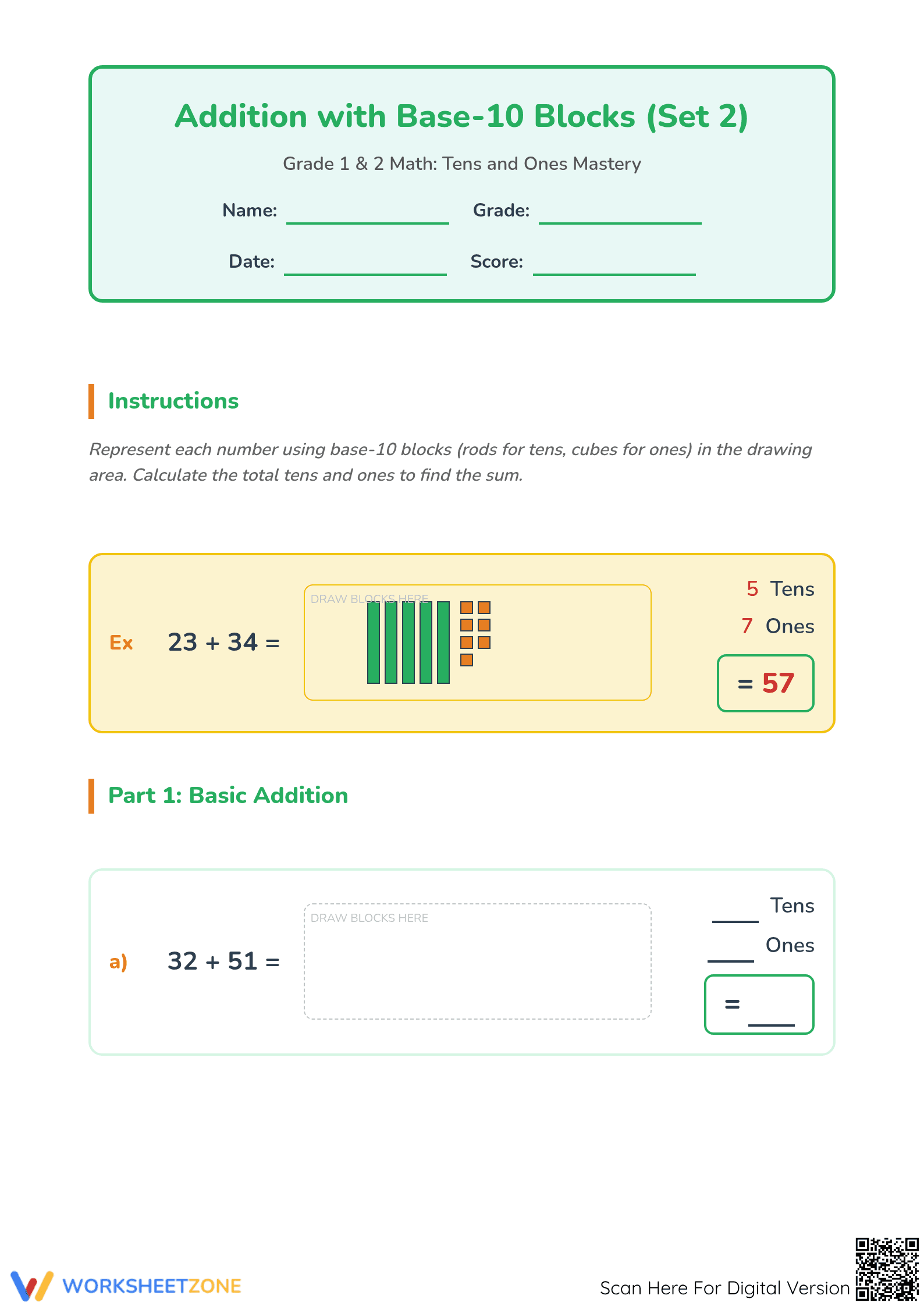
This comprehensive 5-page math worksheet focuses on double-digit addition using concrete visual representations. Students utilize base-10 block drawings—rods for tens and cubes for ones—to decompose numbers and find accurate sums. By bridging the gap between physical manipulatives and abstract equations, this resource ensures learners develop a robust understanding of place value and regrouping.
At a Glance
- Grade: 1–2 · Subject: Math
- Standard:
CCSS.MATH.CONTENT.1.NBT.C.4— Add within 100 using concrete models or drawings and strategies based on place value- Skill Focus: Addition with base-10 blocks
- Format: 5 pages · 17 problems · Answer key included · PDF
- Best For: Independent practice and visual place value reinforcement
- Time: 25–35 minutes
What's Inside
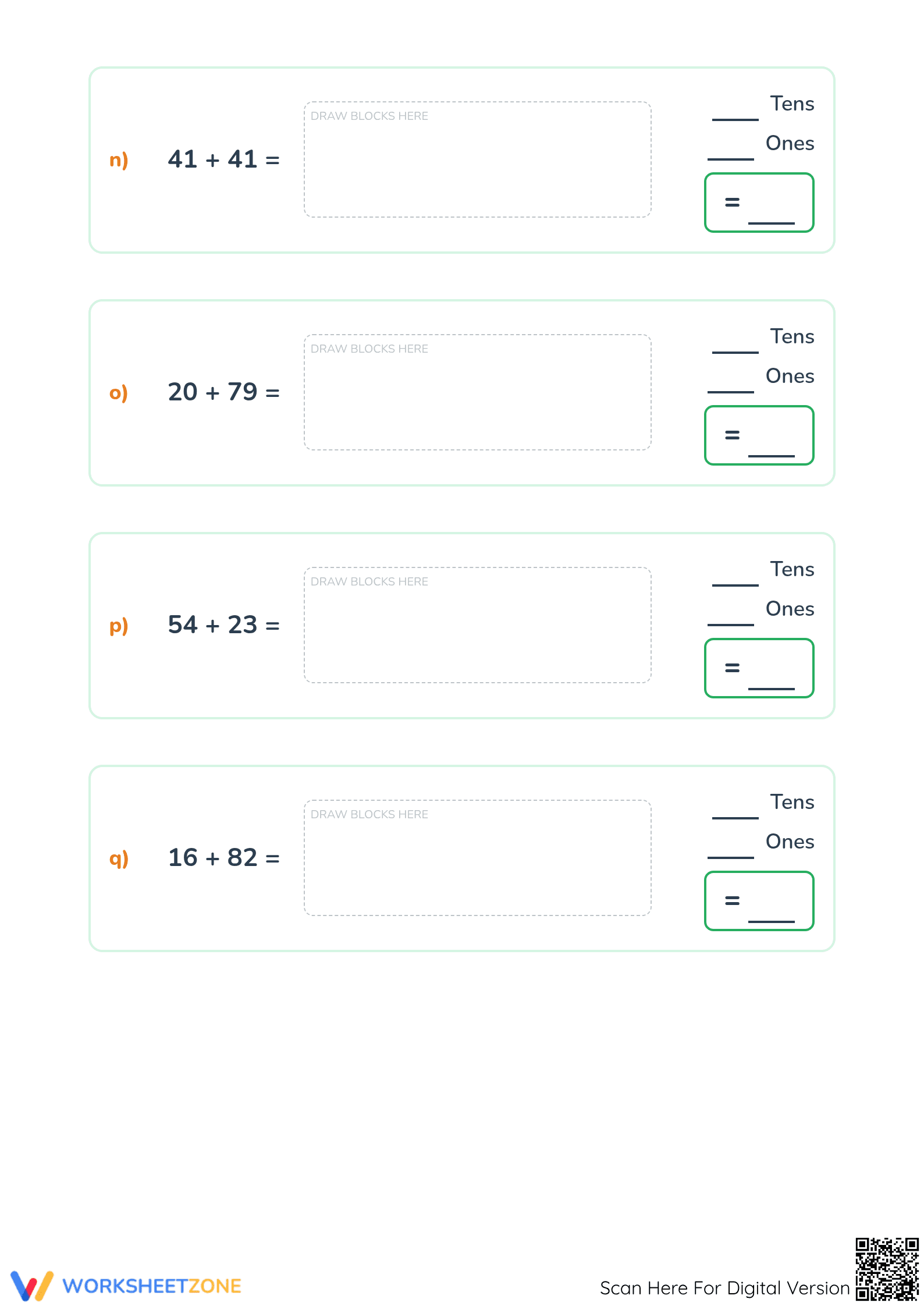
This resource contains 17 carefully scaffolded addition problems across two distinct parts. Part 1 focuses on basic addition with visual prompts, while Part 2, titled "Double Digit Fun," increases the complexity to build fluency. Every page includes dedicated "Draw Blocks Here" areas for rods and cubes, alongside a numeric breakdown for tens and ones, ensuring a full answer key is ready for immediate feedback.
Skill Progression
- Guided practice: The worksheet begins with a worked example showing 23 + 34, explicitly modeling how to draw rods and cubes and transfer those counts to the final sum box.
- Supported practice: The first 12 problems (a–l) provide a consistent structure with large drawing areas and labeled slots for tens and ones to guide student thinking.
- Independent practice: The "Double Digit Fun" section (m–q) maintains the scaffolding while encouraging students to apply their developed skills to higher two-digit values.
The sequence follows a gradual-release model, moving from observing the model to creating it independently with minimal teacher intervention.
Standards Alignment
This worksheet is strictly aligned to CCSS.MATH.CONTENT.1.NBT.C.4, which requires students to add within 100 using concrete models or drawings and strategies based on place value. It also supports CCSS.MATH.CONTENT.2.NBT.B.5 by providing a visual strategy for fluently adding within 100. Both standard codes can be copied directly into lesson plans, IEP goals, or district curriculum mapping tools.
How to Use It
Assign this worksheet during the independent practice phase of a lesson on place value or two-digit addition. For a formative assessment, observe students as they draw their blocks to ensure they are correctly identifying tens and ones before calculating the final numeric sum. This 5-page set is expected to take approximately 30 minutes for Grade 1 or 2 students to complete thoroughly.
Who It's For
This resource is designed for first and second-grade students who are transitioning from single-digit addition to double-digit operations. It serves as an excellent differentiation tool for English Language Learners or students with IEPs who benefit from visual math representations. It pairs naturally with a math passage about counting or a classroom set of physical base-10 blocks for hands-on exploration.
According to the NAEP framework, visual representation is a critical component of mathematical literacy, allowing students to translate abstract concepts into tangible data. This worksheet addresses the core requirements of CCSS.MATH.CONTENT.1.NBT.C.4 by requiring students to utilize base-10 block drawings to solve 17 addition problems. Research from Fisher & Frey (2014) highlights that gradual release strategies, like the one employed here, significantly improve student retention of place value concepts. By identifying tens and ones in a structured "rods and cubes" format, learners develop the cognitive pathways necessary for mental math and later regrouping skills. This 5-page printable PDF provides the repetition and scaffolding needed for classroom mastery, making it a reliable choice for Tier 1 or Tier 2 math intervention.


