




























Views
Downloads

Essential Addition with Base 10 Blocks Worksheet | Grade 1-2

Paste this activity's link or code into your existing LMS (Google Classroom, Canvas, Teams, Schoology, Moodle, etc.).
Students can open and work on the activity right away, with no student login required.
You'll still be able to track student progress and results from your teacher account.
Mastering Place Value Addition
This comprehensive 5-page worksheet packet empowers first and second-grade students to master two-digit addition through the visual power of base-10 blocks. By drawing tens rods and ones cubes, learners bridge concrete modeling with abstract numerical operations, fostering deep conceptual understanding and essential computational fluency.
At a Glance
- Grade: 1 · 2 · Subject: Math Addition
- Standard:
1.NBT.C.4— Add within 100 using concrete models or drawings and strategies based on place value- Skill Focus: Addition with Base-10 Blocks (Tens and Ones)
- Format: 5 pages · 17 problems · Answer key included · PDF
- Best For: Small group instruction or independent practice
- Time: 25–35 minutes
What's Inside
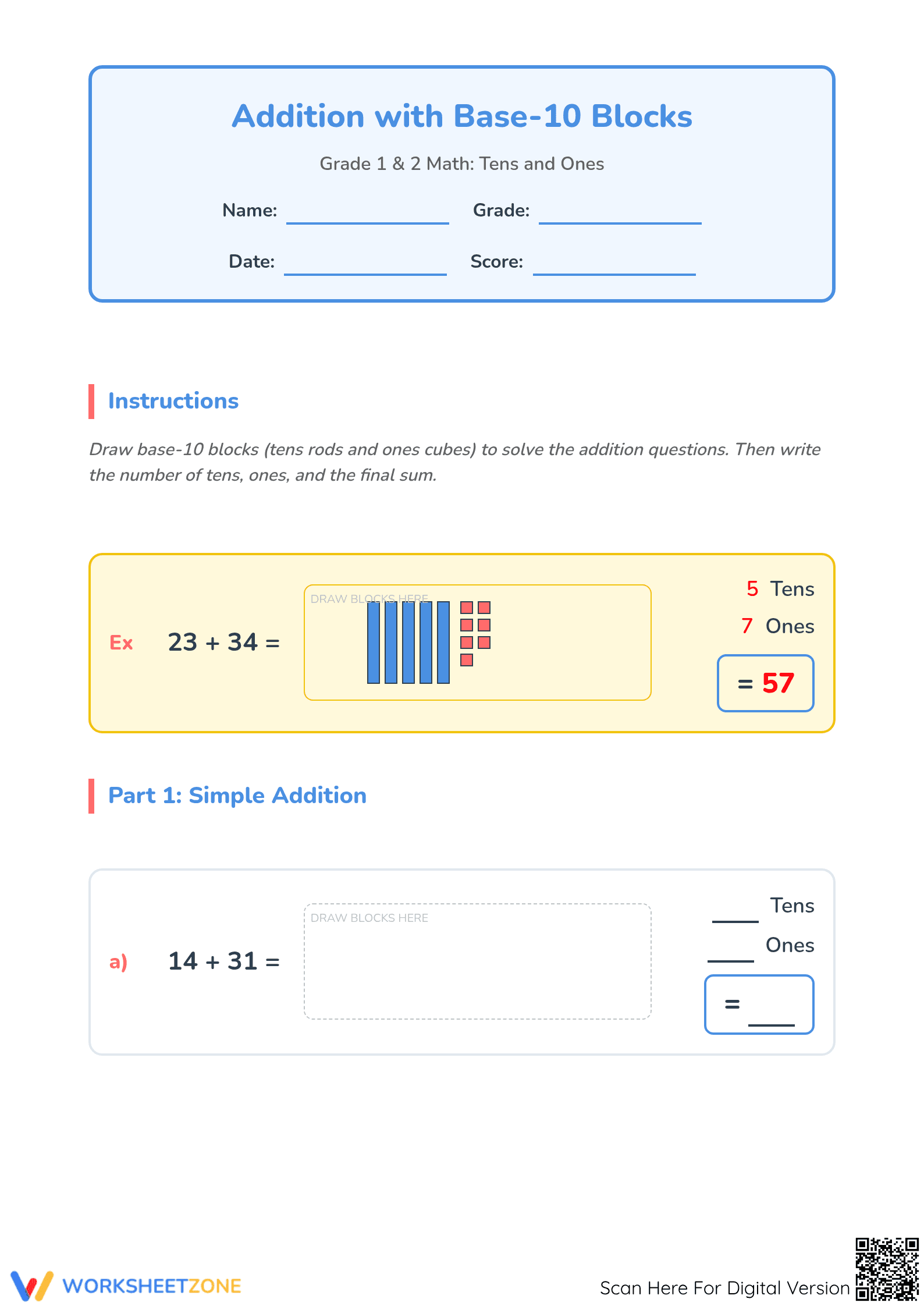
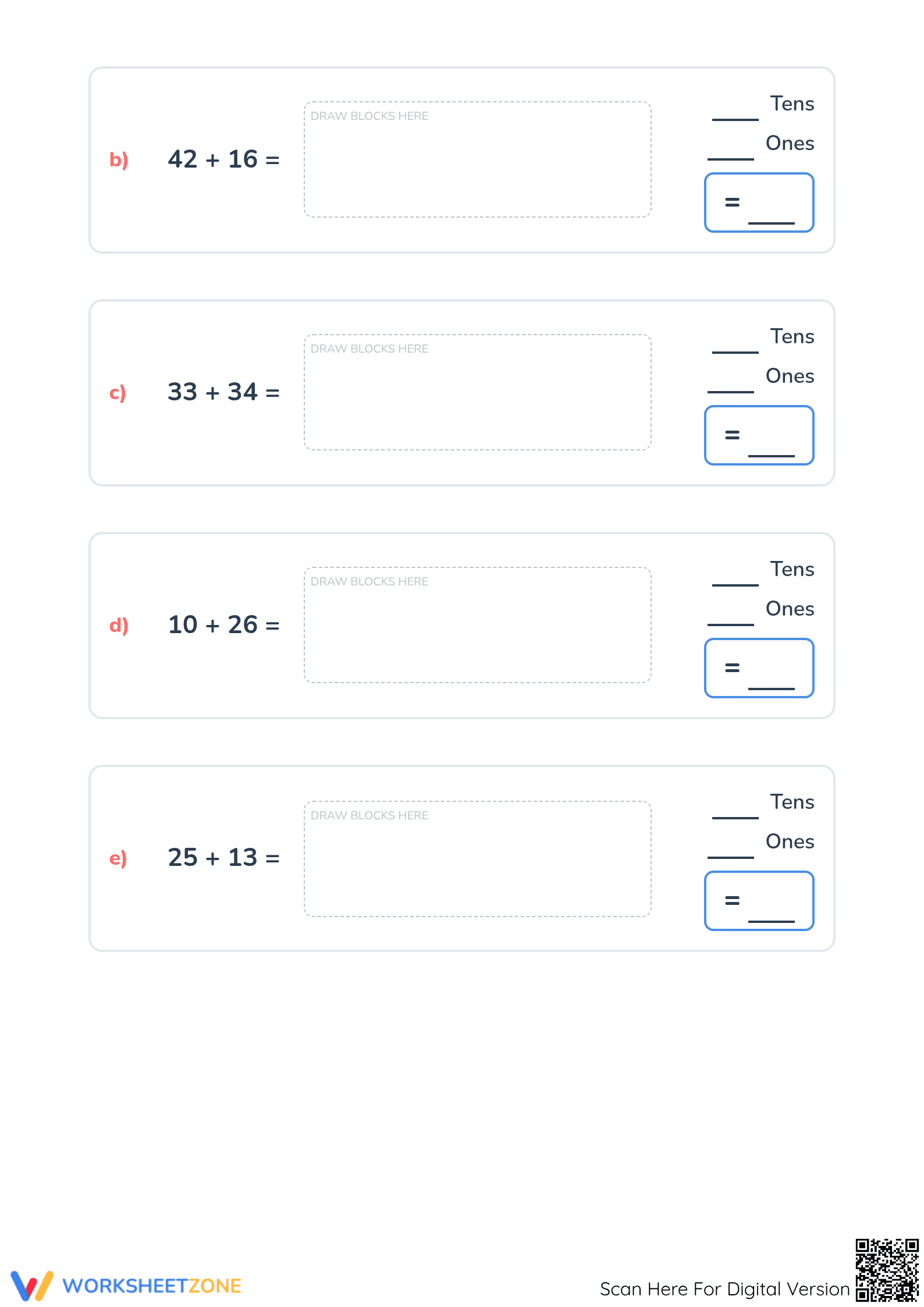
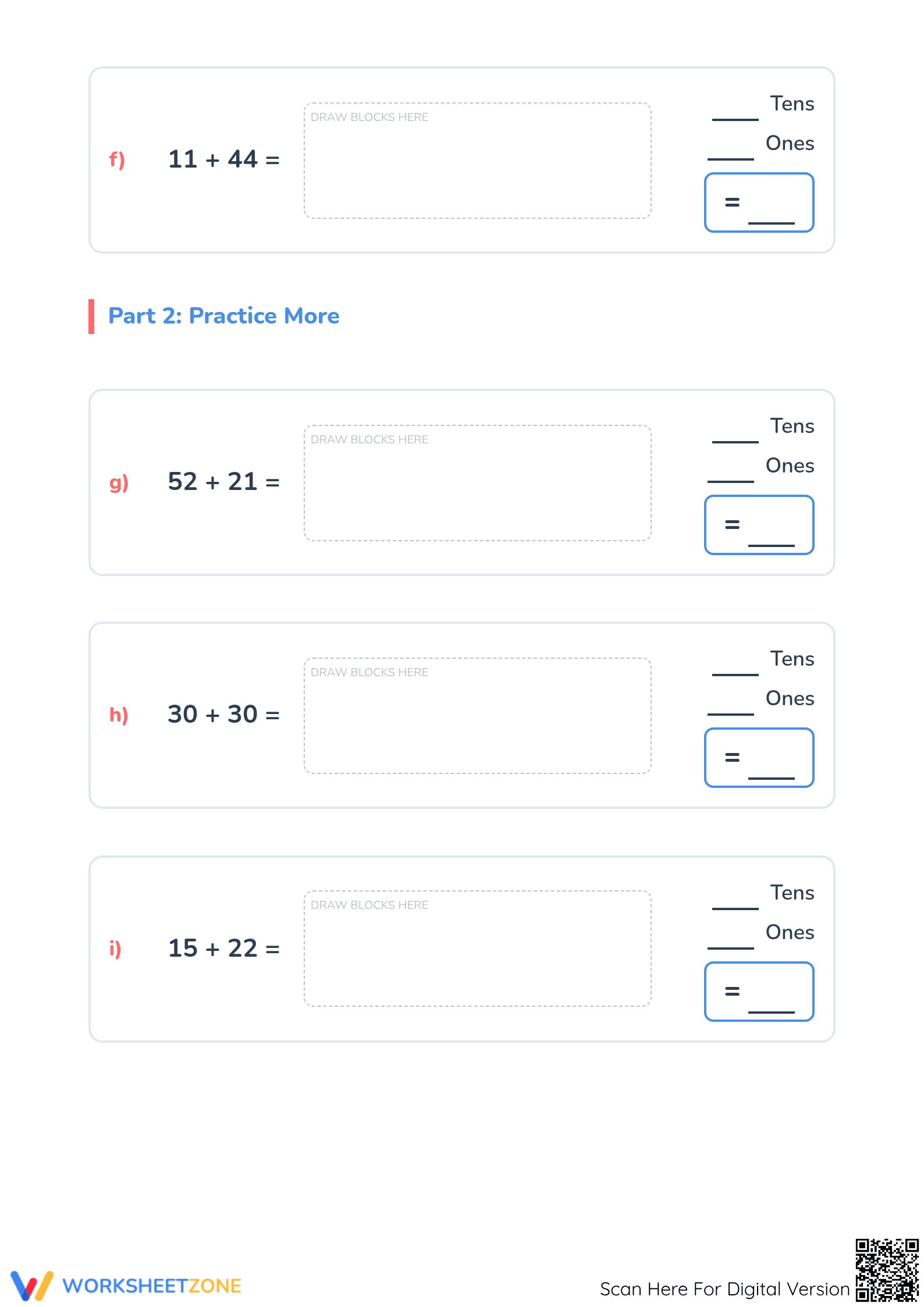
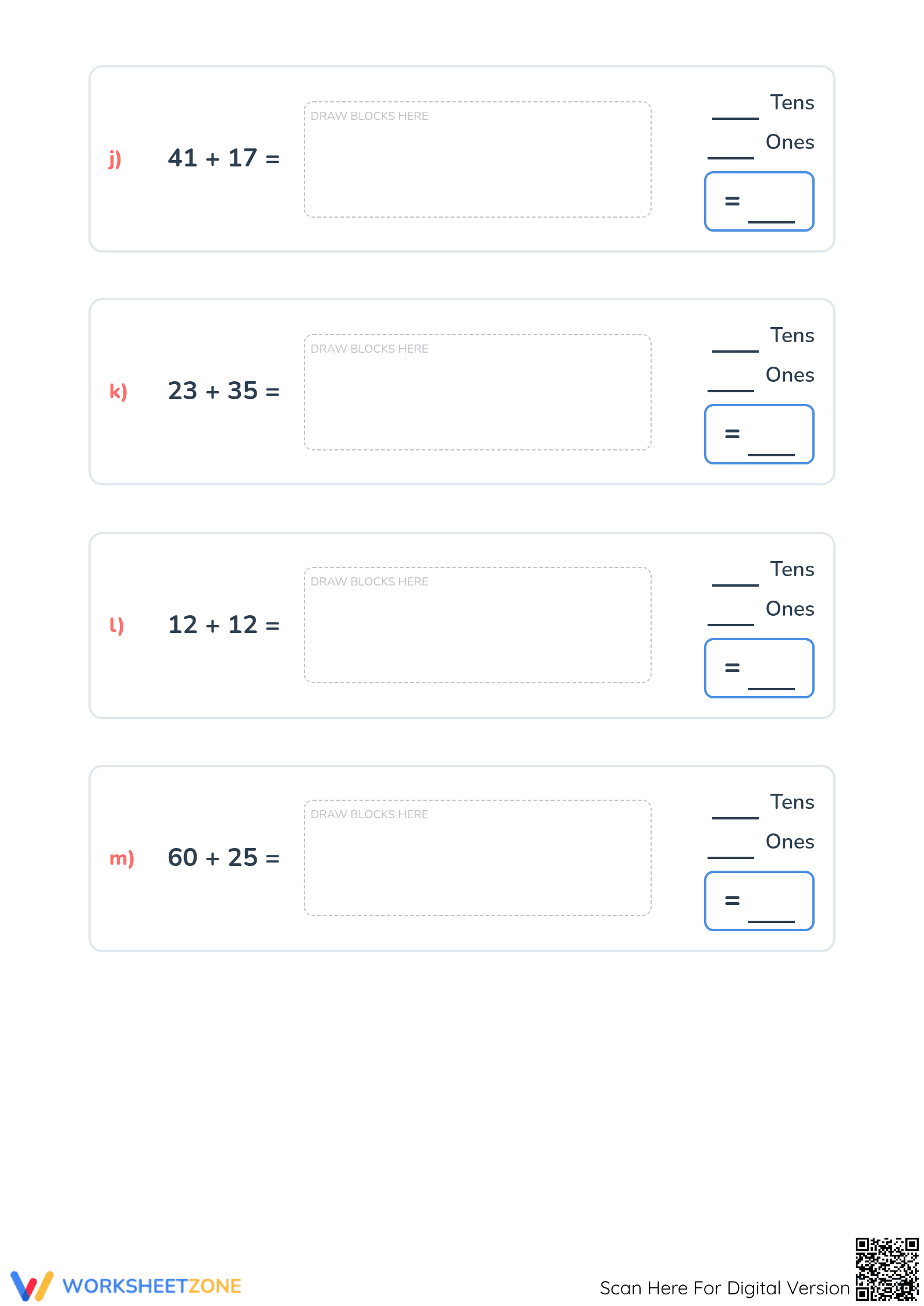
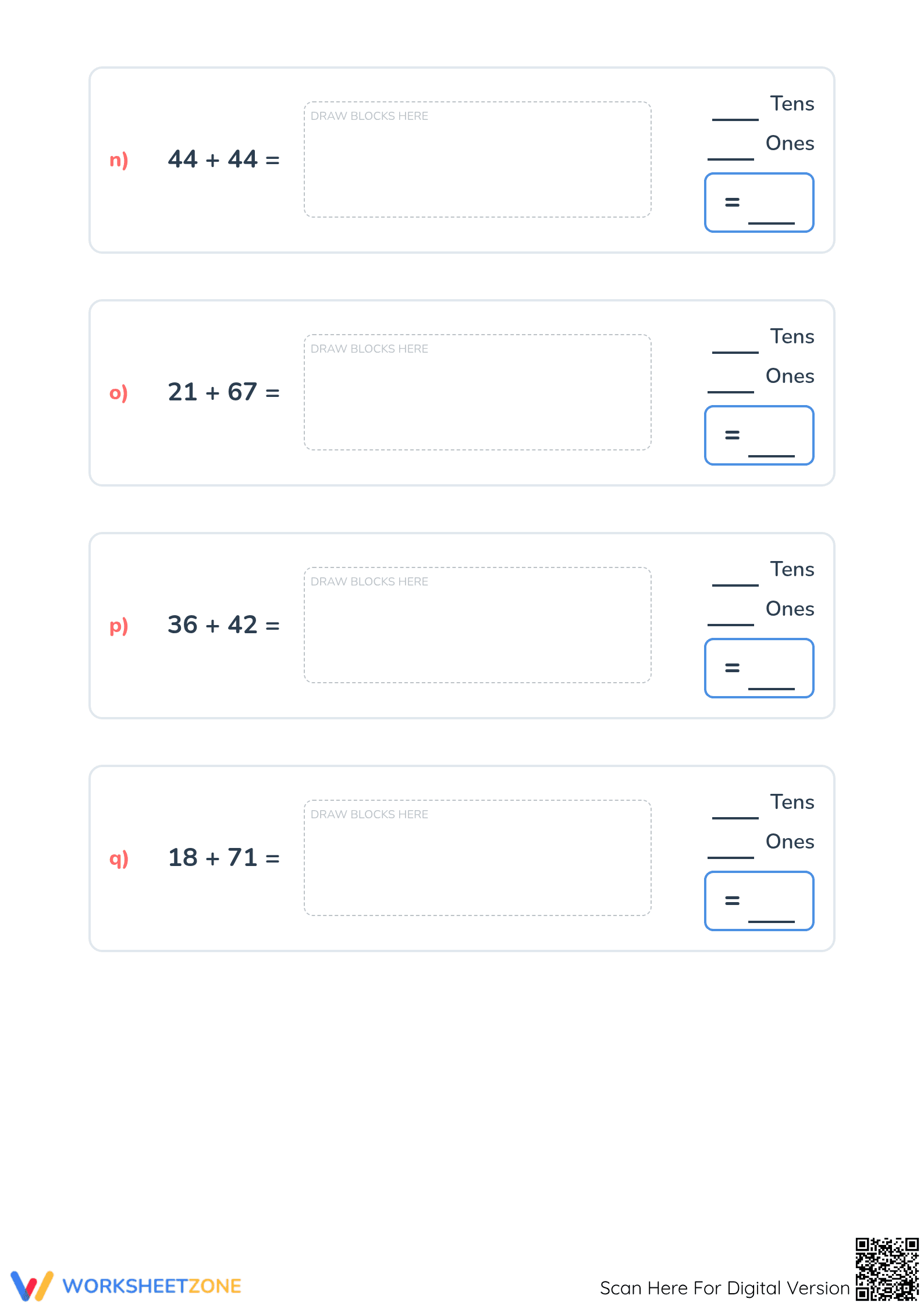
This instructional packet contains 17 unique addition tasks across five organized pages. Each problem features a "Draw Blocks Here" workspace for students to illustrate their understanding. It includes an illustrative example, a "Simple Addition" section for initial mastery, and a "Practice More" section to reinforce retention. A full answer key is provided for rapid grading.
Skill Progression
- Guided Practice: A worked example (23 + 34) demonstrates decomposing numbers into tens and ones.
- Supported Practice: Part 1 has six problems prompting students to record "Tens" and "Ones" counts with drawings.
- Independent Practice: Part 2 offers eleven additional problems (Questions g-q) for students to apply skills independently.
This "I Do, We Do, You Do" framework facilitates transition from modeling to mental math.
Standards Alignment
Explicitly aligned with `CCSS.MATH.CONTENT.1.NBT.C.4`: "Add within 100, including adding a two-digit number and a one-digit number, and adding a two-digit number and a multiple of 10, using concrete models or drawings and strategies based on place value." It also supports the second-grade goal of adding within 100 with fluency. Standard codes are ready for lesson plans, IEP goals, or curriculum mapping.
How to Use It
Ideal for the "during" phase of direct instruction on place value addition. Teachers can model the drawing process before students complete pages independently. A formative assessment tip: observe students drawing "ones" cubes; miscounting indicates a need for one-to-one correspondence intervention. Expected completion time: 25 to 35 minutes.
Who It's For
Designed for first and second-grade students who benefit from visual and tactile number representations. Excellent for RTI groups or students with IEP goals for 2-digit addition without regrouping. Pairs well with physical base-10 block manipulatives or a digital place value chart.
The use of visual representations like base-10 blocks is essential for developing "place value number sense," a foundational architecture for all future multi-digit operations. This worksheet provides 17 structured opportunities for students to engage with the `1.NBT.C.4` standard, ensuring conceptual understanding rather than rote memorization. Requiring students to draw their own models promotes active cognitive engagement, reducing mathematical anxiety and increasing long-term retention. NAEP data consistently shows higher performance in students who can accurately model place-value concepts using standard base-ten notation and visual aids.


