


























Views
Downloads

Essential Addition up to 10 Worksheet | Grade 1 Math
Paste this activity's link or code into your existing LMS (Google Classroom, Canvas, Teams, Schoology, Moodle, etc.).
Students can open and work on the activity right away, with no student login required.
You'll still be able to track student progress and results from your teacher account.
Mastering Addition Concepts
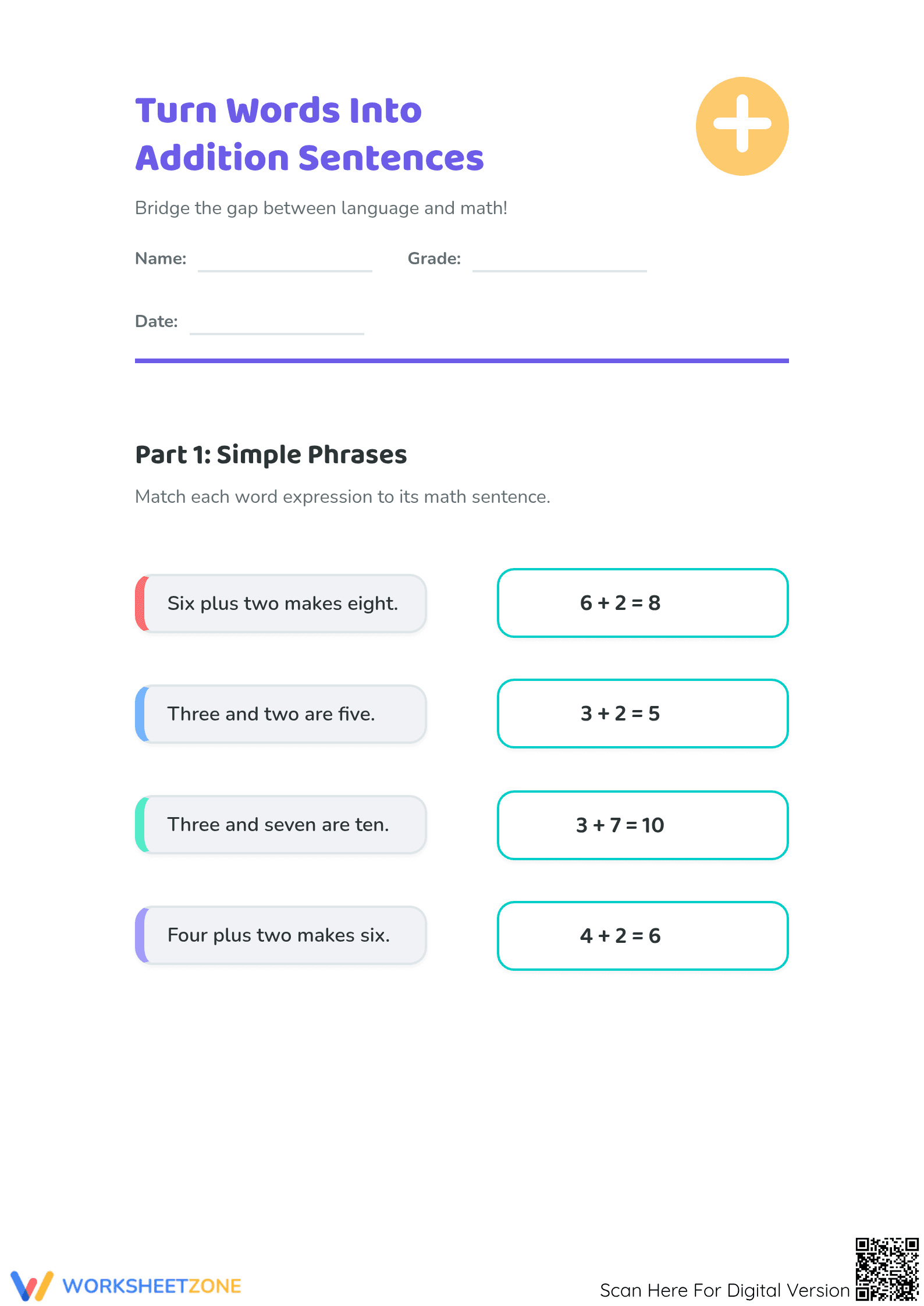
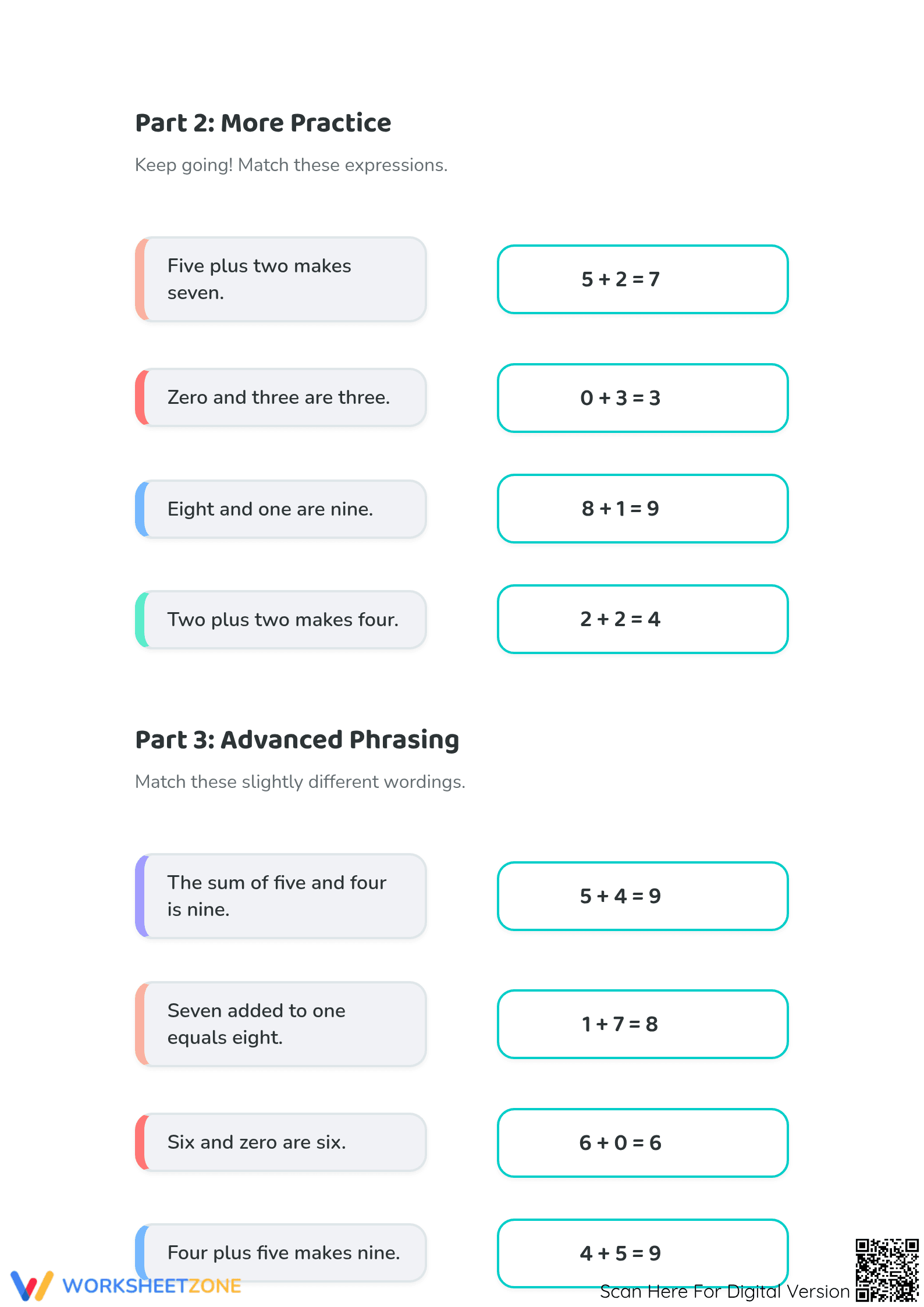
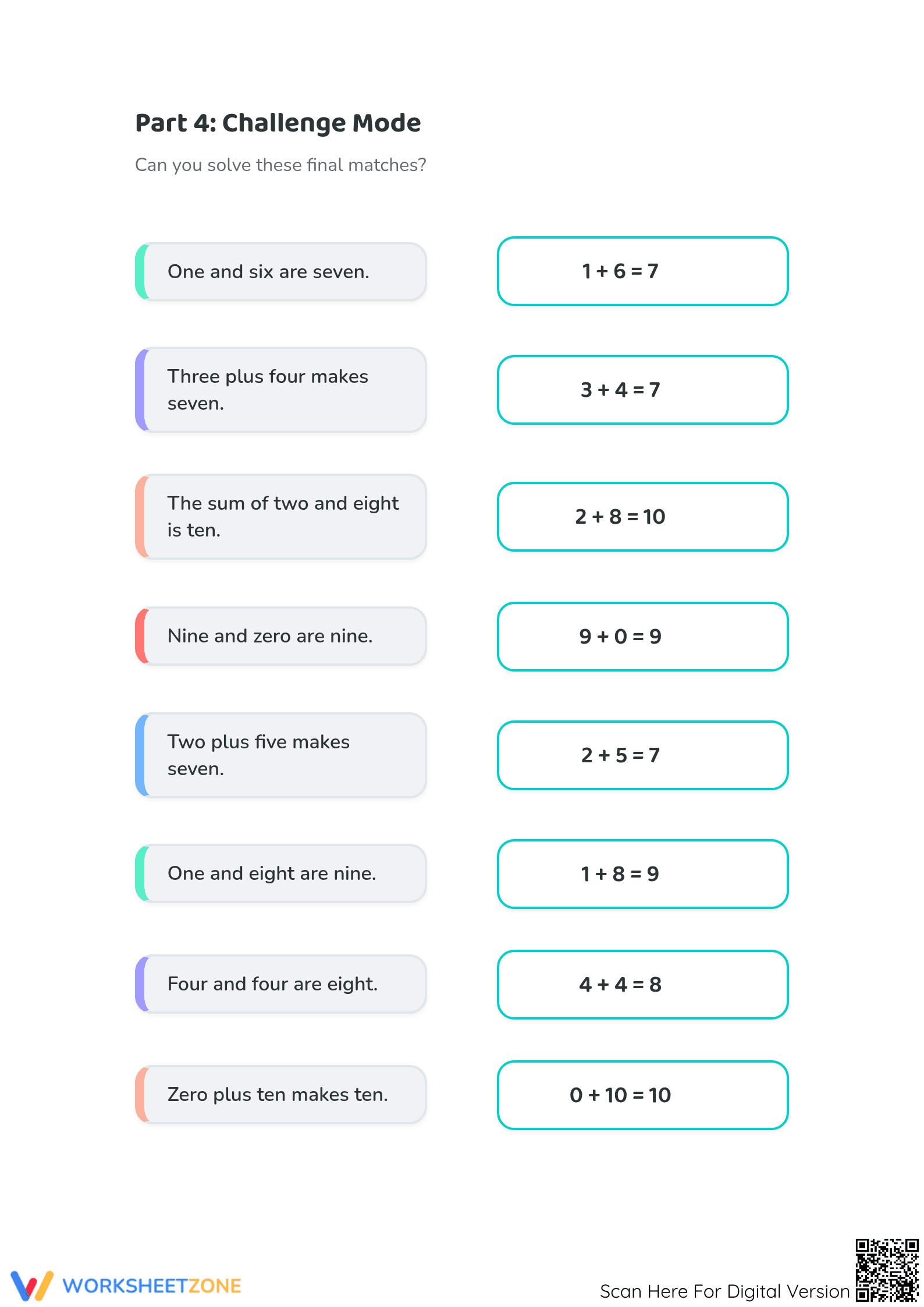
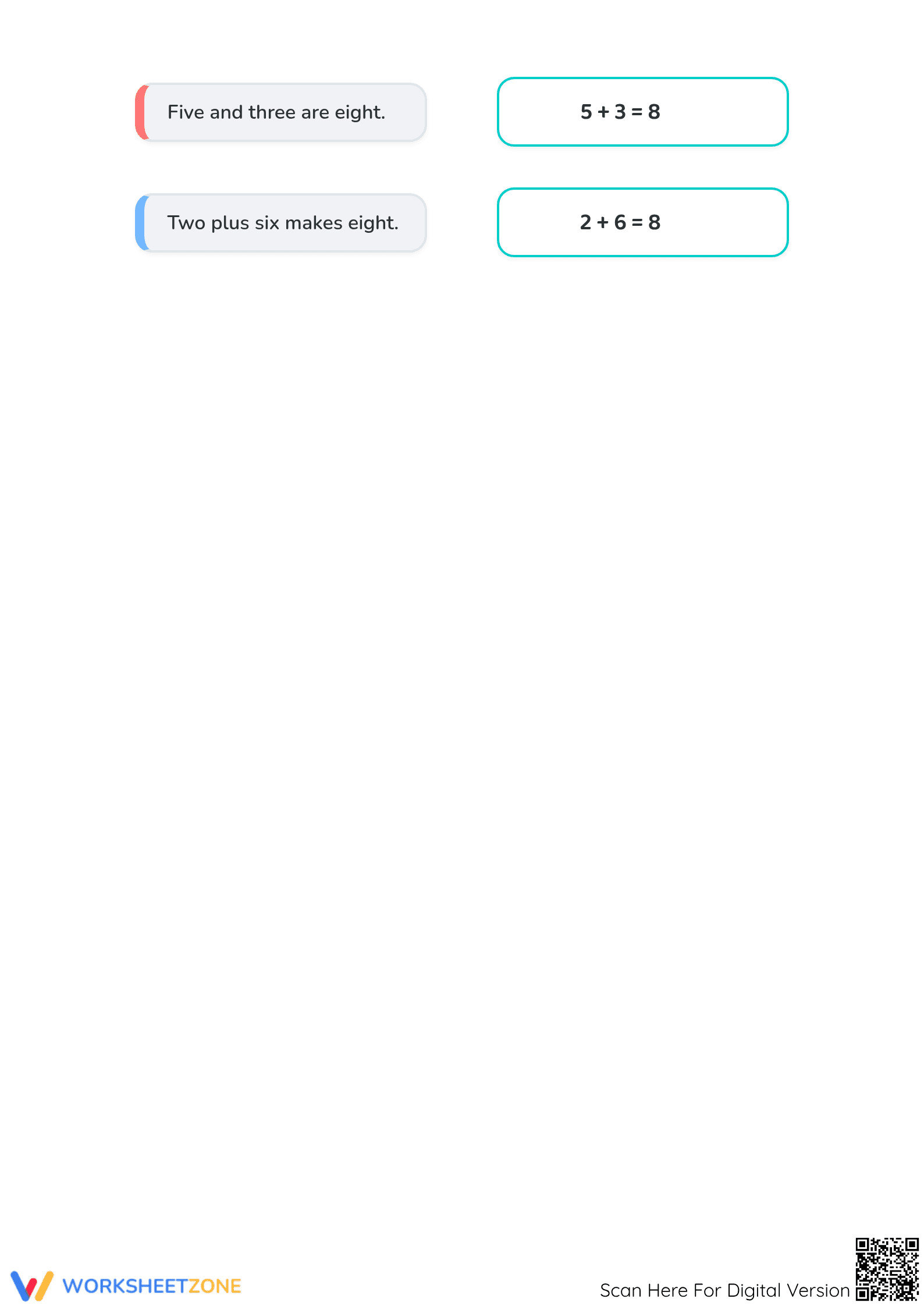
This worksheet provides first-grade students with focused practice in connecting pictorial representations to abstract addition sentences. Through a simple matching activity, learners strengthen their understanding of “add to” a group, a foundational concept for all future arithmetic. The clear, uncluttered layout helps students focus on translating visual information into a mathematical expression, building both number sense and confidence.
At a Glance
- Grade: 1 · Subject: Math
- Standard:
CCSS.MATH.CONTENT.1.OA.A.1— Use addition within 20 to solve problems using objects and drawings.- Skill Focus: Representing addition with objects and equations
- Format: 4 pages · 16 problems · Answer key included · PDF
- Best For: Independent practice, math centers, or formative assessment
- Time: 10–15 minutes
What's Inside
This resource includes a four-page worksheet with 16 matching problems. Each problem presents a visual group of objects (e.g., three stars and two stars) paired with four possible addition sentences. Students draw a line to connect the picture to the correct equation. A complete, four-page answer key is provided for easy grading. The document is delivered as a PDF, ready for immediate printing and classroom use.
A Foundation in Skill Progression
The worksheet design follows a gradual release model, reinforcing newly taught lessons. The consistent format across all 16 problems helps students build procedural fluency and work with increasing independence.
- Guided Practice: A teacher can model the first two problems, demonstrating how to count objects and find the matching addition sentence.
- Supported Practice: Students can then work in pairs on the next page, verbalizing their thinking and checking their reasoning.
- Independent Practice: The final two pages are ideal for independent work, allowing students to demonstrate understanding and providing clear data on skill mastery.
Standards Alignment
This worksheet directly aligns with Common Core State Standard CCSS.MATH.CONTENT.1.OA.A.1, which requires students to use addition to solve problems using objects, drawings, and equations. The tasks provide direct practice with core components of this standard, specifically using drawings (pictures of objects) and equations. Standard codes can be copied directly into lesson plans or curriculum mapping tools.
How to Use It
This versatile resource can be used for independent practice after direct instruction, as a math center station, or for formative assessment. Teachers can observe students to gauge their understanding. Most students will complete the worksheet in approximately 10 to 15 minutes.
Who It's For
Designed for first-grade students developing addition understanding, it benefits visual learners and English Language Learners by providing clear visual context. For differentiation, students can use physical manipulatives. This worksheet pairs well with a number line anchor chart for extra support.
This activity provides targeted practice for CCSS.MATH.CONTENT.1.OA.A.1, emphasizing the critical step of matching visual groupings to formal number sentences for moving from concrete to abstract mathematical thinking. By engaging with these 16 problems, students get repeated, low-stakes exposure to the part-part-whole structure of addition, essential for building automaticity and a solid foundation for operational fluency and algebraic thinking as outlined by the Common Core standards.


