


























Views
Downloads


Printable Kindergarten Counting and Cardinality Worksheet
Paste this activity's link or code into your existing LMS (Google Classroom, Canvas, Teams, Schoology, Moodle, etc.).
Students can open and work on the activity right away, with no student login required.
You'll still be able to track student progress and results from your teacher account.
This Kindergarten counting dots worksheet provides a foundational approach to number recognition and cardinality. Students engage with two distinct tasks designed to bridge the gap between abstract numerals and concrete quantities. By counting dot arrays and drawing their own sets, learners solidify their understanding of the relationship between numbers and physical objects.
At a Glance
- Grade: Kindergarten · Subject: Math
- Standard:
K.CC.B.4— Connect counting to cardinality and understand the relationship between numbers and quantities- Skill Focus: Counting and number representation
- Format: 2 pages · 9 problems · Answer key included · PDF
- Best For: Early finishers and math centers
- Time: 10–15 minutes
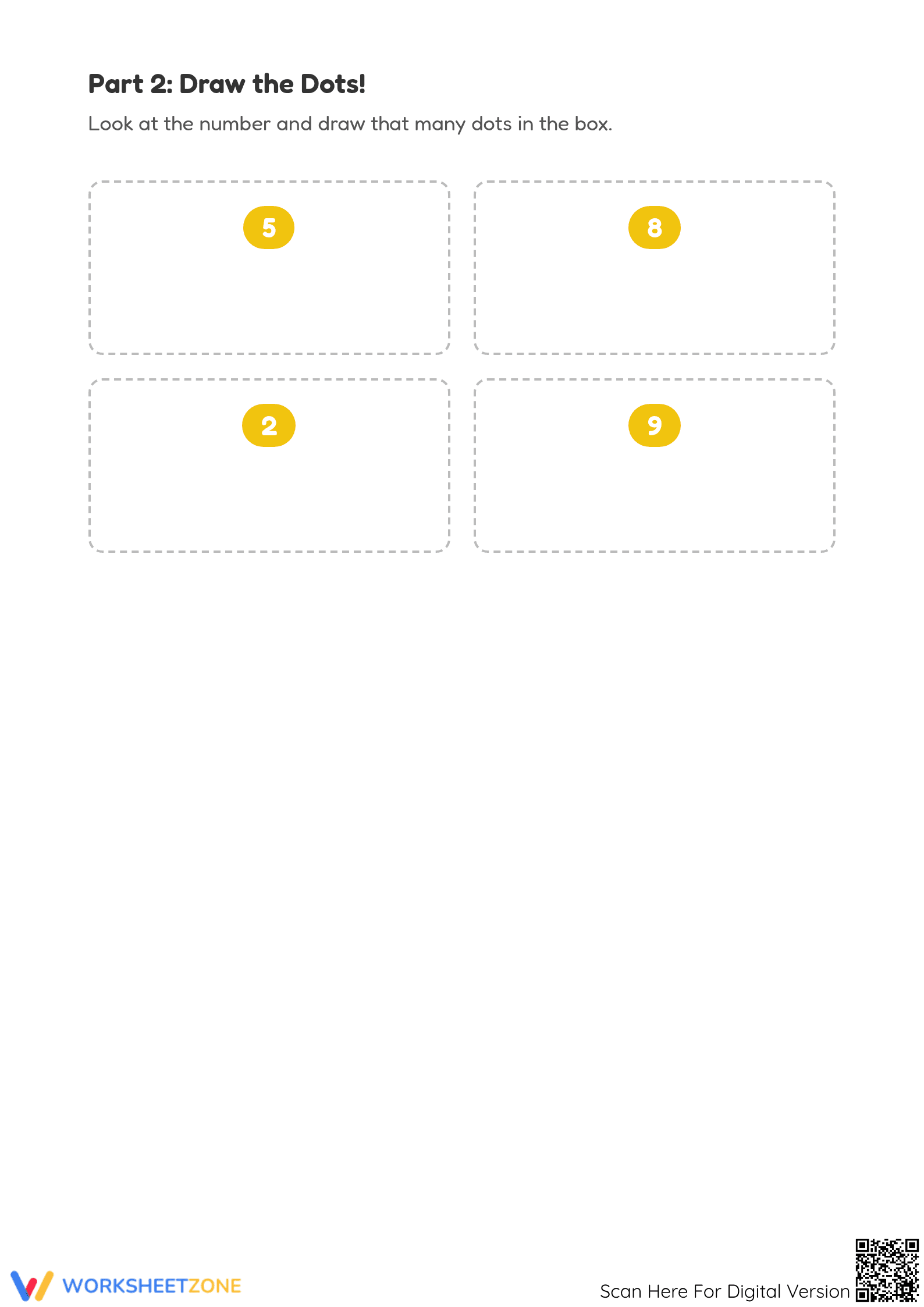
This two-page resource contains nine high-interest problems. The first page features five matching tasks where students count structured dot arrays and connect them to the corresponding numeral. The second page transitions to independent production, challenging students to look at four different numbers and draw the correct number of dots in designated boxes. A complete answer key is provided for rapid grading.
Zero-Prep Workflow
This worksheet is optimized for a seamless classroom experience with a total teacher prep time of under 2 minutes.
- Print: Generate copies for the whole class or a specific small group in about 30 seconds.
- Distribute: Hand out the sheets during the math block transition for immediate engagement.
- Review: Use the included answer key to check for student mastery of 1-1 correspondence in roughly one minute.
Standards Alignment
This activity is strictly aligned with K.CC.B.4, which requires students to understand the relationship between numbers and quantities. It specifically targets sub-standard 4.A, connecting counting to cardinality by ensuring that when counting objects, students say the number names in the standard order. The standard code can be copied directly into lesson plans, IEP goals, or district curriculum mapping tools to ensure instructional compliance and tracking.
How to Use It
Deploy this as a "Do Now" morning activity to reinforce counting skills at the start of the day. Alternatively, it serves as an excellent formative assessment tool during small-group instruction. Observe students as they count: look for finger-pointing to each dot to verify one-to-one correspondence. Completion time generally ranges from 10 to 15 minutes, making it a perfect filler for transitions or as part of a rotation.
Who It's For
This resource is tailored for Kindergarten students developing early numeracy skills. It is also suitable for Grade 1 students requiring remediation in basic cardinality. The clean, uncluttered layout supports learners with visual processing needs. Pair this worksheet with physical manipulatives, such as plastic counters or buttons, to provide a multi-sensory learning experience during the initial practice phase.
According to the ScienceDirect TpT Analysis (2024), structured worksheets that utilize dual-modality tasks—such as the matching and drawing activities found in this resource—significantly enhance the retention of cardinality concepts in early learners. The K.CC.B.4 standard is a critical predictor of later mathematical success, as it establishes the mental framework for addition and subtraction. By requiring students to both decode a quantity (counting dots) and encode a quantity (drawing dots), this worksheet engages multiple cognitive pathways. Research indicates that when students move beyond simple recognition to active representation, their understanding of 1-1 correspondence becomes more durable. This printable resource provides the "low floor, high ceiling" opportunity necessary for diverse Kindergarten classrooms to achieve mastery without overwhelming the teacher with extensive preparation. The 9 problems included are statistically sufficient to provide a snapshot of student progress for data-driven instructional planning or IEP progress monitoring in early intervention settings.


