


























Views
Downloads

Winter Addition Worksheet | Essential Kindergarten Math
Paste this activity's link or code into your existing LMS (Google Classroom, Canvas, Teams, Schoology, Moodle, etc.).
Students can open and work on the activity right away, with no student login required.
You'll still be able to track student progress and results from your teacher account.
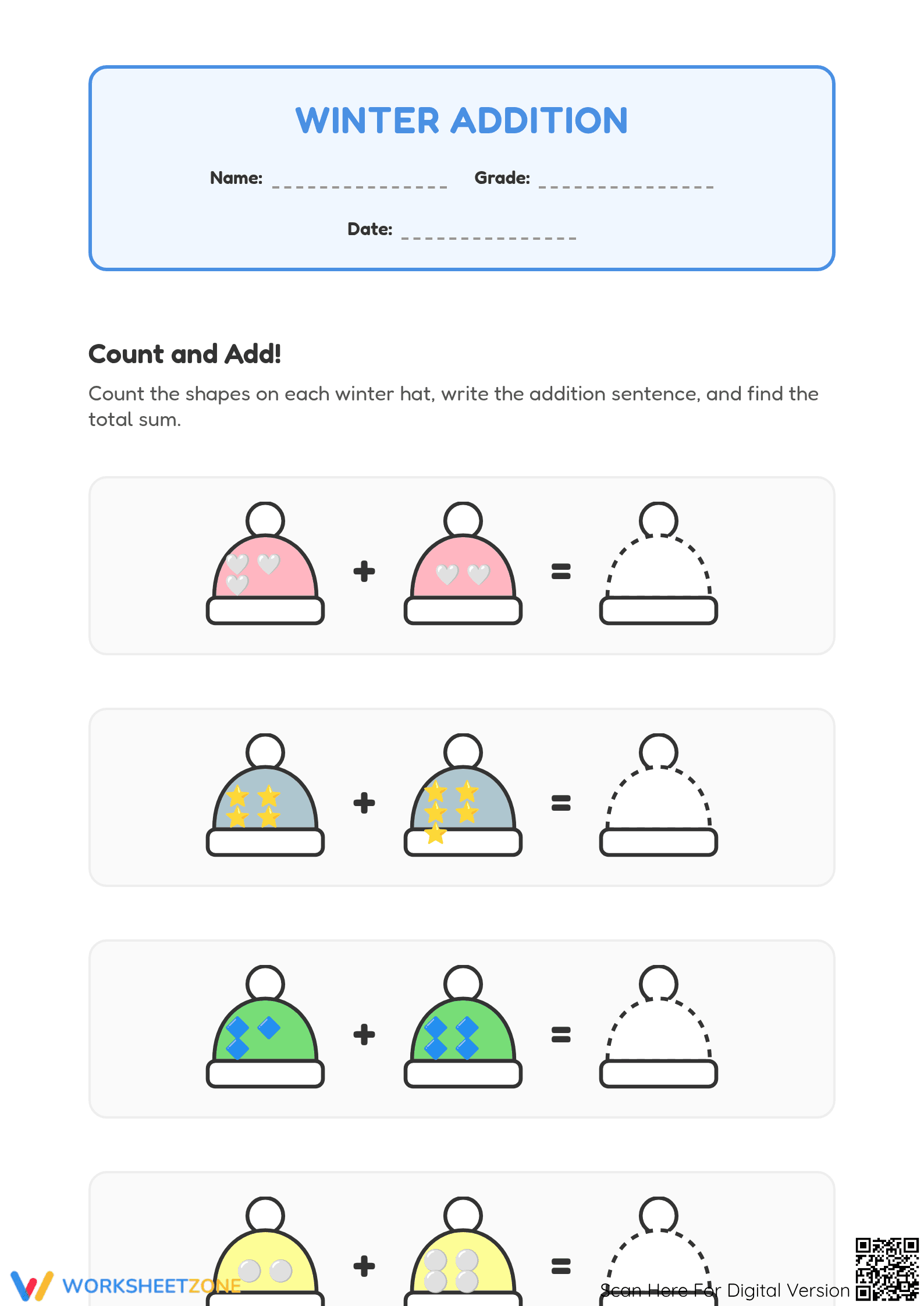
This winter-themed addition worksheet helps early learners master basic arithmetic by counting seasonal shapes on colorful winter hats. Students engage with visual representations to build a strong foundation in number operations and algebraic thinking. By translating objects into math sentences, children develop the critical conceptual understanding required for kindergarten success.
At a Glance
- Grade: Kindergarten · Subject: Math
- Standard:
K.OA.A.2— Add within 10 using objects to solve problems- Skill Focus: Counting and adding visual sets
- Format: 2 pages · 6 problems · Answer key included · PDF
- Best For: Winter-themed morning work or math centers
- Time: 10–15 minutes
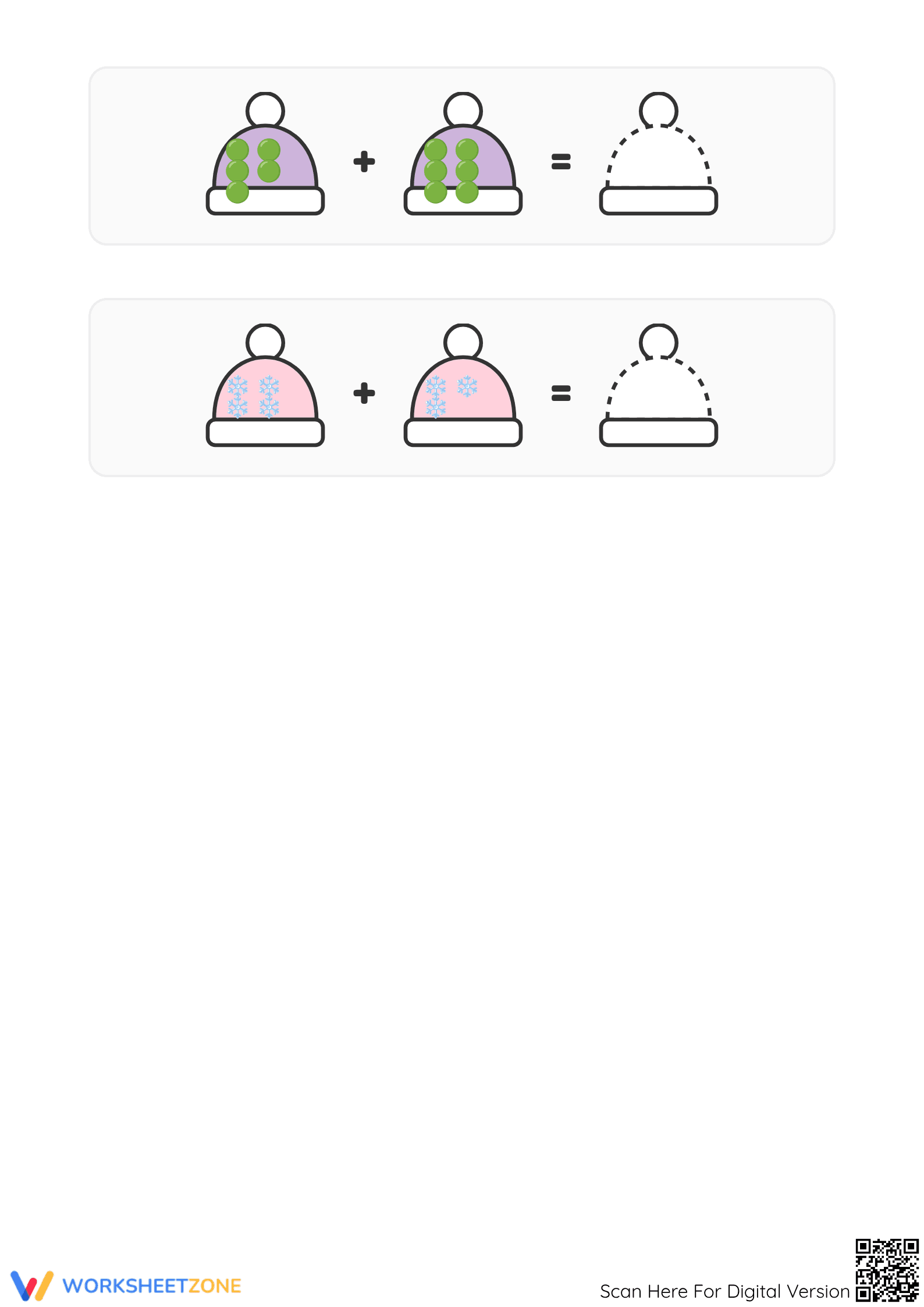
This two-page PDF features six distinct addition problems designed to bridge the gap between counting and arithmetic. Each task displays two winter hats containing different quantities of shapes, including stars, hearts, and snowflakes. Students count the objects in each hat, write the corresponding numbers in the provided spaces, and solve the equation to find the total sum. A comprehensive answer key is included to facilitate quick grading or student self-correction.
The zero-prep workflow for this resource is designed for busy educators seeking high-quality seasonal content. First, print the two-page document in seconds. Second, distribute to students with no extra manipulatives or complex setup required. Third, review the visual sums as a whole class or through individual student check-ins. Total teacher preparation time is under two minutes, making it an ideal emergency sub plan or transition activity during the winter months.
This resource aligns with CCSS.MATH.CONTENT.K.OA.A.2, which requires students to solve addition and subtraction problems and add and subtract within 10 by using objects or drawings to represent the problem. The activity encourages students to move from concrete counting to abstract numerical representation. This standard code can be copied directly into lesson plans, IEP goals, or district curriculum mapping tools to ensure instructional alignment.
Use this as a formative assessment during direct instruction to gauge student mastery of one-to-one correspondence. Educators should observe if students are counting every shape individually or if they can recognize small groups through subitizing before adding. The expected completion time is 10–15 minutes. For an extension, have students color the hats according to their sums, creating a multi-sensory learning experience that reinforces the mathematical concepts.
This activity is designed for Kindergarten students but serves as an excellent intervention for first graders needing additional visual support. It pairs naturally with winter-themed storybooks or seasonal weather units. The clear layout and large graphics make it accessible for students with fine motor delays who need ample space to write numbers. It is a versatile tool for general education classrooms, special education settings, and homeschool environments.
Research by Fisher & Frey (2014) emphasizes that visual representations, such as the objects used in this K.OA.A.2 worksheet, are vital for bridging the gap between concrete and abstract mathematical thinking. By counting shapes on winter hats, students practice the plain-English skill of adding within ten using visual models. This scaffolding technique is proven to reduce cognitive load while increasing student engagement in early numeracy tasks. The worksheet’s structured approach mirrors high-quality instructional materials, ensuring that mathematical practice remains focused and rigorous. Providing a clear path from counting to equation writing supports the gradual release of responsibility, allowing students to eventually perform mental math with greater confidence. Educators can rely on this evidence-based design to support foundational math goals across diverse classroom settings and instructional moments.


