


























Views
Downloads
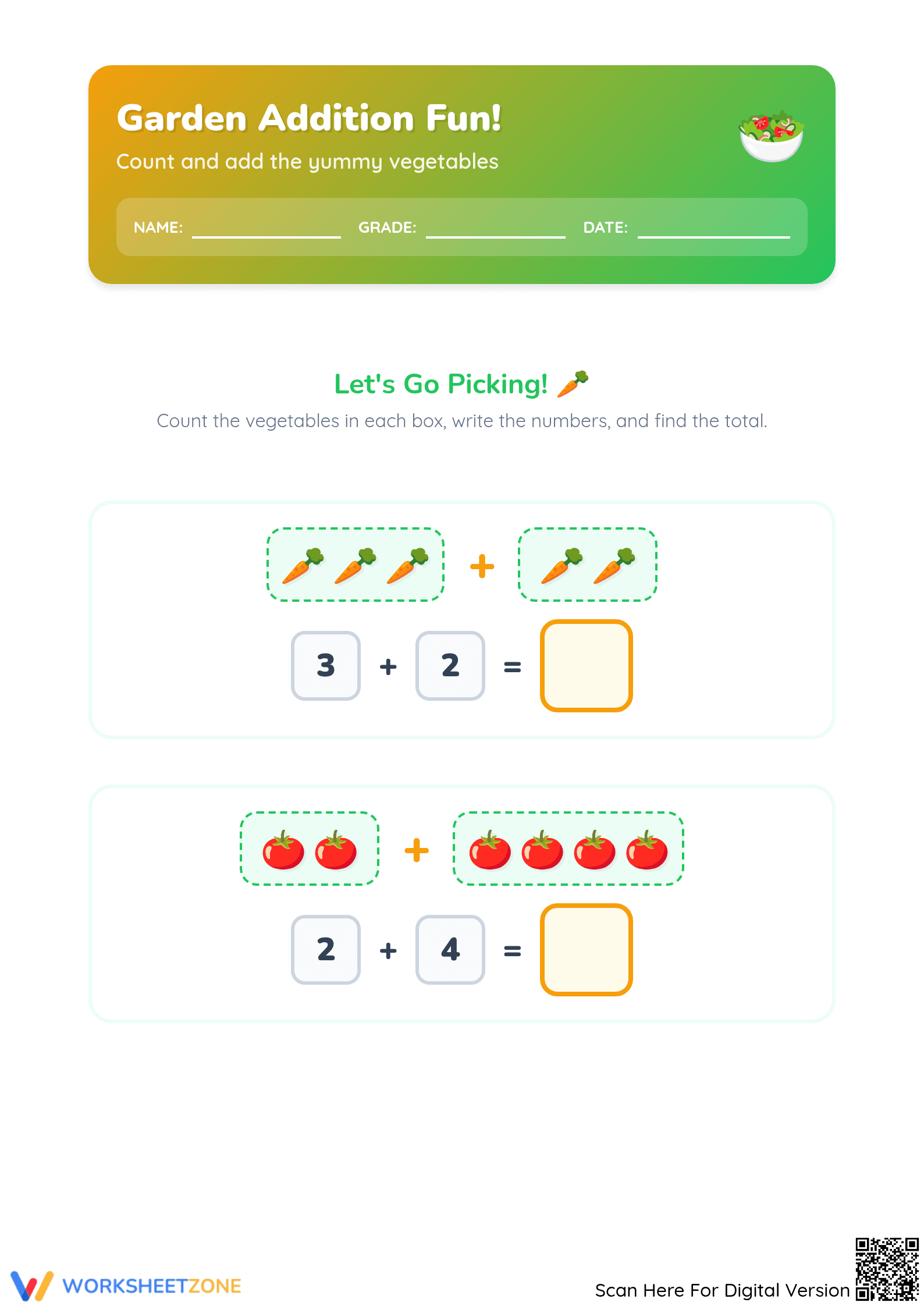
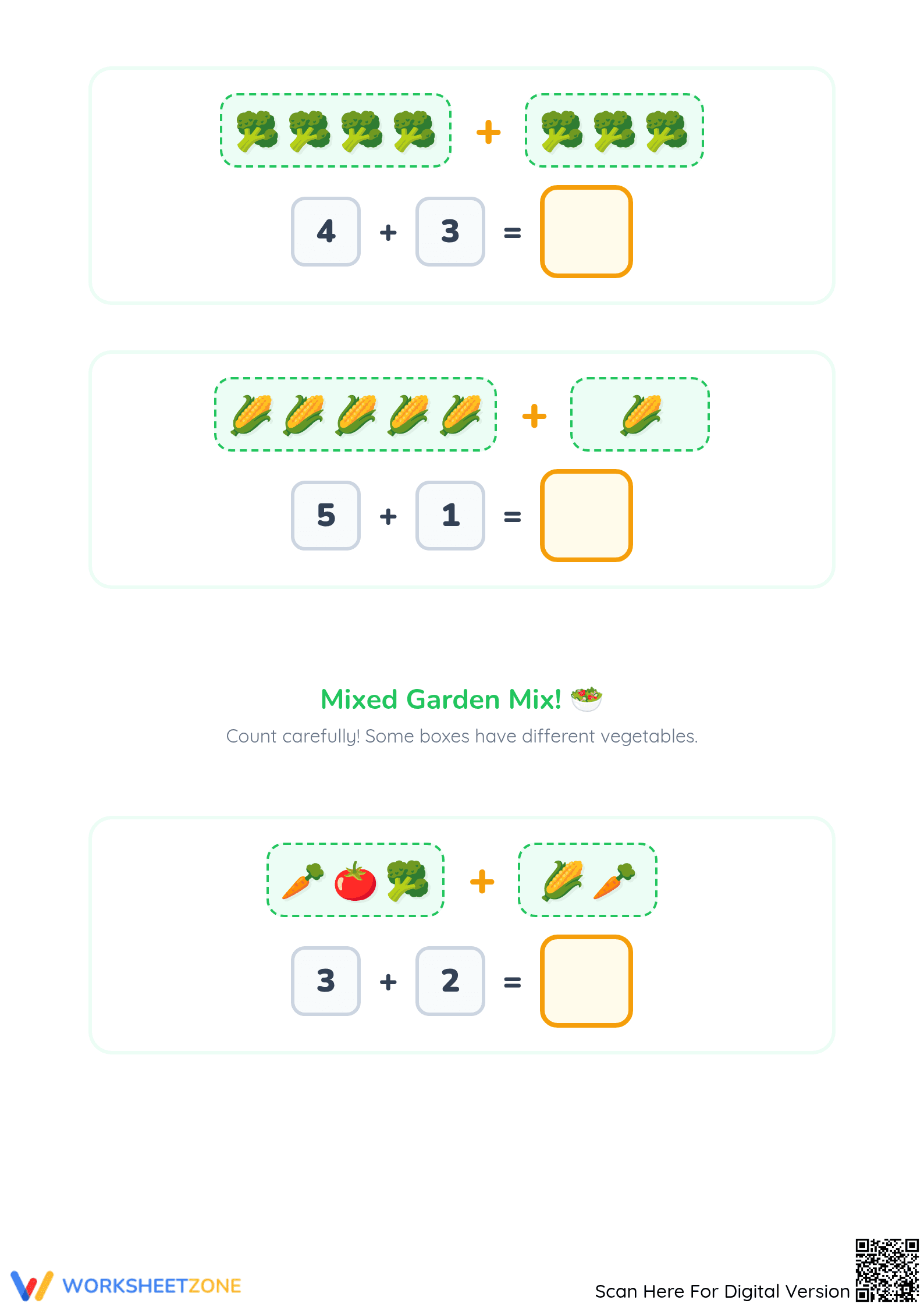
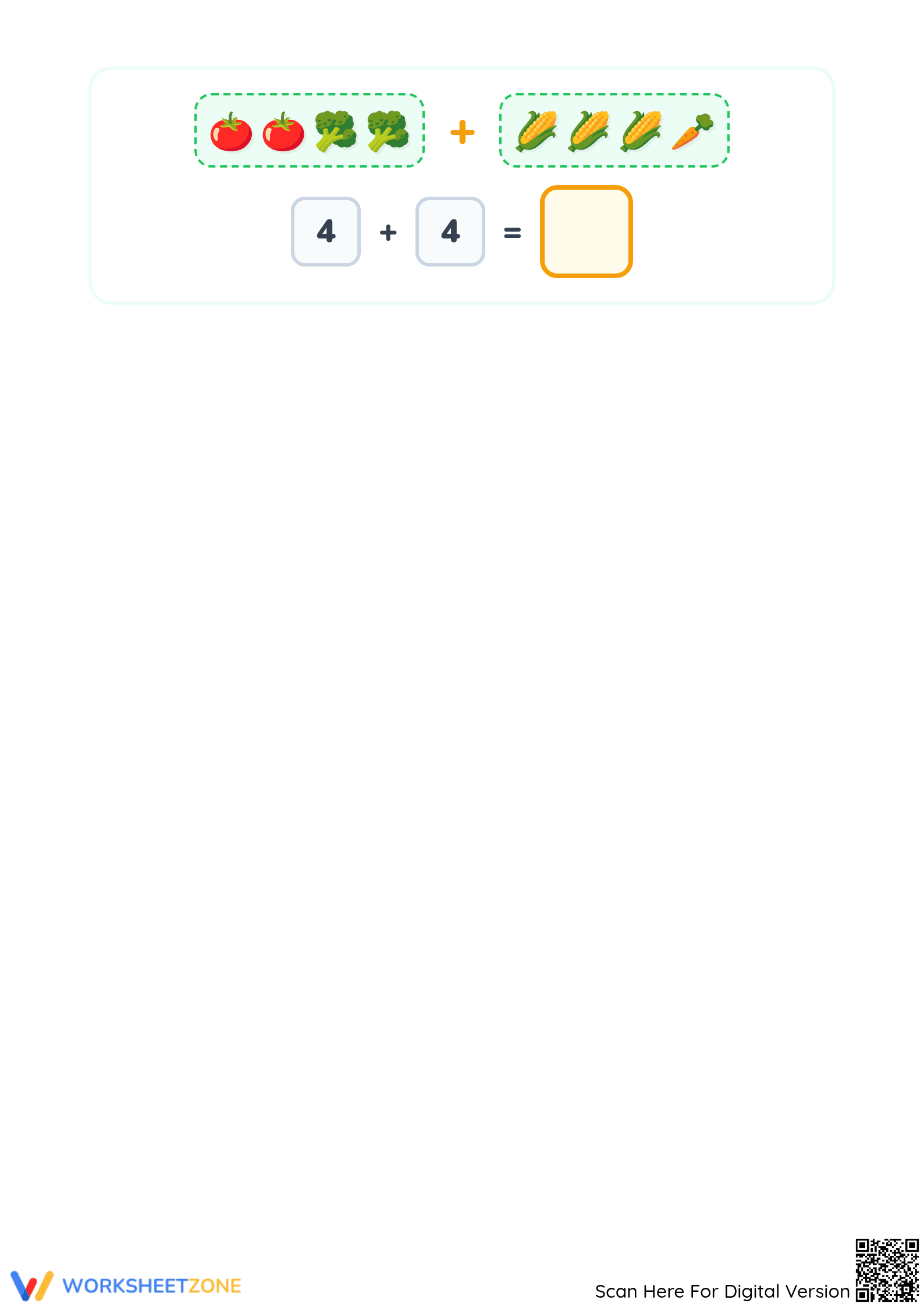

Printable Garden Addition: Visual Sums within 10 Worksheet
Paste this activity's link or code into your existing LMS (Google Classroom, Canvas, Teams, Schoology, Moodle, etc.).
Students can open and work on the activity right away, with no student login required.
You'll still be able to track student progress and results from your teacher account.
Students develop a concrete understanding of early arithmetic by connecting physical counts to numerical symbols. This worksheet uses garden illustrations to guide kindergarteners through visual addition within 10. By counting vegetables like carrots and tomatoes before writing the corresponding numbers, learners bridge the gap between simple counting and formal addition equations effectively.
At a Glance
- Grade: Kindergarten · Subject: Math
- Standard:
K.OA.A.1— Represent addition with objects and drawings to solve problems- Skill Focus: Visual addition within 10
- Format: 3 pages · 6 problems · Answer key included · PDF
- Best For: Small group math center rotation
- Time: 10–15 minutes
This three-page PDF packet features six distinct addition scenarios set in a friendly garden theme. Each page presents two large, clear task boxes containing sets of vegetables like carrots, tomatoes, broccoli, and corn. Students are prompted to count the items in each set, write the numerals in the provided boxes, and calculate the total sum. A complete answer key is included for quick verification.
Zero-Prep Workflow
The zero-prep design ensures this resource is ready for immediate classroom use or as an emergency sub plan. Teachers can print the three pages in less than 30 seconds, requiring no cutting or lamination. Distribution to a standard class of 25 takes approximately one minute. Reviewing the completed work is streamlined by the visual layout, allowing for a whole-class check-in in under two minutes total.
Standards Alignment
The primary alignment is K.OA.A.1, which requires students to represent addition with objects and drawings. This resource specifically targets the "objects and drawings" component. Additionally, it supports K.OA.A.2 by solving addition word problems within 10. Both standard codes can be copied directly into lesson plans, IEP goals, or district curriculum mapping tools.
How to Use It
Use this worksheet during the "guided practice" phase of a lesson on addition. After a whole-group counting exercise using manipulatives, transition students to these pages to practice translating sets into numbers. For a formative assessment tip, observe if students count each item individually or "count on" from the first number. This task is expected to take between 10 and 15 minutes.
Who It's For
This resource is designed for kindergarten students beginning their journey with operations. It is also an excellent remedial tool for first graders who need a concrete, visual reminder of how addition works. The large font and clear spacing make it accessible for English Language Learners and students with processing delays who benefit from high-contrast support.
According to the NAEP framework for early mathematics, transitioning between concrete representations and abstract notation is a critical milestone for algebraic thinking. Research from RAND AIRS 2024 emphasizes that visual scaffolds, such as garden imagery, significantly reduce cognitive load for novice learners during the initial acquisition of addition facts. By explicitly pairing counts of objects with numerical boxes, this worksheet follows the "Concrete-Representational-Abstract" sequence recommended by Fisher & Frey (2014) for effective mathematics instruction. Mastery of K.OA.A.1—representing addition with objects and drawings—prepares students for the increased complexity of multi-digit operations and word problem solving in higher grades. This evidence-based approach ensures that learners do not just memorize facts but actually understand the underlying concept of "putting together." This worksheet serves as a high-quality resource for foundational numeracy, ensuring every student has the tools to succeed in early childhood mathematics through visual support.


