


























Views
Downloads


Essential 3-Digit Addition with Regrouping | Grade 3-4
Paste this activity's link or code into your existing LMS (Google Classroom, Canvas, Teams, Schoology, Moodle, etc.).
Students can open and work on the activity right away, with no student login required.
You'll still be able to track student progress and results from your teacher account.
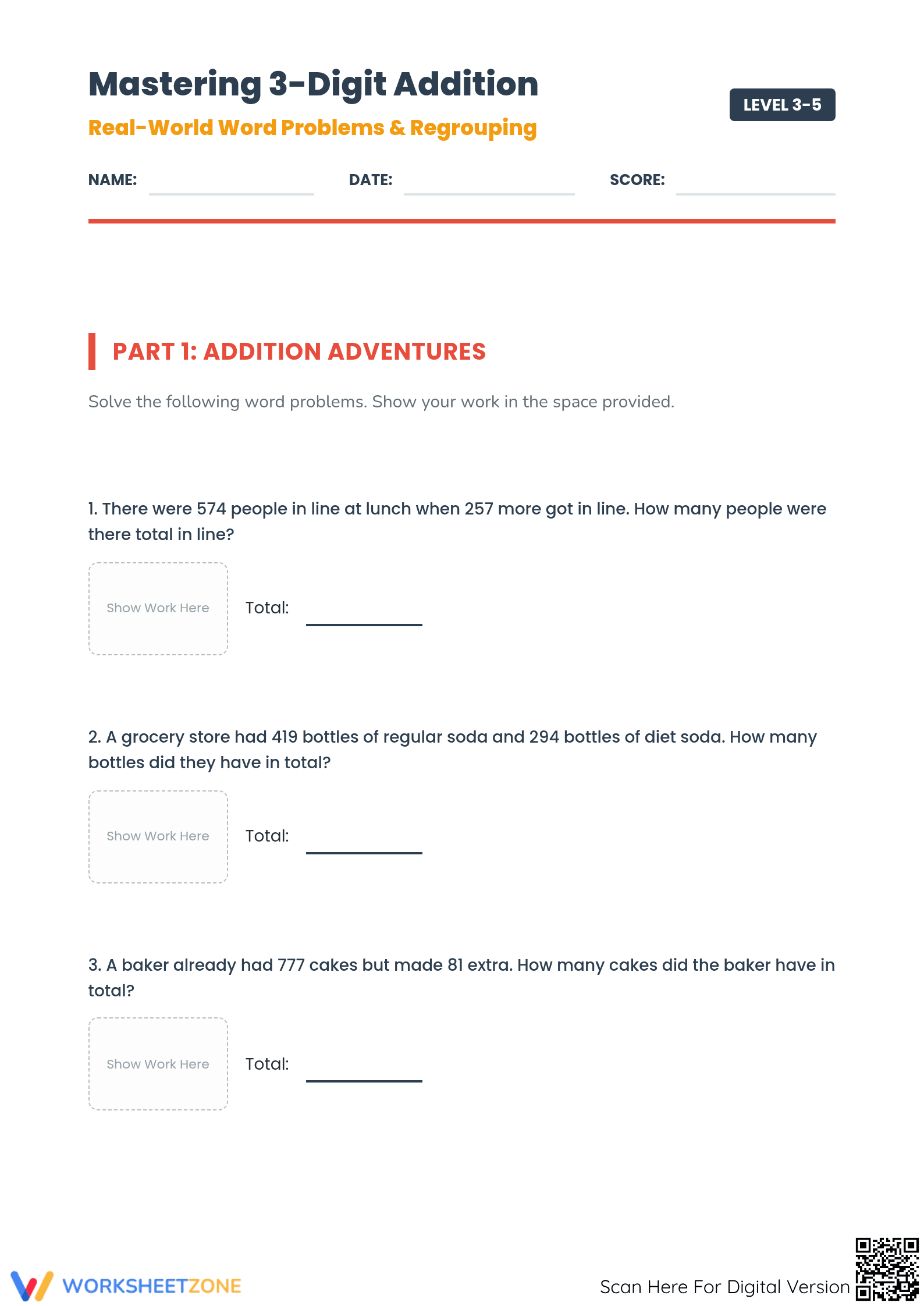
Build mathematical fluency and confidence with this comprehensive five-page practice packet focused on three-digit addition with regrouping. This resource moves students beyond rote calculation by embedding place value concepts into real-world scenarios, ensuring learners understand the practical application of the standard algorithm while developing essential problem-solving stamina for multi-step mathematical tasks.
At a Glance
- Grade: 3–5 · Subject: Math
- Standard:
CCSS.MATH.CONTENT.3.NBT.A.2— Fluently add within 1000 using place value strategies and algorithms- Skill Focus: 3-digit addition with regrouping
- Format: 5 pages · 23 problems · Answer key included · PDF
- Best For: Independent practice and formative assessment
- Time: 35–45 minutes
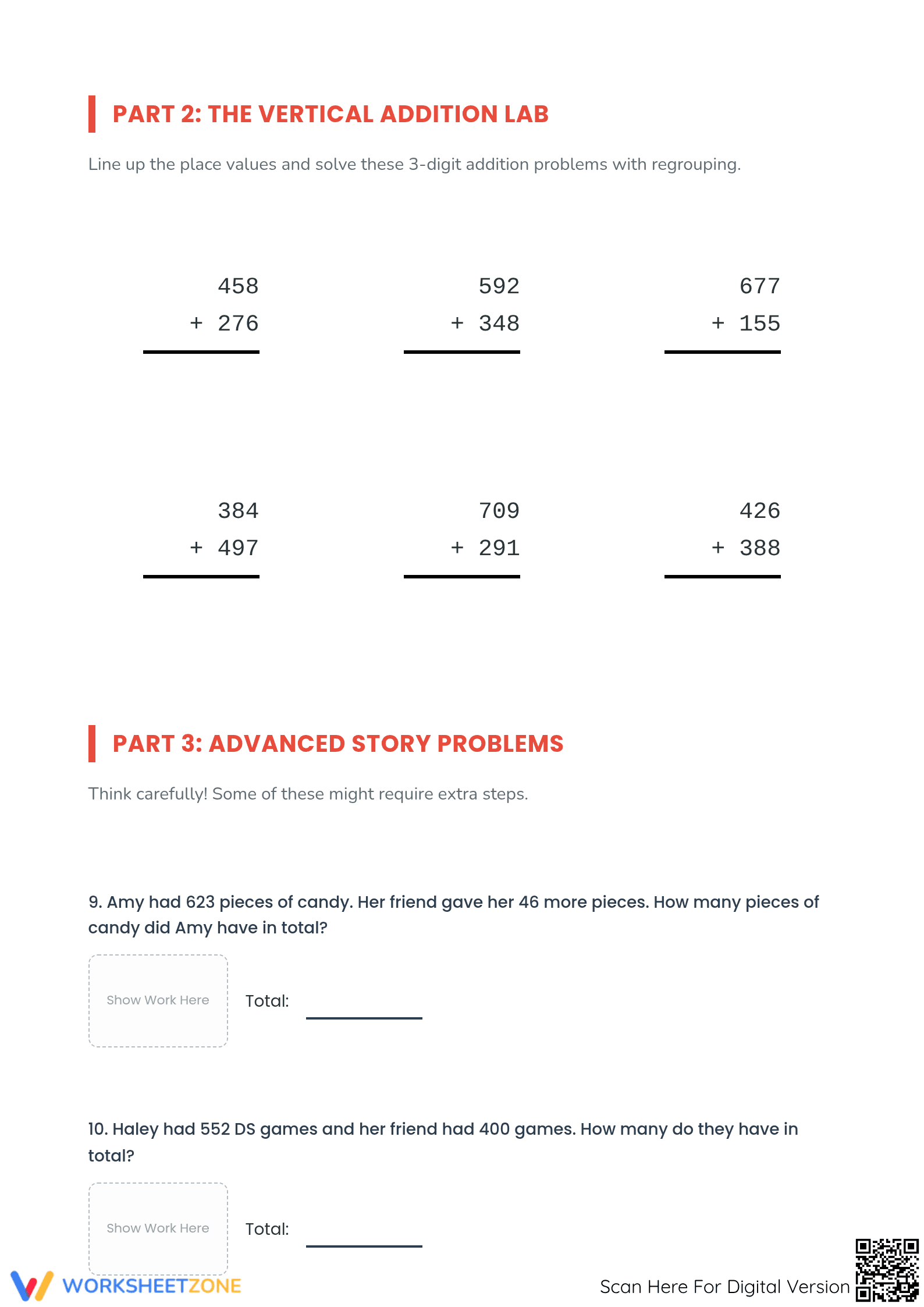
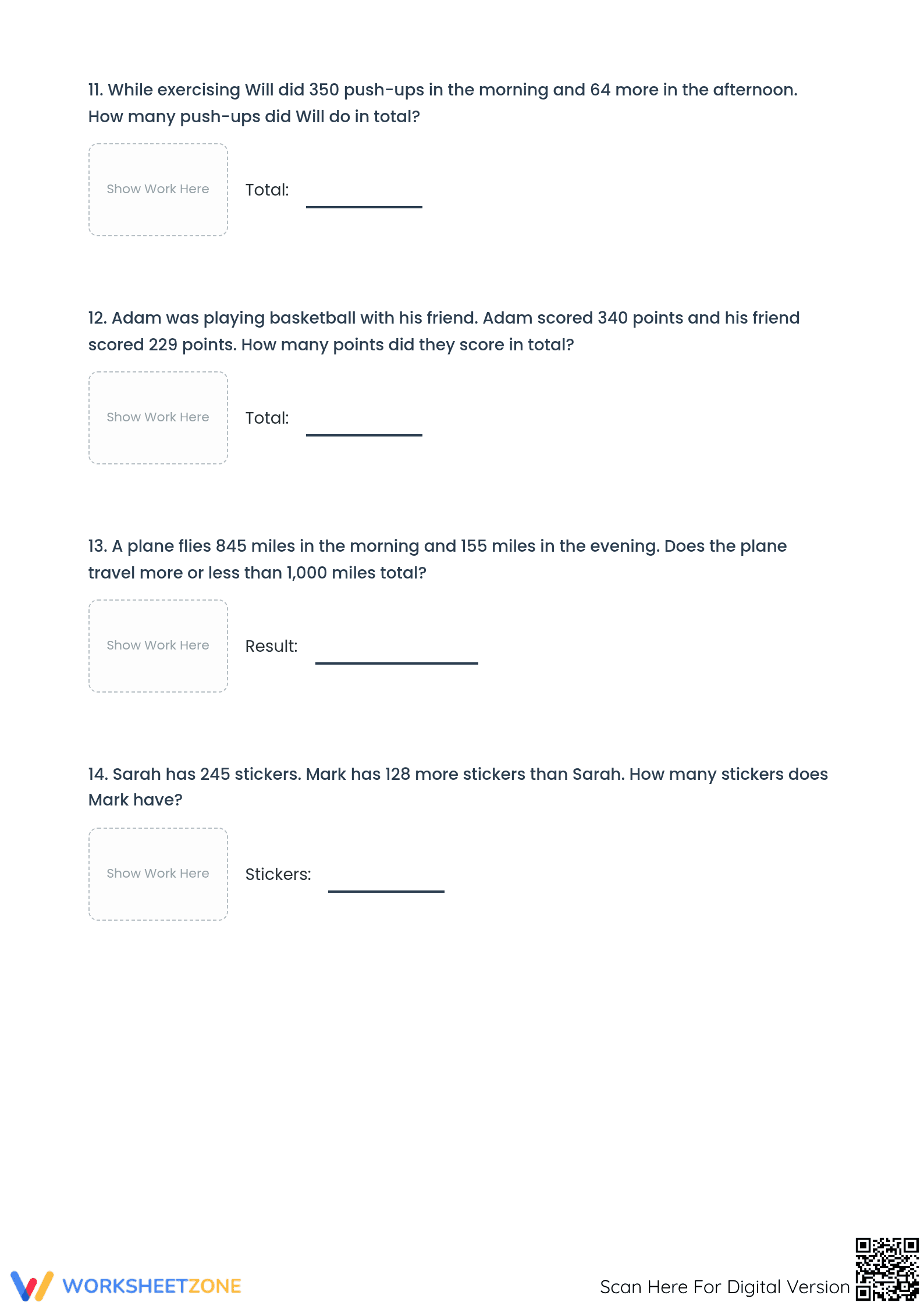
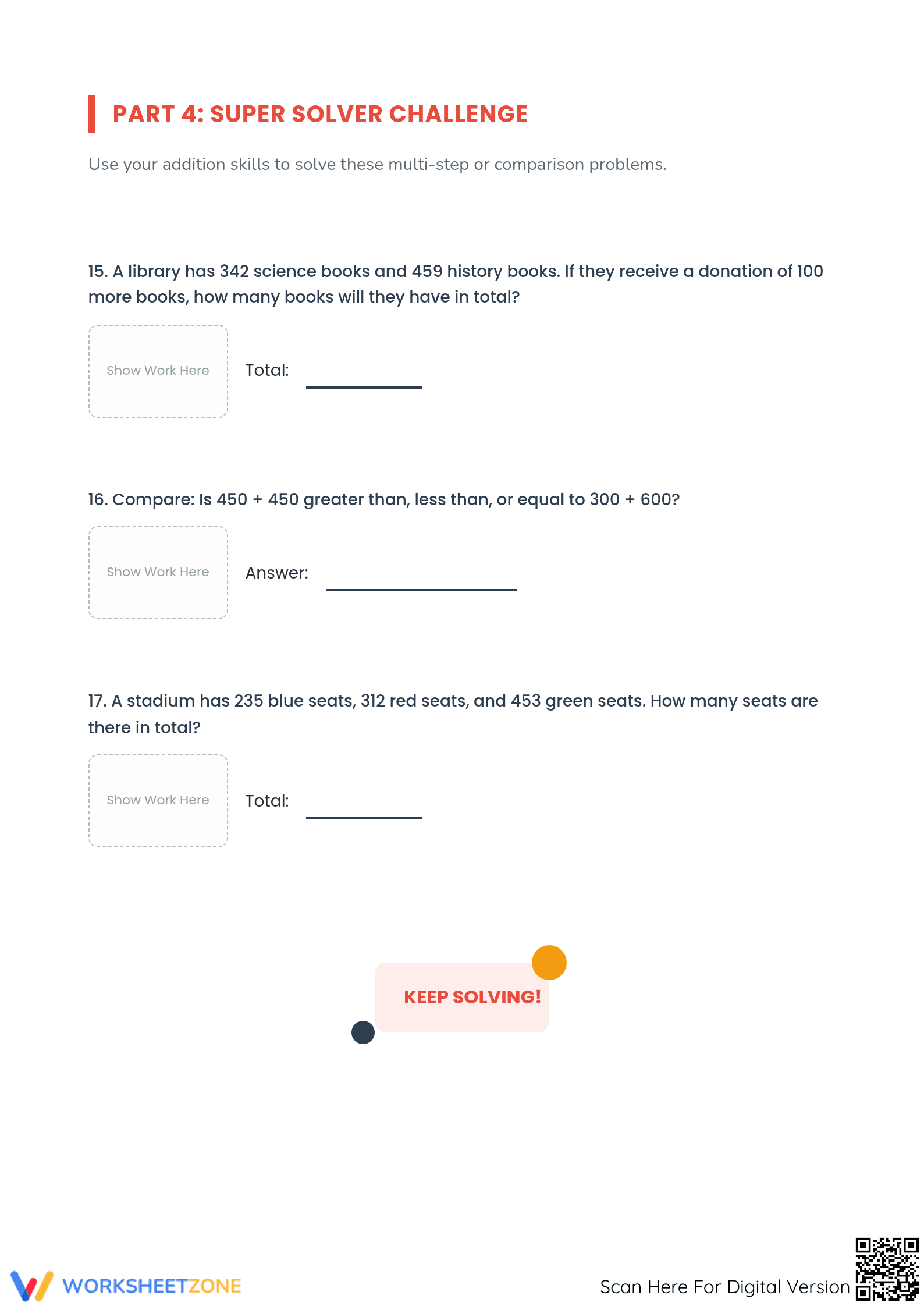
What's Inside: This instructional set features 23 unique problems distributed across four distinct sections. The packet includes 17 real-world word problems that require students to translate text into numerical equations, a "Vertical Addition Lab" containing 6 focused computational problems for algorithm reinforcement, and a dedicated challenge section for multi-step reasoning. A full five-page answer key is provided for rapid grading or student self-correction.
Skill Progression: The worksheet follows a deliberate gradual release model. Parts 1 and 2, "Addition Adventures," offer guided practice through situational word problems where students identify relevant numbers and show their work. The "Vertical Addition Lab" provides supported practice by isolating computation, allowing students to focus purely on regrouping mechanics across place values. Finally, the "Super Solver Challenge" requires independent mastery, as students tackle comparison problems and multi-digit totals in complex contexts.
Standards Alignment: This resource is explicitly designed for `CCSS.MATH.CONTENT.3.NBT.A.2`. Students will fluently add within 1000 using strategies and algorithms based on place value, properties of operations, and the relationship between addition and subtraction. By requiring students to show their work, the resource supports SMP.1 (Make sense of problems and persevere in solving them) and SMP.6 (Attend to precision). This standard code can be copied directly into lesson plans, IEP goals, or curriculum mapping tools.
How to Use It: This packet is ideal for a mid-unit formative assessment to check for regrouping misconceptions before moving into four-digit operations. Assign the first two pages as a collaborative in-class activity, then use the "Vertical Addition Lab" and "Super Solver Challenge" as a tiered homework assignment. During instruction, observe students to see if they are correctly "carrying" tens into the hundreds place; those struggling may benefit from using base-ten blocks alongside the paper-and-pencil tasks.
Who It's For: This resource targets 3rd and 4th-grade students working toward place value mastery, serving as an excellent remediation tool for 5th graders needing a refresher. It pairs naturally with place value anchor charts or direct instruction on the standard addition algorithm. Clear formatting and ample workspace make it accessible for students with dysgraphia or those who require structured visual cues.
Mastery of multi-digit addition is foundational for higher-level mathematics. Research from Fisher & Frey (2014) emphasizes that gradual release of responsibility—moving from situational word problems to abstract computational labs—is most effective for long-term retention. This worksheet implements that research by providing 23 tasks that require students to fluently add within 1000, specifically targeting CCSS.MATH.CONTENT.3.NBT.A.2 through place-value-based algorithms. By requiring both vertical alignment and narrative interpretation, the resource forces students to engage with quantitative reasoning for state-level assessments. Educational leaders and classroom teachers can use this printable as a high-quality data point for student growth, ensuring every learner can accurately regroup across the tens and hundreds places in diverse problem formats.


