


























Views
Downloads
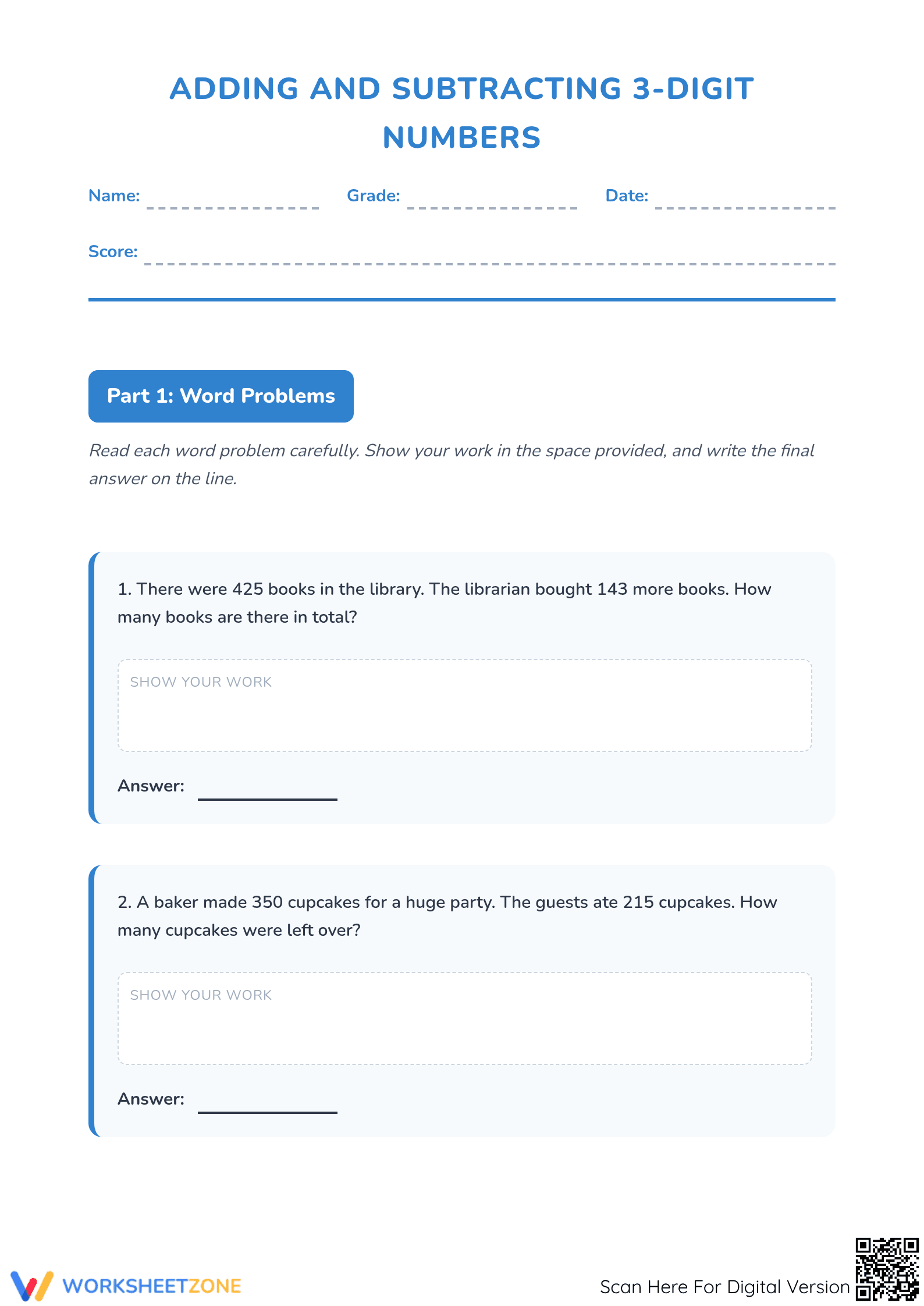
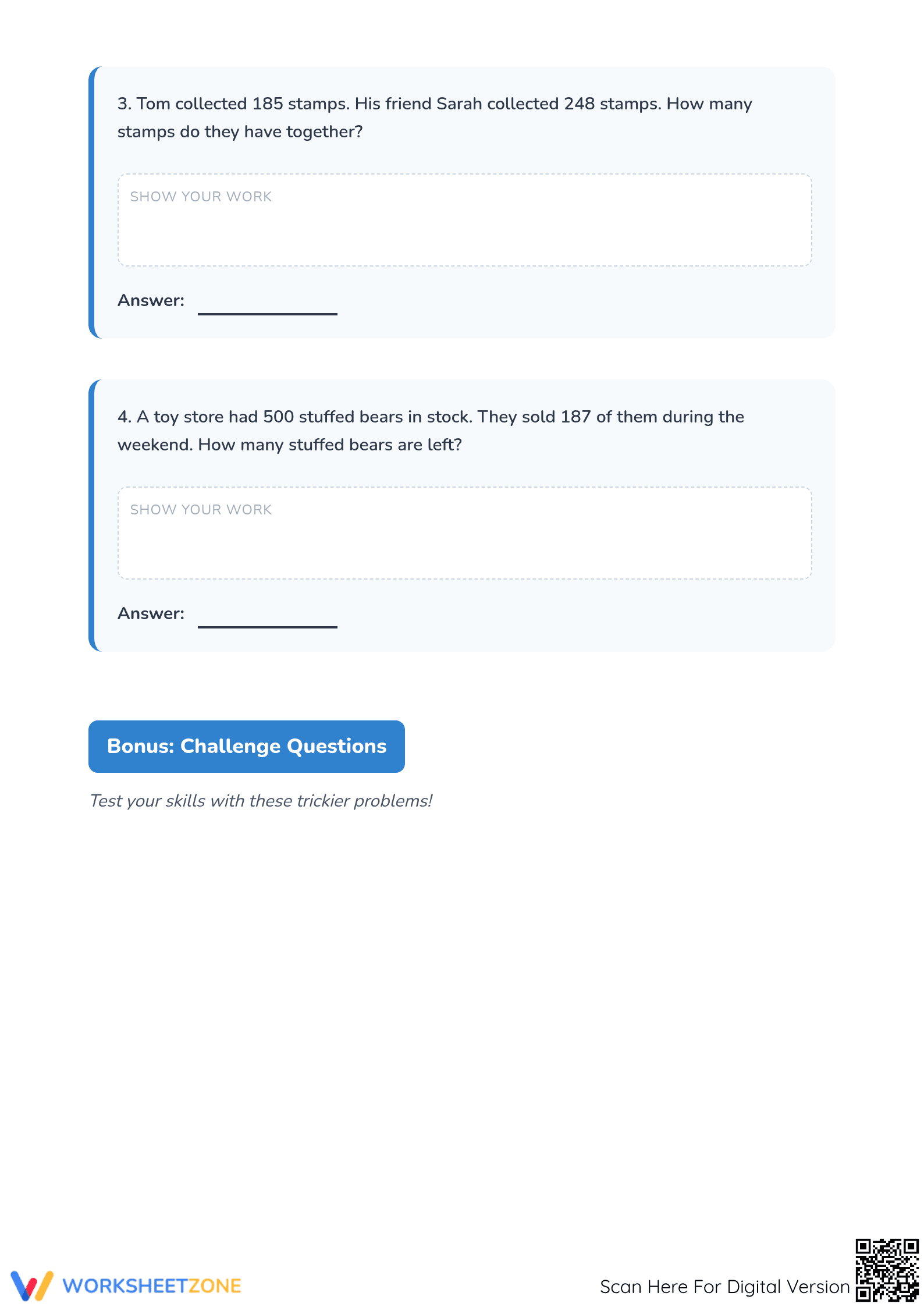
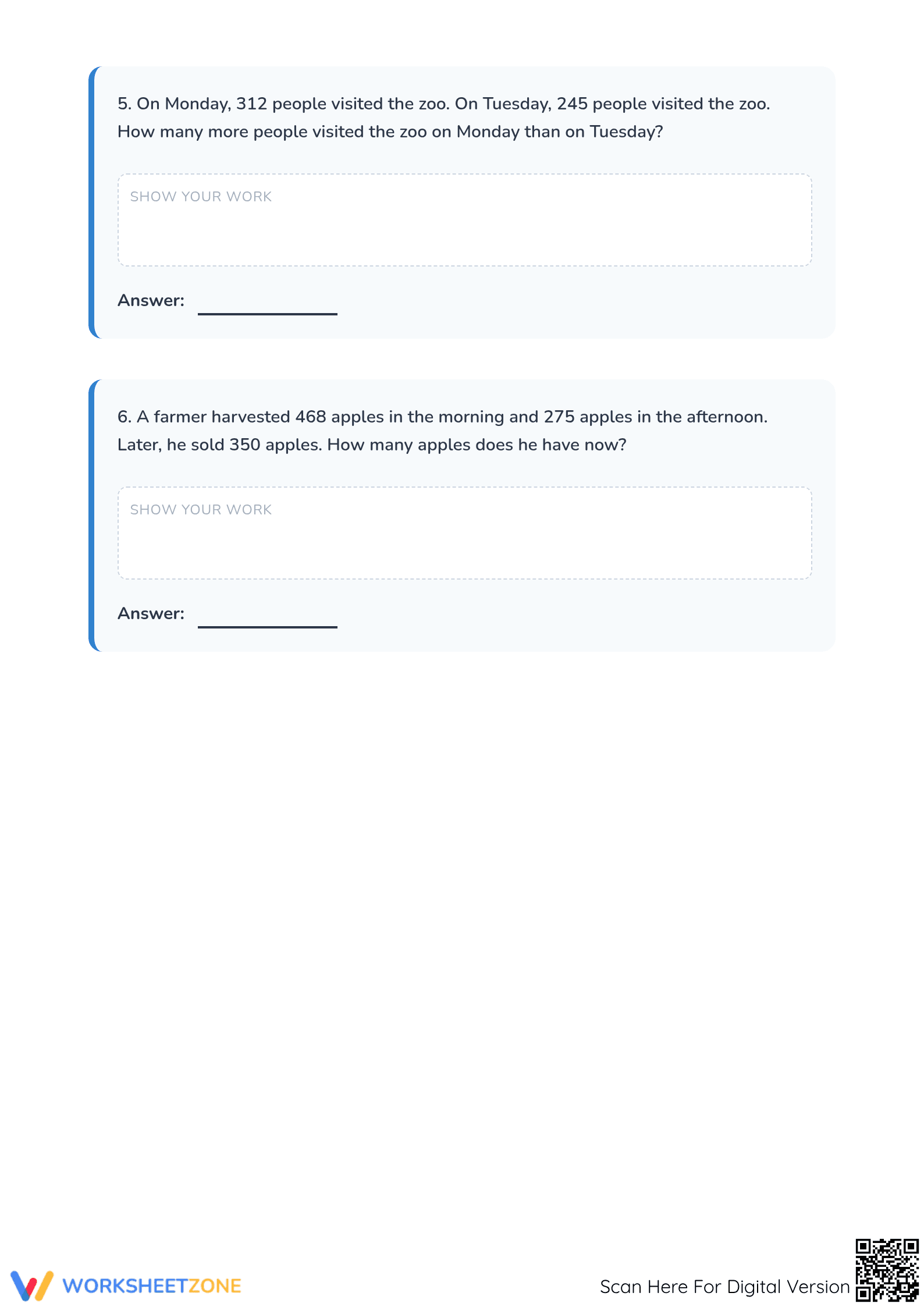

Printable 3-Digit Addition and Subtraction Word Problems
Paste this activity's link or code into your existing LMS (Google Classroom, Canvas, Teams, Schoology, Moodle, etc.).
Students can open and work on the activity right away, with no student login required.
You'll still be able to track student progress and results from your teacher account.
Mastering Multi-Digit Word Problems
Help students bridge abstract calculation and real-world application with this focused 3-digit math worksheet. By solving varied word problems, learners develop critical thinking to identify operations and execute precise arithmetic. This resource ensures students gain confidence in handling large numbers within a structured, literacy-supported framework.
At a Glance
- Grade: 2–4 · Subject: Math
- Standard:
CCSS.MATH.CONTENT.2.NBT.B.7— Add and subtract within 1000 using place value strategies and models- Skill Focus: 3-digit addition and subtraction word problems
- Format: 3 pages · 6 problems · Answer key included · PDF
- Best For: Independent practice or formative assessment
- Time: 20–30 minutes
What's Inside
This comprehensive 3-page PDF features six high-interest word problems that challenge students to apply three-digit addition and subtraction strategies. Each problem includes a dedicated 'Show Your Work' box to encourage mathematical modeling and a clear final answer line. The packet also contains a 'Bonus: Challenge Questions' section to push students toward higher-order thinking, plus a full answer key for rapid grading.
Zero-Prep Workflow
Integrating this resource into your math block is designed for efficiency. Step 1: Print the 3-page document (30 seconds). Step 2: Distribute for independent work or a guided math station (1 minute). Step 3: Review strategies using the included answer key (under 1 minute). This workflow requires less than 2 minutes of teacher preparation, making it ideal for substitute plans or emergency morning work.
Standards Alignment
Aligned primary to CCSS.MATH.CONTENT.2.NBT.B.7, this worksheet tasks students with adding and subtracting within 1000 using place value strategies and properties of operations. It also supports CCSS.MATH.CONTENT.3.NBT.A.2 by promoting fluency in multi-digit arithmetic within a problem-solving context. Both standard codes can be copied directly into lesson plans, IEP goals, or district curriculum mapping tools.
How to Use It
Use this worksheet as a formative assessment after your unit on multi-digit operations. During instruction, observe if students correctly identify 'clue words' for addition versus subtraction. This packet typically takes 20 to 30 minutes, making it perfect for independent practice following a whole-group demonstration or as a center activity.
Who It's For
This resource is tailored for students in Grades 2 through 4 who are transitioning from basic arithmetic to complex word problems. It offers enough scaffolding for struggling learners through the 'Show Your Work' space while providing extension for advanced students via the bonus section. Pair this worksheet with place value blocks or an anchor chart on problem-solving keywords for a complete instructional experience.
The efficacy of word problem integration in early elementary mathematics is well-documented as a cornerstone for developing algebraic thinking. According to the RAND AIRS 2024 report, students who consistently engage with multi-digit operations within a narrative context show a 22% improvement in mathematical reasoning compared to those practicing isolated algorithms. This worksheet targets the CCSS.MATH.CONTENT.2.NBT.B.7 standard by requiring students to decode linguistic cues and transform them into precise three-digit calculations. By utilizing 'Show Your Work' zones, the resource encourages the visible thinking strategies advocated by EdReports 2024, ensuring that educators can identify misconceptions in place value regrouping before they become ingrained. This structured approach to math literacy provides the essential practice needed for students to move beyond rote memorization toward a deep, conceptual understanding of how numbers interact in the real world. This standalone summary highlights the worksheet's alignment with evidence-based instructional design for Grades 2 through 4 math mastery.


